






 Portuguese
  Spanish


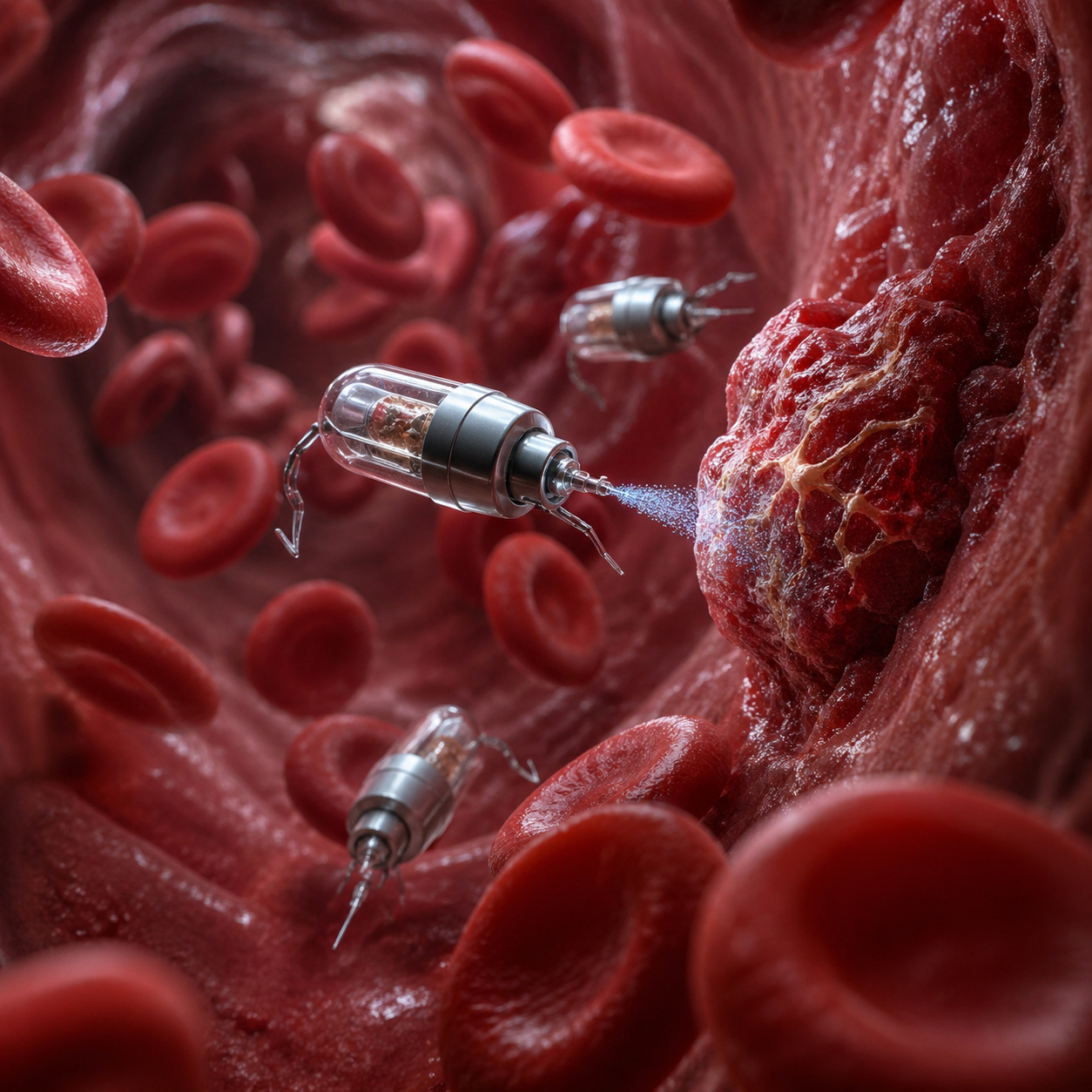

Magnetic microrobots already navigate vessels and deliver drugs with precision, pointing to a new frontier for treating stroke, tumors, and aneurysms.
In recent years, biomedical engineering teams have taken an important step towards high-precision medicine with the development of microrobots capable of moving inside blood vessels and delivering therapeutic agents directly to the site of the disease. In September 2023, a study published in Nature Communications showed the navigation of ultrasound-activated microrobots in cerebral vessels of live mice, even against blood flow, while in November 2022, Science Advances reported magnetically guided microrobots to vessels feeding tumors in an animal model, indicating that the technology has already begun to be validated in complex biological conditions closer to clinical reality.
These microscopic structures are designed to operate in an extremely challenging environment, marked by constant blood flow, pressure changes, vascular bifurcations, and real-time imaging and control limitations. Still, experimental results show that it is already possible to precisely guide them through delicate and complex vascular networks, reinforcing a structural shift in how drugs are administered: instead of a predominantly systemic logic, research is advancing towards a highly localized approach, with the potential to concentrate treatment at the exact point of the disease and reduce the exposure of the rest of the organism.
The advance represents a structural change in how drugs can be administered, moving from a systemic logic to a highly localized approach.
-
China Develops Custom 140-Ton Electric Mining Truck with 770 kWh Swappable Battery, Deploys 290 Units in Xinjiang’s Largest Zinc Mine

-
Meta to Launch Arena, a New Prediction App Targeting 3.56 Billion Users, Competing with Polymarket and Kalshi

-
Scientist Challenges Famous Human Evolution Theory, Argues Homo Sapiens Evolved Gradually Over Thousands of Years
-
15-Year-Old American Builds Ocean Generator with PVC Pipe and 3D-Printed Propeller for $12, Wins National Prize, Presents at White House, and Makes Forbes 30 Under 30 List




External magnetic field functions as a navigation system to guide microrobots capable of moving inside blood vessels
The operating principle of these microrobots is based on magnetism. The structures are manufactured with magnetic materials or coated with particles sensitive to magnetic fields. This allows an external system, usually composed of coils or computer-controlled magnets, to direct the movement of the robots inside the body.
This type of navigation eliminates the need for internal motors, batteries, or traditional propulsion systems, which is essential at microscopic scales.
In practice, the robot does not “decide” where to go, but responds to magnetic fields that pull, rotate, or orient it within the body fluid. This approach allows for relatively precise control, even in dynamic environments like the circulatory system.
Microrobots can resist blood flow and reach difficult regions
One of the biggest technical challenges of this technology is the force of blood flow. In larger vessels, blood can reach speeds that would easily sweep away microscopic structures. To overcome this, microrobots are designed with shapes and properties that increase their adhesion or stability.


Some models use helical geometry, similar to a microscopic propeller, allowing them to advance against the flow. Others combine controlled movement with interaction with the vessel wall.
Tests conducted in animals, such as pigs, have shown that these devices can:
- Navigate complex vessels
- Maintain controlled trajectory
- Reach specific regions of the body
This result is considered one of the main milestones for the viability of the technology in real medical applications.
Localized drug delivery can reduce side effects
The main objective of magnetic microrobots is targeted drug delivery. In traditional medicine, drugs are administered systemically, circulating throughout the entire body. This means that only a portion of the dose reaches the desired location, while the rest can cause side effects.

With microrobots, the logic changes completely. The medication can be transported directly to the exact point of the disease and released there, reducing the exposure of other body parts.
This model has the potential to increase treatment efficacy and significantly reduce adverse effects.
Applications include stroke, tumors, and aneurysms in hard-to-reach areas
Studies indicate several possible applications for this technology. Among the most cited are:
- Treatment of stroke (AVC), with delivery of thrombolytic agents directly into the clot
- Chemotherapy administration in tumors, reducing systemic impact
- Interventions in aneurysms, with controlled release of therapeutic substances
These scenarios have in common the fact that they involve hard-to-reach regions or those requiring high precision. The ability to reach the exact necessary point can represent a significant change in the treatment of these conditions.
Medical imaging allows real-time movement tracking
Another essential component of the system is the ability to visualize the microrobots. To ensure safety and precision, researchers use medical imaging techniques, such as magnetic resonance or fluoroscopy, to track the movement of structures within the body.
This allows for real-time navigation adjustment and avoidance of unwanted deviations. The integration between robotics, magnetism, and medical imaging is one of the pillars that make this technology possible.
Studies are still in preclinical phase and not yet in widespread use
Despite the advances, it is important to highlight that the technology is still under development. Tests conducted so far occur in controlled environments or animal models. Application in humans requires a series of additional steps, including safety validation, efficacy, and regulatory approval.
Furthermore, there are technical challenges that still need to be resolved, such as:
- Precise control in very small vessels
- Long-term biocompatibility
- Safe elimination of microrobots after use
This means that, although promising, the technology is not yet available for widespread clinical use.
Technology points to more precise and less invasive medicine with microrobots capable of moving inside blood vessels
The advancement of magnetic microrobots fits into a broader trend in medicine: the search for more precise and less invasive treatments.
Instead of open surgeries or systemic drug administration, the idea is to act directly at the site of the disease with minimal interference to the rest of the body. This model can reduce recovery time, lower risks, and improve clinical outcomes.

Although current models rely on external control, researchers are already studying ways to increase the autonomy level of these devices.
This includes the use of sensors, simple algorithms, and automatic responses to environmental stimuli. In the future, microrobots could:
- Detect specific chemical signals
- Identify diseased tissues
- Release drugs autonomously
This advancement would bring the technology closer to truly intelligent systems on a microscopic scale.
Given these advancements, to what extent can medicine be transformed by invisible robots inside the body?
The results obtained so far indicate that the idea of machines operating inside the human body has already left the realm of science fiction.
With capabilities for navigation, control, and drug delivery, magnetic microrobots represent a new frontier in medicine.
The question that arises is direct: if it’s already possible to guide microscopic robots inside blood vessels, how far can this technology evolve and transform disease treatment in the coming decades?







