






 Portuguese
  Spanish


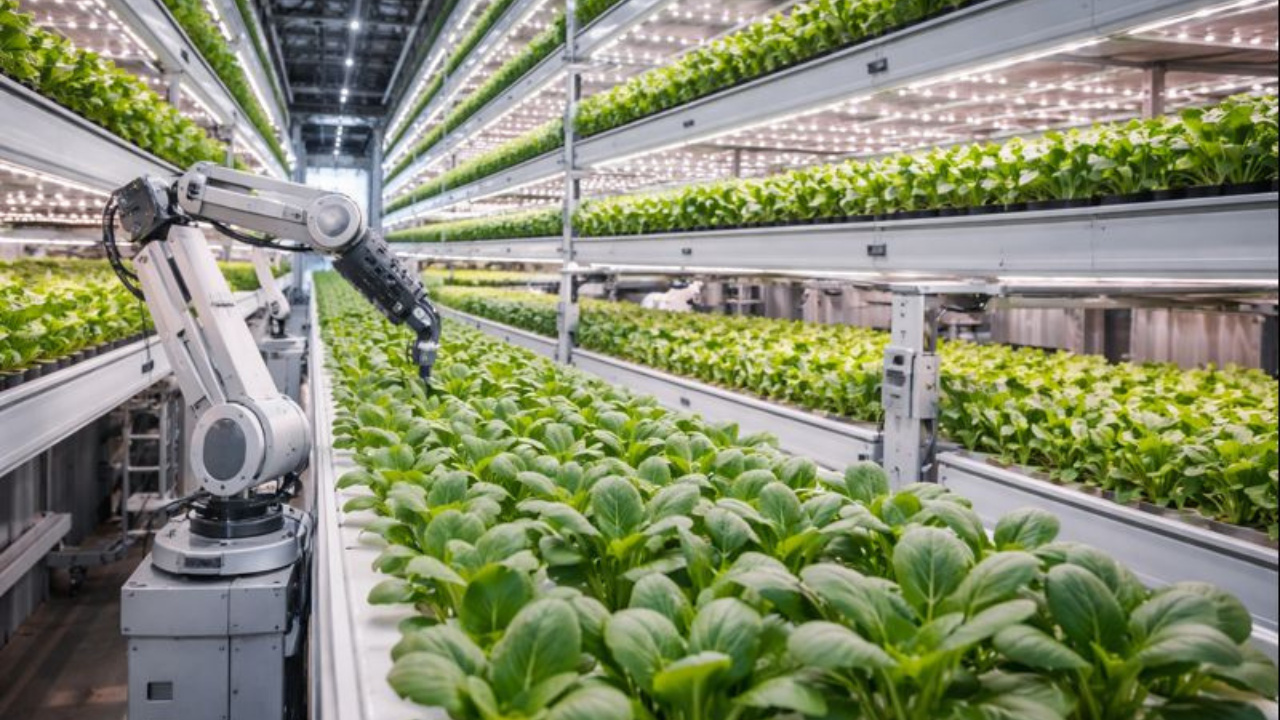


Urban Agriculture Project with Indoor Vertical Farm Uses Artificial Intelligence to Strengthen Food Security in Singapore.
The largest indoor vertical farm on the planet began operations this Wednesday (7) in Singapore, with the promise of transforming food security in Singapore.
Developed by Greenphyto, the structure combines artificial intelligence in agriculture, robotics, and automation to produce up to 2,000 tons of greens per year in a fully controlled environment within the Jurong West industrial zone.
The initiative addresses the country’s strong external dependence, which imports about 90% of the food it consumes, and seeks to reduce risks associated with climate crises and global logistical bottlenecks.
-
The ‘tsunami’ of investments directed at Artificial Intelligence (AI) and semiconductor companies, which prioritize security and more predictable profits, has been a determining factor in the declining trajectory of Bitcoin.

-
Samsung eyes strategic chip factory in South Korea and could shake up the global AI landscape with advancements in HBM memories and advanced packaging.

-
Nvidia makes agreements in South Korea for AI factories and takes data centers, advanced chips, and global cloud to another level by 2027
-
ChatGPT reveals which human job it would choose if it could really work


With over 23 meters in height, the facility symbolizes a new chapter in urban agriculture and the intensive use of agricultural technology in densely populated areas.
Moreover, by concentrating production near consumption centers, the project shortens supply chains, increases supply predictability, and contributes to a national food resilience strategy.
Indoor Vertical Farm as Strategic Response
The indoor vertical farm is a model that organizes cultivation in overlapping layers inside closed and climate-controlled warehouses.
Unlike traditional agriculture, it does not rely on soil or external weather conditions, allowing for continuous production throughout the year. In the case of Greenphyto, plants grow on shelves and receive light, water, and nutrients precisely, with constant monitoring.
Thus, this format becomes relevant in cities with a scarcity of agricultural land. In Singapore, where space is limited, urban agriculture emerges as an alternative to increase local production without competing with residential or industrial areas.
Artificial Intelligence in Agriculture Controls Every Step
According to information released by the company, the entire production process is monitored by artificial intelligence systems in agriculture.
Sensors and algorithms analyze factors such as temperature, lighting, humidity, and irrigation in real-time, automatically adjusting the ideal conditions for each crop.
In addition, industrial robots participate in planting, management, harvesting, and packaging. This level of automation reduces the need for manual labor, increases food standardization, and decreases losses throughout the process.
Thus, agricultural technology acts not just as support but as a central element of the operation.
Hydroponics Ensures Efficiency and Predictability
The adopted method is hydroponics, a technique in which plants receive nutrients directly through water, without the use of soil.
This system allows for greater control over growth, accelerates production cycles, and reduces the consumption of natural resources.
As a result, the indoor vertical farm can carry out frequent and regular harvests, regardless of increasingly common extreme weather events in the Asian region.
Demand-Driven Production and Waste Reduction
Founded by Susan Chong, an entrepreneur in the agricultural technology sector, Greenphyto also bets on a made-to-order production model.
The company adjusts the quantity grown to market demand, which reduces surpluses and waste.
The use of energy-efficient LED lighting reinforces the commitment to operational efficiency.
At the same time, proximity to urban centers shortens the time between harvest and consumption, extending the shelf life of greens and reducing losses in transportation.
What Foods Are Produced
The production of the world’s largest indoor vertical farm focuses on leafy greens, particularly Asian varieties with a short cycle.
Among them are bok choy, choy sum, Chinese mustard, and different types of lettuce such as curly lettuce, Romaine, red, Batavia, butter, and Swiss chard.
Moreover, these crops adapt well to the controlled environment and allow for continuous harvests throughout the year, reinforcing the regularity of supply to the local market.
Food Security in Singapore Receives a Boost
Data from the Singapore Food Agency indicates that dependency on imports makes the country vulnerable to external disruptions. In this context, high-tech urban agriculture projects gain strategic weight.
By integrating indoor vertical farms, artificial intelligence in agriculture, and automation, Greenphyto positions itself as a key player in the effort to strengthen food security in Singapore.
Thus, more than just producing greens, the initiative signals a possible path for cities seeking food autonomy in an increasingly unstable global scenario.








