Portuguese
  Spanish


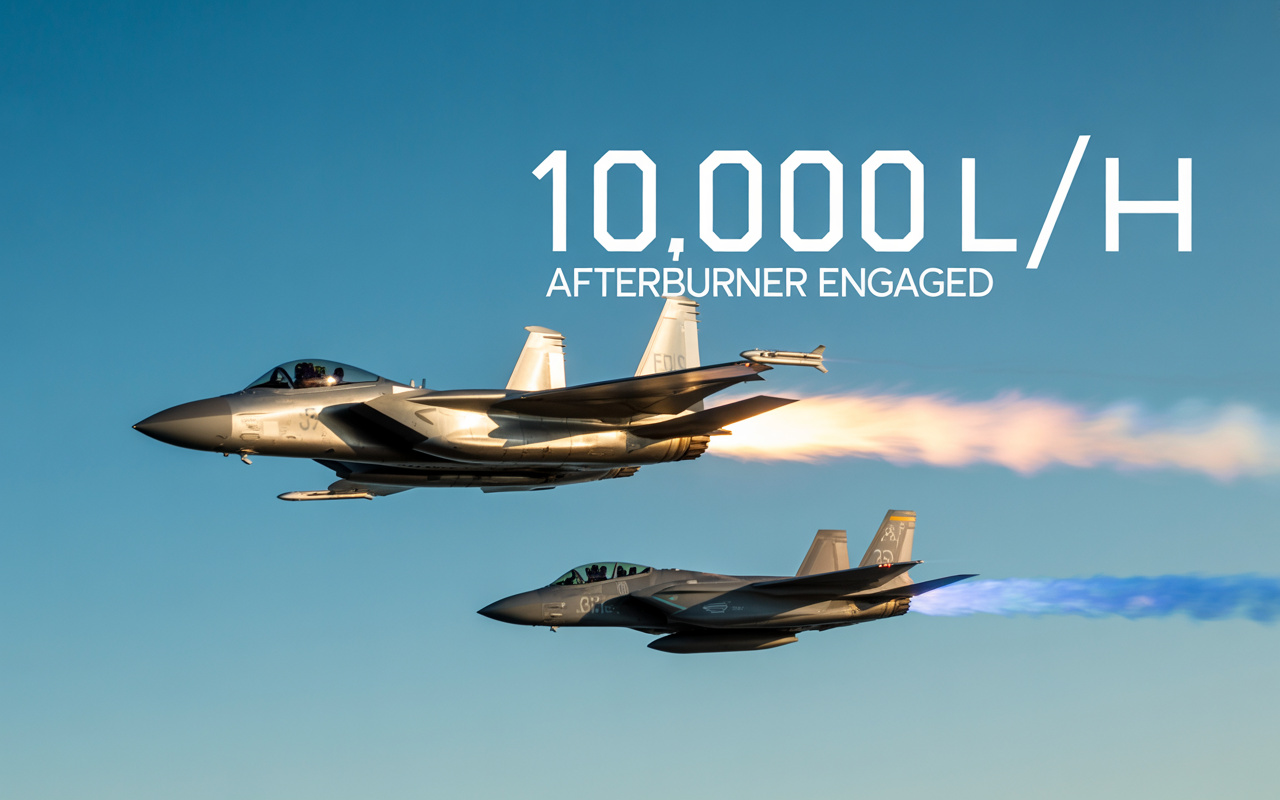

F-15 And F-35 Fighters Consume More Than 10,000 Liters Of Fuel Per Hour With Afterburner, Revealing An Energy Consumption Unmatched In The World Of Engines.
Few vehicles on the planet consume as much fuel as a supersonic military fighter in full operation. If in the automotive world we call a car that does 4 km/l a “gas guzzler,” in the military world there is a completely different reality: engines that burn more than 10,000 liters per hour, transforming aviation kerosene into thrust, heat, and speed.
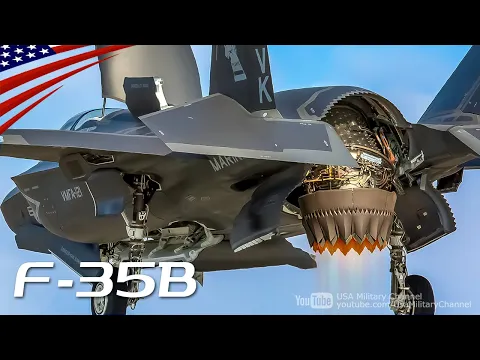
Among the most impressive examples are the F-15 Eagle and the F-35 Lightning II, two high-performance fighters operated by the United States and recognized for their ability to reach supersonic speeds. What few people know is how much this performance costs in fuel.
Fuel Consumption Above 10,000 Liters Per Hour
The first shock is the absolute number. In maximum power mode with the afterburner activated, the F-15 can exceed the mark of 10,000 liters of fuel per hour, while the F-35 operates in a similar range when pushed to the max.
-
Brazil Welcomes Spanish Wamos Air and Nigerian Air Peace, Potentially Transforming International Routes and Increasing Competition

-
Offshore air transport soars in Brazil, surpasses 2.5 million passengers, and reveals how oil has transformed Rio’s airports into key pieces of national logistics.

-
Latin America becomes the “global champion” of aviation taxes, tickets may become more expensive in Brazil, and IATA’s warning exposes risk for flights, tourism, and passengers.
-
Brazil has lost 85 air routes since 2019 and is still flying less than before the pandemic, leaving passengers with fewer destinations, fewer frequencies, and a more limited air network.




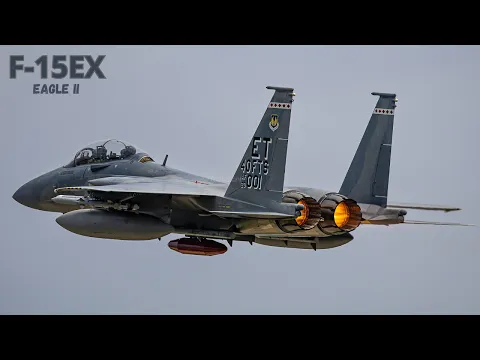

This means that these aircraft can burn the tank of a popular car in seconds. For comparison, a common urban tank of 50 liters would equate to 18 seconds of afterburner use on an F-15.
This scale of consumption does not exist in any other vehicles used daily by civilians, not even in highway trucks, agricultural machines, or supercars.
Why Is The Consumption So High? Afterburner And Supersonic Thrust
The answer lies in how these fighters produce thrust. To accelerate and maintain speeds like Mach 2, the engine needs to deal with three physical demands:
- Aerodynamic drag, which grows exponentially at high speeds.
- Supersonic shockwaves, which increase air resistance.
- Thrust demand, which requires additional fuel injection.
To generate this extra thrust, the turbine enters afterburner mode. In this mode, fuel is injected directly into the hot exhaust to take advantage of residual oxygen and drastically increase power.
The problem is that this process multiplies consumption. In practice, it’s like lighting a flamethrower at the back of an airplane that is extremely efficient to gain speed, but devastating for the fuel tank.
Tank Capacity And Real Range At High Power
The numbers show the size of the energy challenge:
- An F-15 holds about 6,100 liters of internal fuel.
- An F-35 carries approximately 8,278 liters internally.
On paper, these numbers seem high. In practice, a fighter operating with afterburner lasts less than half an hour on just internal tanks.
That’s why these aircraft frequently use:
- External tanks,
- Supplementary pods,
- and in-flight refueling.
Without these resources, the range in supersonic mode would be extremely short.
Comparison With Terrestrial Consumption: The Shock Of Proportion
To understand the energy absurdity, just compare it to what exists in the automotive sector.
A heavy highway truck consumes 40 to 60 liters per hour.
A V12 supercar rarely exceeds 40 liters per 100 km.
An F-15 at full power surpasses 10,000 liters per hour.
This means that a single minute of intense use of a military fighter can equate to hours of operation of a truck under load.
Even giant industrial machines, like mining excavators or locomotives, operate at much lower ranges when the parameter is liters per minute.
What Is Burned? JP-8 And Energy Density
Another important point is the type of fuel. F-15 and F-35 consume JP-8, a high-energy-density aviation kerosene. It was created to operate in:
- Low temperatures,
- High altitudes,
- Extreme combustion chambers.
Even with greater energy efficiency compared to diesel and gasoline, JP-8 does not reduce the impact of consumption. It simply allows the turbine to operate with thermal and chemical stability in extreme conditions.
Why This Matters For Engineering And Defense
The consumption of these fighters is not a flaw. It is a byproduct of a physical requirement: to reach and sustain speeds that no terrestrial vehicle is capable of achieving.
The faster an object moves in the air, the greater the energy cost to overcome drag and air compression. This is one of the reasons why supersonic flight will never be cheap energetically.
The F-15 Eagle and the F-35 Lightning II are clear examples of how military engineering pushes physical limits at an impressive cost. The ability to exceed Mach 1 or Mach 2 and perform combat maneuvers comes with an energy demand that is almost unimaginable for those living in the automotive world.
While we discuss whether a car gets 8 km/l or 12 km/l, there is another universe where consumption is measured in liters per minute, and where 10,000 liters per hour is not an exaggeration — it is simply what physics demands.