






 Portuguese
  Spanish


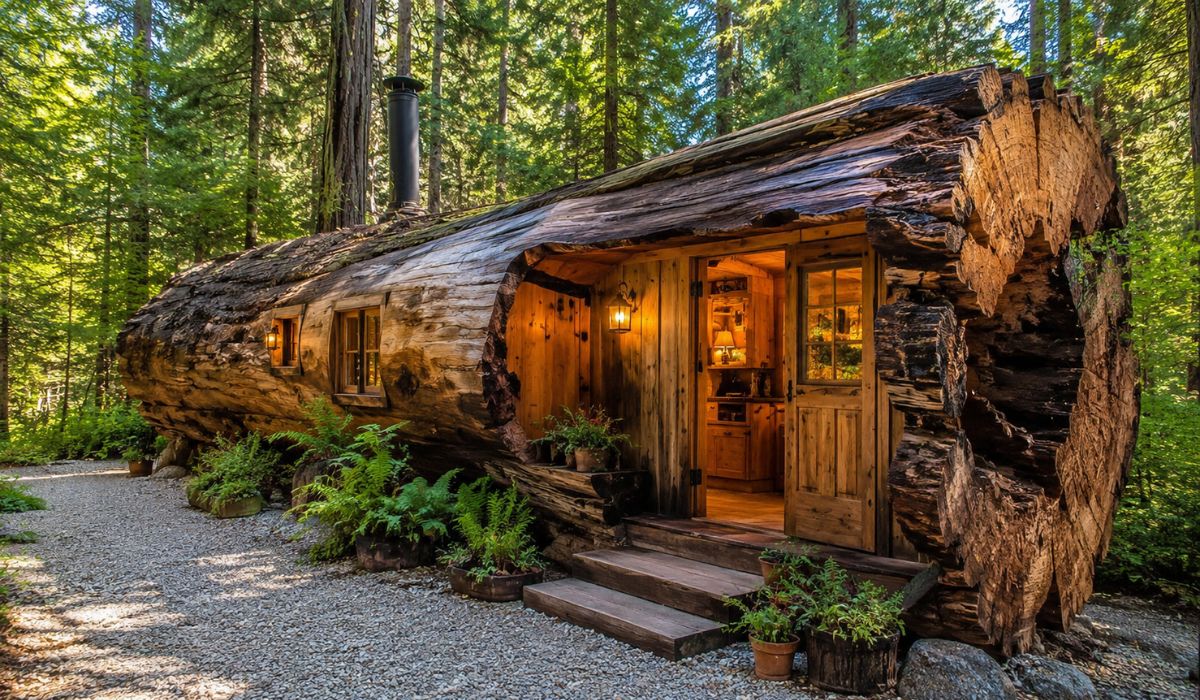


A cabin carved into an almost millennial redwood draws attention in the United States for combining road tourism, unusual architecture, and the history of one of the trees most known for its longevity.
A cabin made from a redwood with an estimated age of 980 years is located in Port Washington, in the state of Wisconsin, United States, and may become a tourist attraction along the I-43 highway.
The structure, built with a hollow trunk in the 1940s, currently belongs to Dav Abdull, who claims to want to display the piece to visitors who do not usually have access to California’s redwood forests.
The construction is currently located next to storage garages in the city.
-
Recycled PET Bottles to Become Eco-Friendly Insulation Solution by 2026: Reduces Heat and Noise, Resists Moisture and Mold

-
2,500-Year-Old Biblical Figurine Discovered by Israel Antiquities Authority Sheds Light on Ancient Child Protection and Fertility Rituals in the Negev Desert

-
Young Innovator from the Brazilian Amazon Develops Acai Seed Brick, Turning Fruit Waste into Building Material, Wins Over 25 Awards, Showcases Globally
-
From Street Vendor to Startup Success: At 25, Brazilian Entrepreneur Projects $90 Million Revenue by 2026 Solving Retail Giants’ Challenges


Seen from the outside, it resembles a small wooden house, but its main feature lies in the origin of the material: the cabin was carved from a single section of redwood, the English name used for the Pacific coast’s redwood.
According to the portal O Antagonista, the story draws attention due to the trunk’s size, the tree’s estimated age, and the project to transform the piece into a tourist stop.
According to the publication, documents related to the structure indicate that the tree was cut in the 1940s, before the current protection rules associated with redwoods, as part of a program described as selective cutting.
Redwood cabin was adapted as a small dwelling
The cabin was designed to function as a compact space for human use.
The interior includes a dining area, kitchen, living room, two beds, and a bathroom, according to the information released about the structure.
The space is also described as a kind of house inside a massive carved trunk, with internal furniture made of redwood.
According to O Antagonista, the cabin is about 30 feet long, 8 feet wide, and walls approximately 1 foot thick.
In approximate measurements, this equates to 9.1 meters in length by 2.4 meters in width.
The thickness of the walls is one of the elements that help to gauge the scale of the tree used in the construction.
Although it functions as a small dwelling, the structure also gained prominence as an exhibition object due to the trunk’s origin.
The original tree is said to have come from a redwood area and was cut in a context of selective management, according to the information gathered by the project associated with the cabin.
The redwood was about 260 feet tall, equivalent to approximately 79 meters, and 14 feet in diameter at the base, about 4.2 meters.
The section used in the cabin was taken from a part located about 100 feet from the ground.
The process of transforming the trunk into a dwelling would have required a year of full-time work by two men.
This information is presented by sources that disseminate the cabin’s story and help explain why the structure has come to be treated as a tourist curiosity in the United States.
Redwood is among the tallest trees in the world
The redwood, scientifically identified as Sequoia sempervirens, naturally occurs in a coastal strip of the western United States, from central California to southern Oregon.
According to the United States National Park Service, the species can exceed 350 feet in height, equivalent to more than 106 meters.
Mature trees can also reach large diameters at the base, which explains the possibility of some trunk sections being transformed into internal structures.
Longevity is another characteristic associated with the species.
Organizations dedicated to the preservation of redwoods record that some redwoods can live for more than 2,000 years.
In this context, the age attributed to the Wisconsin cabin fits within the known longevity range for the species, although the figure of 980 years is presented by sources linked to the piece’s history.
The preservation of redwoods also involves environmental concern.
The Save the Redwoods League reports that only a small portion of the original ancient coast redwood forest remains preserved.
This information helps contextualize why objects made from ancient redwoods often spark public interest and debate about environmental memory.
In the case of the Port Washington cabin, the current focus is on the exhibition of the existing piece and the possibility of moving it to a point of greater visibility for visitors.
Owner wants to display cabin near I-43 highway
Dav Abdull bought the cabin at an auction in 2022, according to information released about the case.
He has not publicly disclosed how much he paid for the structure.
In an interview mentioned by local media, Abdull stated that the piece “should have been saved” and said that many people in Wisconsin are interested in seeing redwoods but cannot travel to the national parks where these trees naturally grow.
The owner’s idea is to install the cabin near I-43, an interstate highway that runs through the Port Washington area.
The proposal is to allow drivers and visitors to stop and see the structure during trips through the region.
Abdull also mentioned the possibility of charging $1 for entry.
The proposal is similar to a tradition of roadside attractions common in the United States, where unusual objects, historical buildings, or large-scale pieces become stopping points for travelers.
In the case of the cabin, the central element is the fact that the structure was made from a real redwood trunk.
The piece appears in public information mainly as an object of visitation and architectural curiosity.
Its possible installation by the highway would increase access for residents and tourists to a structure related to a tree that does not naturally grow in that region of the United States.
The proposed location would also place the cabin in an environment associated with passing tourism.
For this type of attraction, road visibility and ease of access are usually important factors for visitation.
Cabin brings together tourism, architecture, and environmental memory
The cabin also relates to debates about conservation, historical use of wood, and public access to elements of ancient forests.
Since the tree would have been cut in the 1940s, before the current protection rules cited by the sources that disclosed the case, the public discussion today focuses on the destination of the preserved structure.
From a material standpoint, a piece of this type requires conservation care to remain safely exposed.
Moisture control, base stability, protection against deterioration, and public guidance are measures normally associated with the preservation of old wooden structures.
These precautions are relevant because the cabin would be exposed to visitors and possibly to variable environmental conditions.
Installation in an open area or near a highway would also require planning for people circulation, structure support, and material protection.
The scientific relevance of the species does not depend on the cabin, but it helps to contextualize the attention around it.
The United States National Park Service explains that redwoods develop in specific environments, influenced by coastal moisture and fog.
The agency also notes that the species has thick bark and natural characteristics associated with resistance to fire, insects, and diseases.
These conditions make the redwood one of the most studied and preserved trees in the United States.
In the case of the Port Washington cabin, public interest is linked to the possibility of observing, on a real scale, a trunk section that belonged to a large tree.
The transformation of an old trunk into a cabin shows how objects created in another historical context can acquire new uses over time.
What in the 1940s was presented as a wood adaptation for human use now appears related to tourism, material preservation, and dissemination about ancient trees.
If installed near I-43, the structure could serve as a rest stop for drivers and as a physical example of the scale reached by redwoods.
The information about the 980 years should remain attributed to the sources that disclose the cabin’s history.
For visitors, the piece can serve as a tangible connection to a tree that grew for centuries before being converted into a building.


