






 Portuguese
  Spanish


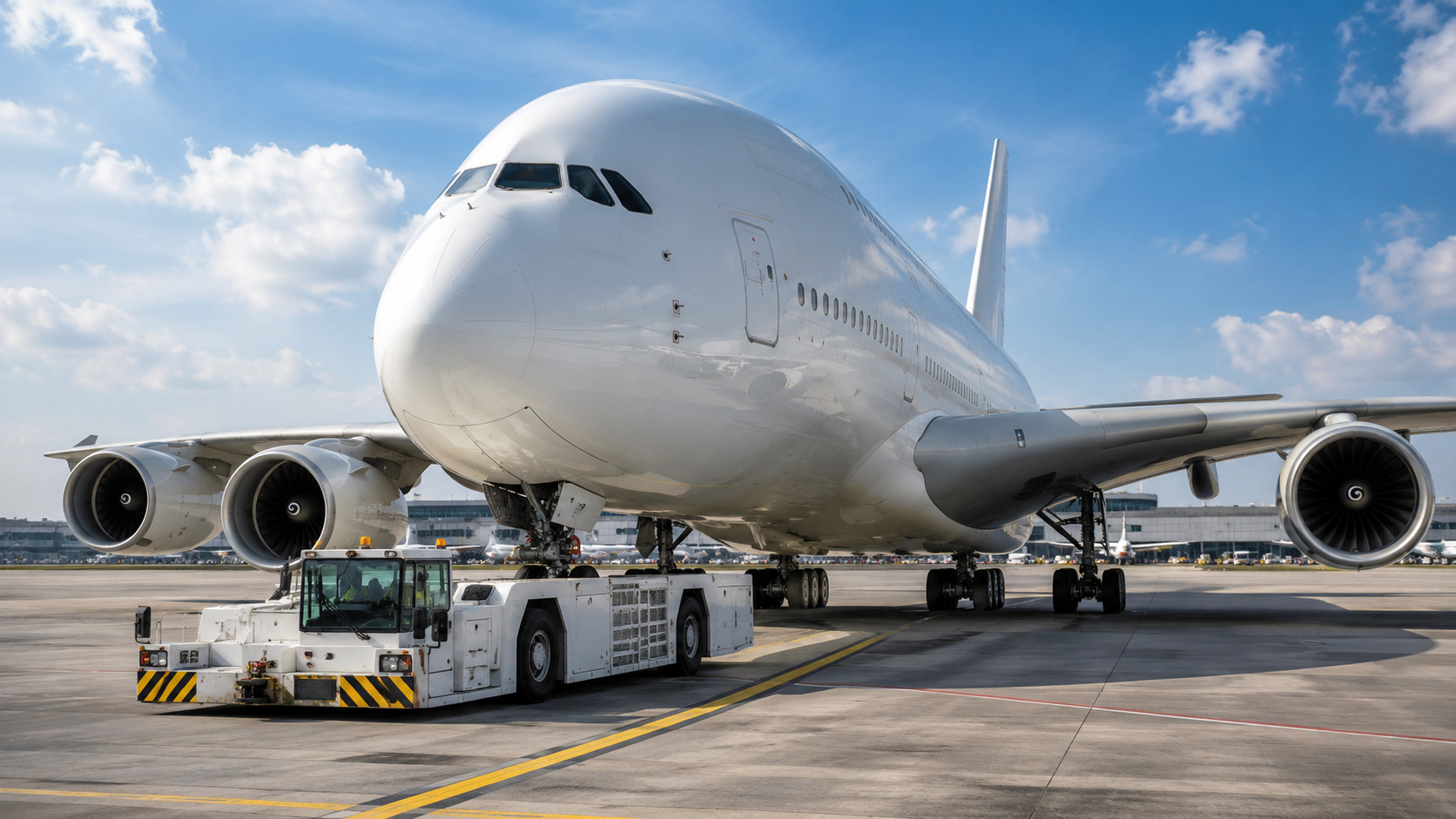

Pushback tractors of up to 70 tons can move giant aircraft like the Airbus A380 with safety, extreme strength, and precision at airports.
According to data from Airbus and TLD, pushback tractors are among the most important equipment in modern airport infrastructure. Although they almost go unnoticed by passengers, they are the ones that remove giant aircraft from the boarding gate and position them correctly for the start of taxiing. In the case of the Airbus A380, the largest commercial passenger aircraft ever built, this means moving an aircraft with 72.7 meters in length, 79.8 meters wingspan, and a maximum takeoff weight of up to 575 tons.
The contrast is impressive. A ground vehicle much smaller than the plane can push or tow a structure that costs hundreds of millions of dollars and weighs over half a million kilograms. This is only possible because the largest aircraft tugs are designed to generate enormous ground grip, distribute traction smoothly, and operate with precision in congested areas of international airports.
Heavy pushback tractor functions like an airport locomotive to move the Airbus A380
In the largest airports in the world, the task of removing a widebody aircraft from the boarding position cannot rely on the aircraft’s own engines. This is where the pushback tractor, also known as the aircraft tug, comes in, a piece of equipment created to push and tow planes safely on the apron.
-
Brazil’s “Tuscany” Boasts Award-Winning Olive Oils, Scenic Trails, and Mantiqueira Landscapes

-
Ancient Indian Tunnels Built in 1615 Still Use Gravity to Supply 1.8 Million Liters of Water Daily, Unlike Modern Cities Spending Millions on Pumps and Grids

-
Inspired by a 2000s Wonder Woman cartoon, she amassed 1,581 items, including a comic signed by Stan Lee, becoming the world’s largest collector.
-
Man Mistakes Lottery Email for Spam, Nearly Loses $185 Million Powerball Prize in Australia




Heavy models like the TLD TMX-650 have a mass between 55 and 70 tons and were developed precisely for this type of operation. According to the manufacturer, the equipment was designed to perform pushback and towing on medium and large aircraft, including Boeing 767, Boeing 777, Boeing 747, Airbus A330, Airbus A340, and Airbus A380.
This level of robustness is necessary because the challenge is not only in overcoming the initial inertia of the plane. The real challenge is to do this without jerks, without skidding, and without transferring excessive effort to the aircraft’s front landing gear. In airport operations, force without control is useless. What matters is force with precision.
Why the aircraft tug needs to weigh up to 70 tons to push a giant plane
The high weight of a pushback tractor is not an exaggeration in design. It exists because, to push hundreds of tons, the vehicle needs to transform power into real grip on the pavement. The greater the mass of the tug, the greater its ability to apply force without losing traction.
In the case of the TMX-650, TLD reports a maximum driveline capacity of 46,000 daN, equivalent to about 105,660 pounds-force. This number helps explain why this type of equipment functions like a true airport locomotive, capable of moving giant aircraft with fine control at low speed.
In practice, this allows a single operator to remove the plane from the gate, make angle corrections, and align the aircraft for taxiing. Even in an apron surrounded by boarding bridges, trucks, baggage conveyors, ground crews, and other aircraft, the system can perform the maneuver with a high level of safety.
Airbus A380 relies on pushback because using the engines at the gate would be risky
Many people imagine that a plane like the Airbus A380 could simply start the engines and leave the gate on its own. In real operation, this almost never happens. Using the engines at the gate would create risks for employees, ground equipment, the terminal, and other nearby aircraft.
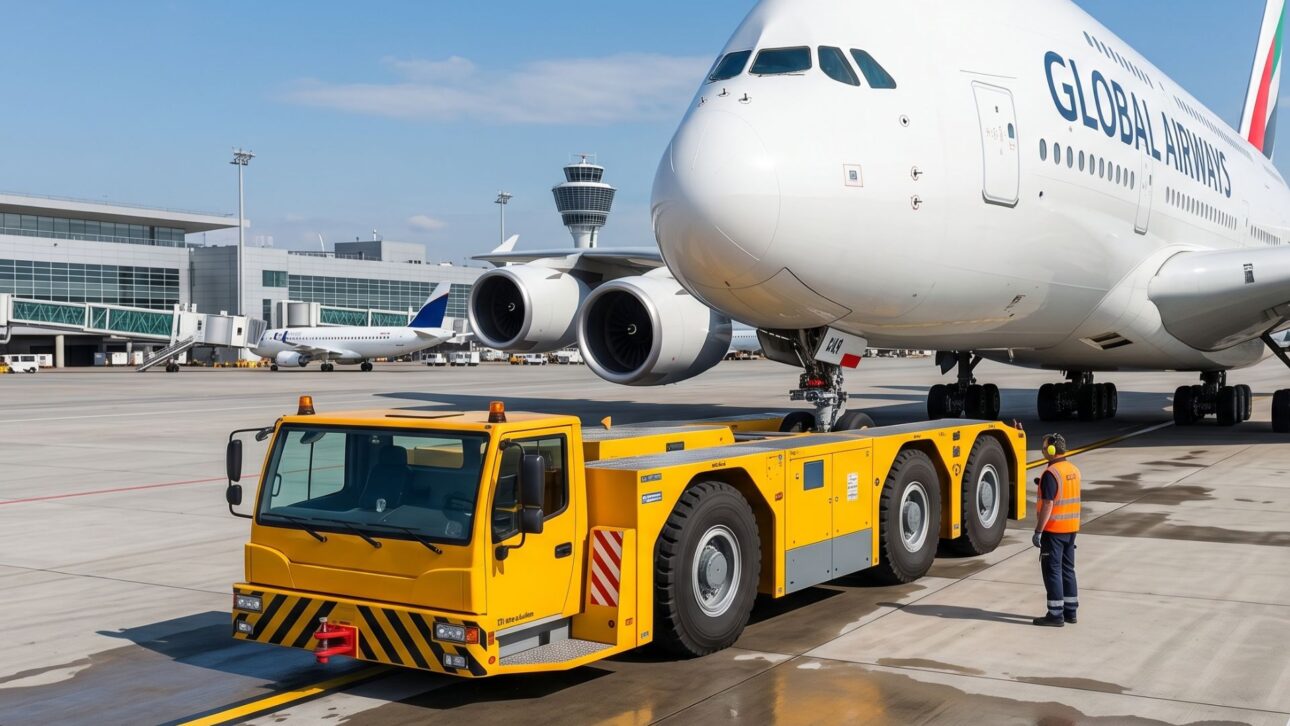
Therefore, aircraft pushback has become a standard procedure in commercial aviation. The tug pushes the plane backward or positions it at a safe point on the apron, and only then does the aircraft begin to move with its own engines. This method reduces operational risk, improves ground organization, and makes movement much more predictable.
In the case of the A380, this is even more important because its physical size increases the complexity of the maneuver. With nearly 80 meters of wingspan and up to 575 tons of maximum takeoff weight, any movement needs to be extremely controlled from the first meter.
Precision of the pushback tractor is as important as its traction power
Moving a giant aircraft is not just a matter of power. At airports, a few meters make all the difference. A slightly wrong angle when leaving the gate can compromise the taxi sequence, increase ground time, or create a risk of interference with other operations.

For this reason, modern tractors are designed with a focus on enhanced visibility, ergonomics, and fine maneuver control. TLD itself highlights that the TMX-650 was developed with an ergonomic design to offer more comfort to the operator and a better field of view, something crucial in congested ramp environments.
It is this combination of high mass, extreme strength, and operational precision that makes the equipment so valuable. Passengers almost never pay attention to it, but without this vehicle, the gate departure of giant planes like the Airbus A380 would be much slower, riskier, and more expensive for airlines and airports.
Pushback tractor is an invisible but essential piece for modern commercial aviation
In practice, the aircraft tug functions as a link between the airplane and the airport’s ground infrastructure. It allows ground operations to occur with rhythm, predictability, and safety, especially in high-traffic hubs where every minute on the ground has a financial impact.
Heavy models, like those used with widebodies, show that aviation does not rely solely on jet engines, giant wings, and sophisticated electronic systems. It also depends on discreet machines, built to work on the ground, that endure enormous effort and perform high-responsibility maneuvers every day.
While the spotlight is on planes that cross oceans and carry hundreds of passengers, the pushback tractor remains almost invisible. Yet, it performs one of the most impressive tasks in airport operations: smoothly and precisely setting a giant like the Airbus A380 in motion even before the engines take over.


