






 Portuguese
  Spanish


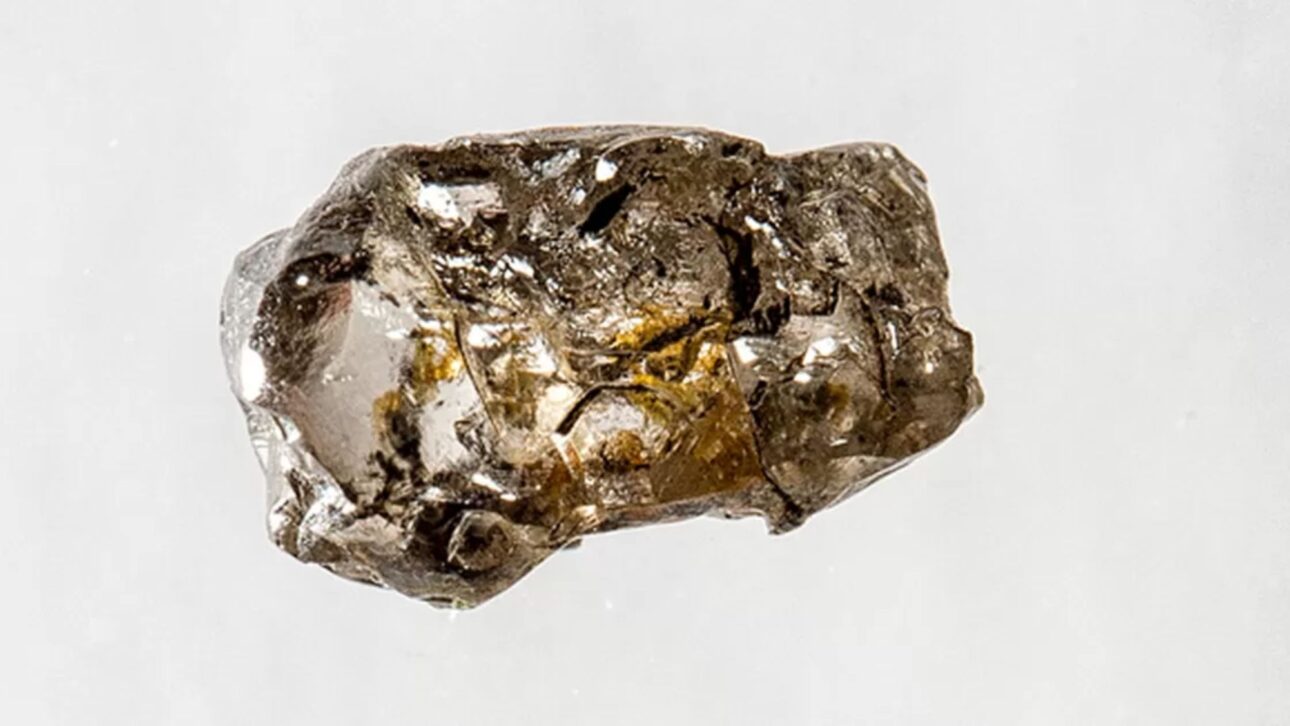
Published in 2022 in Nature Geoscience, the study of the Karowe diamond does not speak of liquid water, but rather water bound to the structure of minerals such as ringwoodite. It is the second stone of this type ever found, after a Brazilian one in 2014, and the analysis relies on a single sample.
The diamond that is rewriting part of what is known about the Earth’s interior was described in a study published in September 2022 in the journal Nature Geoscience. The analysis was conducted by mineralogist Tingting Gu, then a researcher at the Gemological Institute of America, the GIA, now at Purdue University, alongside geoscientist Frank Brenker, from Goethe University Frankfurt, and other collaborators. The stone, a rare gem-quality type IaB diamond extracted from the Karowe mine in Botswana, contains mineral inclusions that point to a water-saturated environment about 660 kilometers deep.
Contrary to the image of a drop trapped in the jewel, what the diamond carries is not liquid water, but rather water chemically bound to the structure of minerals formed under extreme pressure. Inside the stone, the team identified a set of ringwoodite, ferropericlase, and enstatite that only forms at the boundary between the transition zone and the lower mantle, the so-called 660-kilometer discontinuity. The presence of these minerals in hydrated conditions suggests that this boundary, previously seen as a possible dry barrier, may allow water to pass into the depths of the planet.
What the Karowe diamond really carries
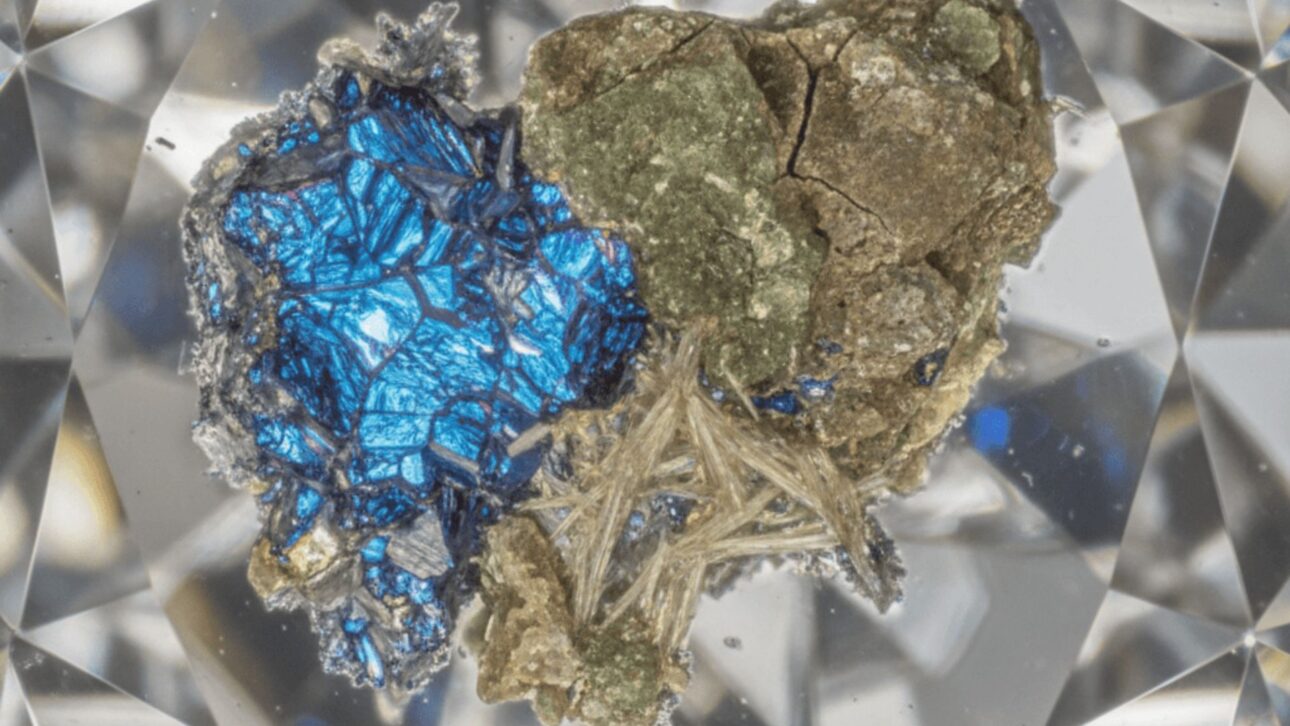
Being extremely resistant, they trap small fragments of minerals from the environment in which they were formed and preserve them almost intact during the long journey to the surface, carried by volcanic rocks called kimberlites.
-
Artesian Well Becomes Lifeline for Small Brazilian Farm: Drilling Reaches 60 Meters, Finds Marble, Navigates Rock Fissures, and Strikes Fresh Water

-
Street Cleaner in Brazil Finds Discarded Books That Helped His Wife Pass Civil Service Exam and Become Police Captain
-
July’s Night Sky to Feature Planetary Alignments, New Moon, Venus at Sunset, Buck Moon, and Two Meteor Showers

-
Fisherman Catches 18kg Catfish Near Brazil’s Itaipu Lake, Among Largest Recorded in Recent Years



In the case of the Karowe diamond, these inclusions hold a direct record of a region that no probe has ever reached.
The set of minerals found is what makes the sample so valuable.
According to the study by Gu and Brenker, the combination of ringwoodite, ferropericlase, and nickel-poor enstatite indicates that the diamond formed at about 23.5 gigapascals of pressure and around 1,650 degrees Celsius, conditions that correspond to a depth of 660 kilometers.
Since ferropericlase and enstatite only coexist in this way at this range or below it, they function as a kind of tag that fixes the stone’s point of origin.
Why it is not a drop of water hidden in the stone
The most repeated idea about these discoveries, that of a drop of water trapped in the diamond, does not correspond to what science actually observes.
The water detected is incorporated into the very crystalline structure of minerals like ringwoodite, in the form of hydroxyl groups, and not as free liquid.
Ringwoodite, a high-pressure polymorph of olivine, has the unusual ability to accommodate significant amounts of water within its atomic network.
It is from this property that the famous comparison with a hidden ocean in the mantle arises.
The calculation is an extrapolation, because if a good part of the transition zone is as hydrated as these samples, the total volume of water trapped in the minerals could rival all the water in the surface oceans.
It is worth emphasizing, however, that this is an inference about a diffuse reservoir linked to minerals, and not a description of an underground sea of running water.
The 660 km discontinuity and the idea of a dry boundary
The depth of 660 kilometers marks one of the most important changes in the structure of the Earth’s mantle.
It is there that ringwoodite, under increasing pressure, decomposes into bridgmanite and ferropericlase, the minerals that dominate the lower mantle and store much less water.
Because of this transformation, part of the scientific community treated the region as a possible barrier to the transit of water and material between layers.
The study of the Karowe diamond suggests otherwise, indicating that hydrated conditions extend across this boundary.
Water reaches these depths mainly carried by tectonic plates that sink in the subduction process, and there is, beneath Europe, a true cemetery of these plates submerged in this zone, as observed by Frank Brenker.
Still, Nature Geoscience itself emphasizes that the composition and flow of volatiles across the 660-kilometer boundary remain under debate, given the scarcity of natural samples from this depth.
The Brazilian Precedent and the Limit of a Single Sample
In 2014, a team led by Graham Pearson from the University of Alberta described in the journal Nature the first terrestrial ringwoodite ever found, trapped in a diamond from Juína, Mato Grosso, mined from river gravel.
That sample contained about 1.5% water by weight and offered the first direct evidence of a hydrated transition zone, at least locally.
Frank Brenker, incidentally, also participated in that work.
The major limitation, recognized by the authors themselves, is that everything relies on very few stones.
The diamond from the Karowe mine is only the second terrestrial ringwoodite ever identified and, being larger than the Brazilian one, allowed for more precise determination of the chemical composition.
Even so, one or two samples are not enough to claim that the entire deep mantle is moist, and the question of whether water is abundant and global or restricted to specific points remains, in the words of the scientific literature itself, highly controversial.
The Karowe diamond does not bring a bottled ocean nor a lost drop, but perhaps something more surprising, the chemical signature of a wetter planetary interior than previously imagined.
By linking a jewel from Botswana to a stone mined in Brazil, science is piecing together, fragment by fragment, the portrait of a water cycle that descends far beyond the surface and may influence volcanism and plate tectonics.
The picture is still incomplete, and each new diamond from these depths is a rare piece in this mosaic.
And you, did you ever imagine that a simple diamond could carry traces of water 660 kilometers inside the Earth? Do you think discoveries like this should be disclosed more carefully, without mentioning hidden oceans where there is water trapped in minerals? Leave your opinion in the comments, with respect for different views, and share this article with those who are fascinated by the mysteries of our planet’s interior.


