Portuguese
  Spanish


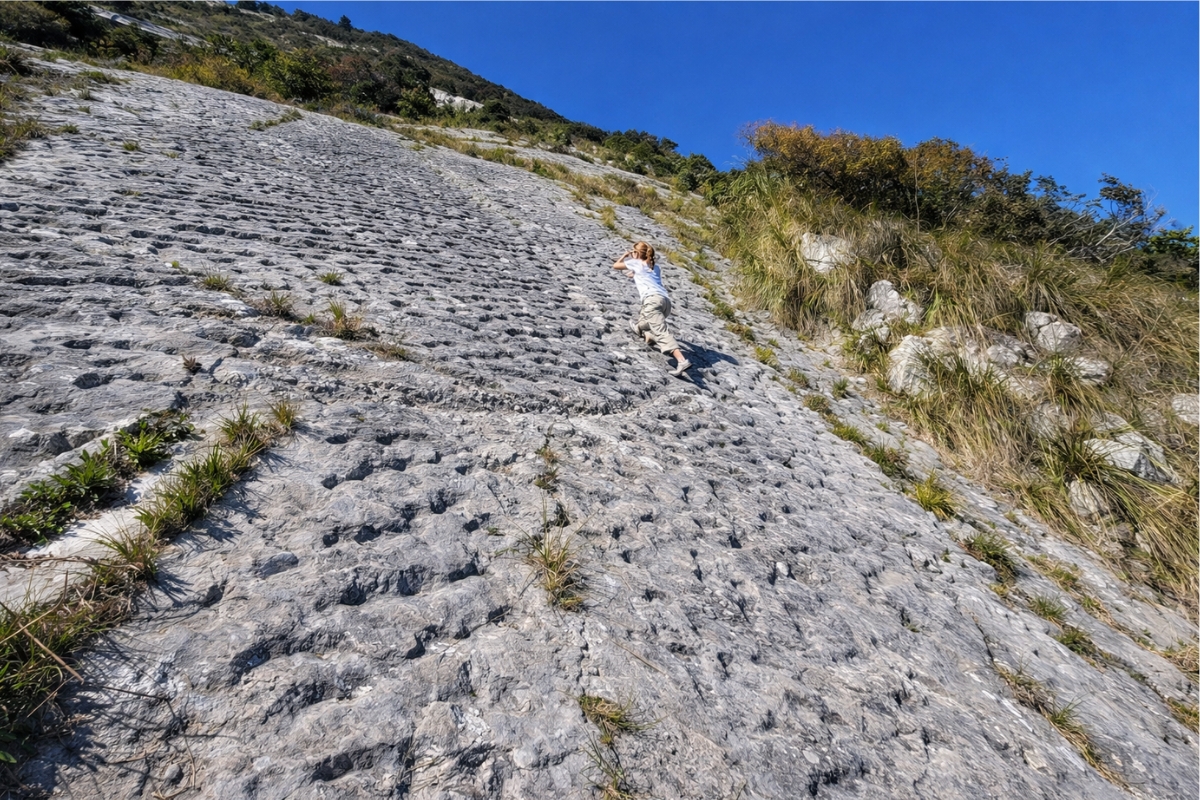


Climbers Identified Grooves on Mount Conero in Italy, About 79 Million Years Ago, and the Hypothesis Points to a Collective Retreat of Sea Turtles After Quake in the Adriatic Sea
A rocky cliff overlooking the Adriatic Sea has become a focus of scientific interest after climbers noticed hundreds of aligned grooves in the rock.
The interpretation is that the marks record a rare moment from the Late Cretaceous, when marine animals likely reacted to an extreme event and left traces that were nearly immediately preserved.
Grooves on Mount Conero Draw Attention for Repetition and Direction
The marks appear in large quantities and follow consistent patterns of depth and orientation, which reduces the chance that they are the result of common wear.
-
Brazilian Innovator Uses 3D-Printed Device to Cool Two Rooms with One Air Conditioner
-
China Uses 432 Robots to Move a 7,500-Ton Historic Building in Shanghai, Preserving Architecture While Creating Space for Underground Center
-
Dutch Initiative Swaps Cigarette Butts for Food to Clean Streets, Combat Pollution, and Turn Waste into Recycled Furniture

-
Kenyan Company Recycles Over 10 Million Flip-Flops from Indian Ocean Beaches into Elephant and Giraffe Sculptures Sold for Up to $1,200

The site is located in the Conero Regional Park, in an area where rock formations have been studied for decades.
The climbers sought technical support by comparing the grooves with other recent findings in the same region.
Geologist Was Called and the Team Organized Verification of the Site
Geologist Paolo Sandroni was approached to assess the significance of the marks and brought the case to researcher Alessandro Montanari.
After that, members of the group returned to the cliff to systematically document details.
The work aimed to understand whether the grooves had a biological origin and what process might have ensured their preservation.
Drone and Rock Samples Helped Reconstruct the Scenario
The documentation included drone recordings to map the distribution of the marks on the cliff.
Rock samples were also collected just above the grooves, which helped contextualize the layer where the trace appears.
The analysis indicated an ancient deep-water environment, with hundreds of meters, confirmed by typical microfossils from the seafloor.

Scaglia Rossa Layer Indicates Ancient Seafloor and Tectonic Activity
The grooves are located in a limestone layer called Scaglia Rossa, known for recording millions of years of sedimentation in deep sea.
What is now part of a mountain was once a seafloor and ended up elevated by tectonic forces over millions of years.
This type of transformation explains why a submarine trace can currently be found on an exposed rock wall.
Earthquake and Underwater Avalanche May Have Preserved the Trace in Minutes
The analyzed samples indicate that the animals lived about 79 million years ago, during the Late Cretaceous.
The geological interpretation suggests that an earthquake caused an underwater mud avalanche that covered the area shortly after the marks were left.
According to Live Science, a science communication and news website, the sequence would have been quick, first the collective retreat and then the burial, which would explain the preservation of the record.
Why Are the Marks Attributed to Sea Turtles and Not Other Reptiles?
Researchers believe that the only large vertebrates capable of leaving this type of groove during that period would be marine reptiles such as sea turtles, plesiosaurs, and mosasaurs.
Since plesiosaurs and mosasaurs are generally described as more solitary animals, the hypothesis of turtles gains strength by involving group behavior.
The idea is that a large number of individuals moved simultaneously, with some swimming to more open areas and others staying closer to the bottom.
Questions About the Pattern of Movement Keep the Issue Open
One point of debate is that the marks suggest a movement in which both front flippers enter the sediment together.
Experts note that current turtles tend to swim with an efficient pattern similar to underwater flight, which does not always match the found design.
Even with this doubt, the geological context reinforces the occurrence of an underwater avalanche linked to an earthquake, which supports the quick preservation of the marks.
The area may now attract more detailed studies to confirm the author of the trace and understand how the sea turtles reacted to the extreme event in the ancient Adriatic.
According to Live Science, an international science communication website, the discovery was documented based on the analysis of the marks and the geological context of the region.