






 Portuguese
  Spanish


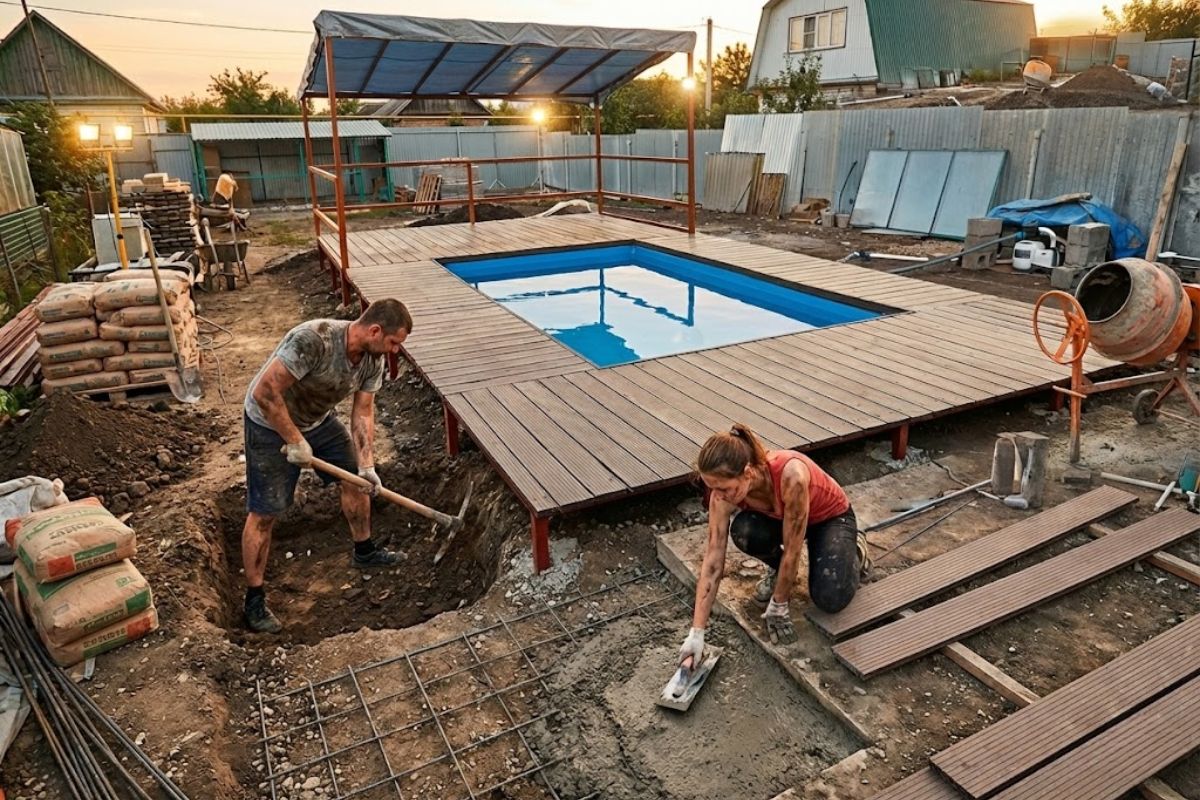


In Just 7 Days Of Intense Work, Husband And Wife Transformed A Standard Garden Into A Full Pool, With Deep Excavation, Stone And Cement Base, Walls Measured Centimeter By Centimeter, Wrinkle-Free Waterproof Lining, Wood Deck And Roof That Protects And Keeps The Water Warm In All Seasons.
A full pool built from scratch in record time became a reality when a couple decided to transform their own backyard into a leisure area and faced a sequence of heavy steps, from the first hole in the ground to the final finishing.
In just 7 days, the project underwent excavation, land reinforcement, concreting, wall construction with blocks, installation of internal panels, waterproofing with lining, filling, and finishing with wood deck and a roof with a metal structure and panels.
Seven Days Of Work Without Pause
The pace was truly that of construction. From Dawn To Dusk, husband and wife alternated tasks, carried materials, leveled surfaces, and progressed through stages that normally require planning and persistence.
-
Brazil to Convert 80 Public Properties into 11,000 Affordable Homes Across 44 Cities to Address Housing Shortage

-
Brazilian Company Develops Wall Panels from Recycled Refrigerator Foam with Comparable Thermal and Acoustic Performance

-
Brazil’s São Paulo Region Unveils Latin America’s Largest Timber Shopping Mall, Built in 7 Months, Capturing Carbon and Preventing 900 Tons of Emissions
-
Danish Island Uses Seaweed for Durable, Centuries-Old Roofing Solution


Each day, the full pool took shape, moving from concept to a real volume in the backyard.
The First Step: Excavate The Backyard Until It Becomes A “Well”

It all started with the roughest part: digging the garden. The couple removed layers of soil, creating space layer by layer, with hand tools and machine support when the terrain required more force.
The goal was clear: to reach a depth that would allow for a stable and aligned base for the full pool.
As the excavation progressed, the hole began to look like a defined well, and the outline of what would become the bathing area became increasingly visible.
The effort was continuous, with the wheelbarrow going back and forth, soil being removed, and the bottom being prepared to receive the next layers.
Terrain Reinforcement With Stone, Board And Cement
With the hole ready, came the stage that ensures the structure does not depend solely on the original ground: reinforcing the terrain.
Stones were placed one by one as a base, creating a supportive layer. On top of them, boards helped stabilize the set, preparing the area to receive cement.
The concrete phase came into play with a mixer, buckets, and manual leveling. The cement was spread and smoothed with a shovel until it was uniform.
This regular base defines the durability of the full pool and prevents the rest of the work from inheriting unevenness.
Walls Raised Block By Block, With Millimetric Measurements

From there, the volume began to rise. Blocks were placed one by one, forming the walls layer by layer.
Here, care was taken centimeter by centimeter: constant measurements, alignment checks, and the pursuit of balance to keep the walls firm and straight.

With the walls gaining height, the couple returned to the internal surroundings: filling gaps, adjusting the base, and placing sand behind the wall, keeping the structure more stable.
The full pool already had shape, but still lacked what truly allows water without risk.
Internal Panels And A Smoother Surface Inside


With the structure up, the interior received panels installed with care. In addition to forming a more consistent finish, these panels help create a more uniform surface resistant to constant contact with water.
Attention to the joints was total.
Each panel was adjusted to be smooth, reducing points of irregularity and preparing the whole for the most sensitive stage: the waterproofing that determines if the full pool will work properly.
Waterproofing With Lining: The Point Where Everything Needs To Fit

The waterproofing was done with a lining applied throughout the interior. The work here is not just about extending: it’s about aligning, stretching, and correcting.
Every centimeter was smoothed to avoid wrinkles and ensure that the material settled well on the edges and, especially, in the corners.
Then, as the water slowly entered, came the fixing phase. The lining was firmly anchored to the sides, with holes made with a drill and fixation points to prevent the lining from loosening over time or allowing infiltrations. It’s this kind of detail that transforms the structure into a full pool ready for use.
Water Rising And Final Details Before The External Finishing
When the hose was turned on, the result began to appear: the water filling the space that, days before, was just removed soil.
Even as the pool was filling, the work continued because finishing and safety do not wait for the water to reach the final level.
By closing the lower layers and checking the fixings, the couple consolidated the functional part of the full pool, ensuring watertightness and stability before moving to the external area.
Wood Deck: From Construction To Leisure Area

With the structure ready, the backyard needed to turn into a place. The solution was a wood deck, set up as a durable platform around the pool.
First, the couple installed metal structures to create a firm base. Then, the wooden boards were cut, measured, and screwed in, one by one.
The deck was not just aesthetically pleasing. It also organizes the surroundings, creates circulation, and improves comfort.
The pool area turned into a vacation spot, with wood and water forming a cleaner and more inviting look to enjoy the full pool.
Coverage With Metal Arches And Panels For Year-Round Use
The final stage elevated the project: the installation of a covering system. The base was made with metal structures in the shape of arches, set up to create a sturdy roof over the pool.
Next, covering panels were placed to reduce the entry of external factors like rain, wind, and leaves, keeping the area cleaner.
In addition to protection, the covering also contributes to thermal insulation, helping the water stay warm longer.
Thus, the full pool was no longer just for summer and became suitable for use at different times of the year, including in cooler periods.
A Standard Garden That Turned Into An Aquatic Refuge
At the end of the process, what was just a garden became a refuge: excavation, reinforced base, erected walls, prepared interior, waterproof lining, water, deck, and covering.
A total transformation in seven days, with visible stages and a project driven by determination.
And you: would you dare to build a full pool in your backyard in just 7 days of intense work?







I really hope a structural engineer was engaged. Also the pool barrier looks to have a climbable point along the rear reatining wall