Portuguese
  Spanish


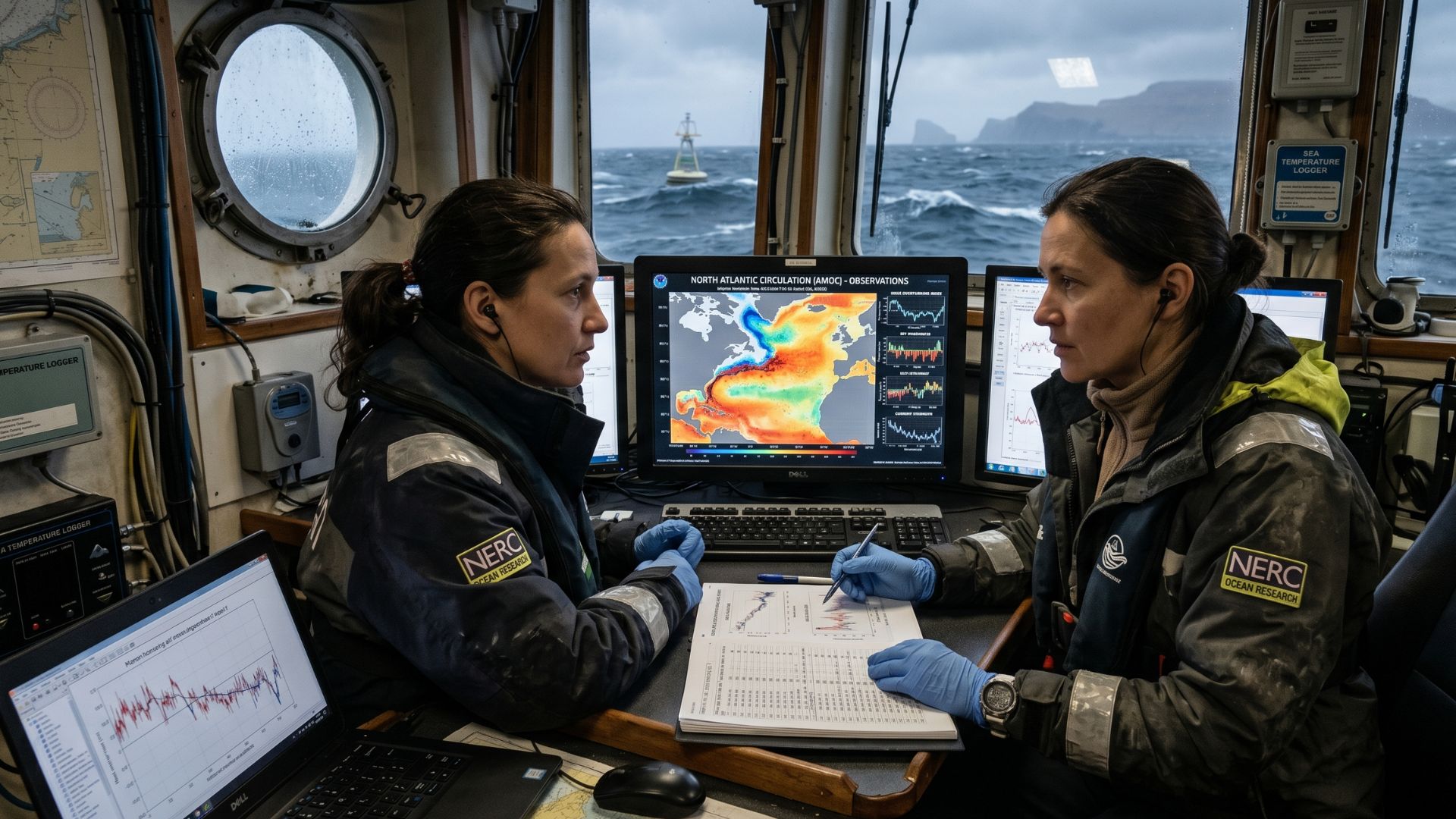

Collapse of the AMOC could result in extreme events in Europe, the Amazon, the Northeast, and anticipate risks still in this decade.
According to Carbon Brief, a study published in 2025 in the journal Geophysical Research Letters by van Westen and Baatsen modeled the combined effects of global warming and a complete collapse of the AMOC, the Atlantic Meridional Overturning Circulation. The result turns an oceanographic topic into a direct alert: in a medium emissions scenario, cold extremes in London could approach -20°C, while Oslo could reach -48°C.
The same model indicates that global warming caused by greenhouse gases would not be enough to compensate for the regional cooling caused by the collapse of the current. In other words, while the planet would continue warming, parts of Europe could face much more extreme winters due to the loss of oceanic heat transport.
Another study, published in August 2025, concluded that the tipping point that would make the collapse inevitable will likely be crossed within a few decades. A 2026 study anticipated this timeline: the threshold that was previously expected to be reached around 2060, at historical rates, could now be reached in the 2040s.
-
In China, Six-Armed Humanoid Robot Revolutionizes Washing Machine Factory, Boosting Efficiency by 30%

-
Engineers Uncover Rain’s Role in Airflow Mystery at Brazilian Underground Facility

-
Brazilian Engineers Lead $200 Million Project to Bring Water from São Francisco River to Transform Supply in Northeastern Cities

-
Brazilian University Tests Recycled Plastic Component for Homes, Aiming for More Sustainable Single-Family Housing Construction


AMOC regulates the atmosphere of Europe, the Atlantic, and the tropics
The AMOC functions as a gigantic heat conveyor in the Atlantic Ocean. Warm, salty waters from the tropical surface move north, carrying heat towards Western Europe.
Upon reaching near the Arctic and Greenland, this water cools, becomes denser, and sinks. It then returns south through the ocean depths, maintaining the circulation cycle that helps distribute heat, salt, and energy across the Atlantic.
This system is what makes Western Europe milder than its latitude would suggest. London is at a similar latitude to Calgary, Canada, but does not usually face the same intense cold pattern precisely because of the heat transported by the Atlantic.
Greenland’s melting could weaken Atlantic circulation
The mechanism of weakening the AMOC is linked to the increasing influx of freshwater into the North Atlantic. This water mainly comes from the melting of Greenland, intensified by global warming.
The AMOC relies on salty, dense water sinking at high latitudes. When freshwater dilutes the surface salinity, it becomes less dense and has more difficulty sinking, even when it cools.
With less sinking, the overturning weakens. The more Greenland melts, the more freshwater enters the system, the more the current loses strength, and the greater the risk of crossing a climatic tipping point.
Collapse of the AMOC could create a feedback loop difficult to reverse
The danger of the AMOC lies in its threshold behavior. The system doesn’t just weaken in a linear and predictable way; it can enter a cycle where each step makes the next more likely.
A weaker current transports less heat to the north, alters the cooling of the waters, and reduces the sinking capacity in the North Atlantic. This further weakens the circulation and reinforces the initial imbalance.

After crossing the critical point, the collapse may become inevitable even if emissions are rapidly reduced. This is why scientists treat the AMOC as one of the major tipping points of the climate system.
London at -20°C and Oslo at -48°C show extreme impact in Europe
The projected numbers for London and Oslo do not represent annual average temperatures, but extreme cold in severe events. Still, they show the scale of regional climate change that a complete collapse of the AMOC could provoke.
London, which today records extremes close to -10°C to -12°C in exceptional episodes, could approach -20°C. This change would pressure infrastructure, transportation, residential heating, agriculture, and public health in the UK.
Oslo, already adapted to harsh winters, could face extremes of -48°C. In this range, much of the infrastructure designed for Norway’s current atmosphere would have to be rethought for a much more aggressive thermal regime.
Global warming would not compensate for the cooling caused by the loss of the AMOC
The result is counterintuitive but central to understanding the study. Even with the planet warming, Western Europe could cool drastically if the AMOC collapsed.


This occurs because the disappearance of ocean heat transport would have a greater regional effect than the average global warming in that area. The heat that currently arrives via the Atlantic would no longer moderate the European winter.
In practice, climate plans based solely on more heat and more drought would need to be revised. Europe could face a mixed scenario: global warming on a planetary scale, but extreme regional cooling caused by the failure of the ocean current.
Scientists warn that the risk of AMOC collapse may have been underestimated
In October 2024, 44 climatologists signed an open letter stating that the risk of AMOC collapse was “severely underestimated” by the IPCC. The panel had classified the collapse before 2100 as very unlikely, with medium confidence.
The scientists argued that this assessment was outdated in light of the most recent evidence. The main point is that traditional climate models have difficulty capturing abrupt changes, especially in systems with tipping points.
Between 2023 and 2025, different studies began to point to similar signs. Historical data, high-resolution simulations, and paleoclimatic reconstructions converged on the hypothesis that the risk is closer and higher than previously thought.
AMOC collapse could alter rainfall in the tropics and affect billions of people
The AMOC also influences the Intertropical Convergence Zone, an equatorial band where warm air rises and forms important rains for monsoons and tropical regimes. When Atlantic circulation weakens, this zone tends to shift southward.
This shift could weaken monsoons in the Northern Hemisphere, affecting regions in Africa and Asia that rely on these rains for agriculture, supply, and food security.
More than three billion people live in areas sensitive to these rain systems. Therefore, the AMOC is not just a European ocean current: it influences climate patterns that sustain food production on entire continents.
Brazil could feel the effects of AMOC in the Amazon, Northeast, and South
An AMOC collapse would also have significant impacts in Brazil. The change in the position of the Intertropical Convergence Zone could alter the rainfall regime over tropical Brazil, with direct effects on the Amazon.

Studies cited in the base text indicate that, in a scenario with a complete AMOC collapse, the Amazon could undergo a drastic change in seasonal rainfall patterns. The dry season could become rainy, and the rainy season could lose strength.
This would affect ecosystems, rivers, agriculture, and biological cycles. An Amazon with a reversed rainfall calendar would not just be a forest under stress: it would be a system operating outside the climatic pattern to which it has adapted.
Northeast Brazil may face more severe droughts with a weakened AMOC
Northeast Brazil is already sensitive to temperature variations in the North Atlantic. When this oceanic region changes, the rainfall patterns over the semi-arid and adjacent areas can also be affected.
With the AMOC weakening, models indicate a risk of intensified drought in the Northeast. This could pressure agriculture, water supply, reservoirs, energy, and food security in historically vulnerable areas.
Southern Brazil could also experience disruptions, especially due to changes in atmospheric circulation associated with the Atlantic and interactions with other phenomena, such as ENSO. The collapse of the AMOC would have global effects, but its regional impacts could be felt concretely in Brazilian territory.
AMOC tipping point may occur within this century
The University of Copenhagen estimated, with 95% confidence, that an AMOC collapse could occur between 2025 and 2095, with the most likely moment around 2057. These dates do not belong to a distant future.
The 2026 research cited in the base text anticipates the risk even further, suggesting that the threshold could be reached in the 2040s. This places the AMOC within the lifespan of people who are already alive today.
Scientific uncertainty remains, but it does not eliminate the risk. When a climatic system capable of reorganizing temperatures, rainfall, and oceans shows signs of approaching a critical point, the safety margin needs to be treated as a political and scientific priority.
AMOC collapse turns ocean current into a global climate alert
The AMOC has always been a silent part of the Atlantic’s climate stability. It redistributes heat, influences rainfall, regulates regional extremes, and helps organize systems that support agriculture, infrastructure, and ecosystems.
The problem is that this stability is being pressured by global warming, Greenland’s ice melt, and the influx of fresh water into the North Atlantic. The risk is not only in the current weakening but in crossing a threshold beyond which the collapse becomes self-sustaining.
For Europe, this could mean extreme cold on a warmer planet. For Brazil, it could mean profound changes in the rainfall of the Amazon, the Northeast, and other regions. The AMOC shows that the climate crisis is not linear: some systems can change state rapidly and redesign the atmosphere of entire continents.