






 Portuguese
  Spanish


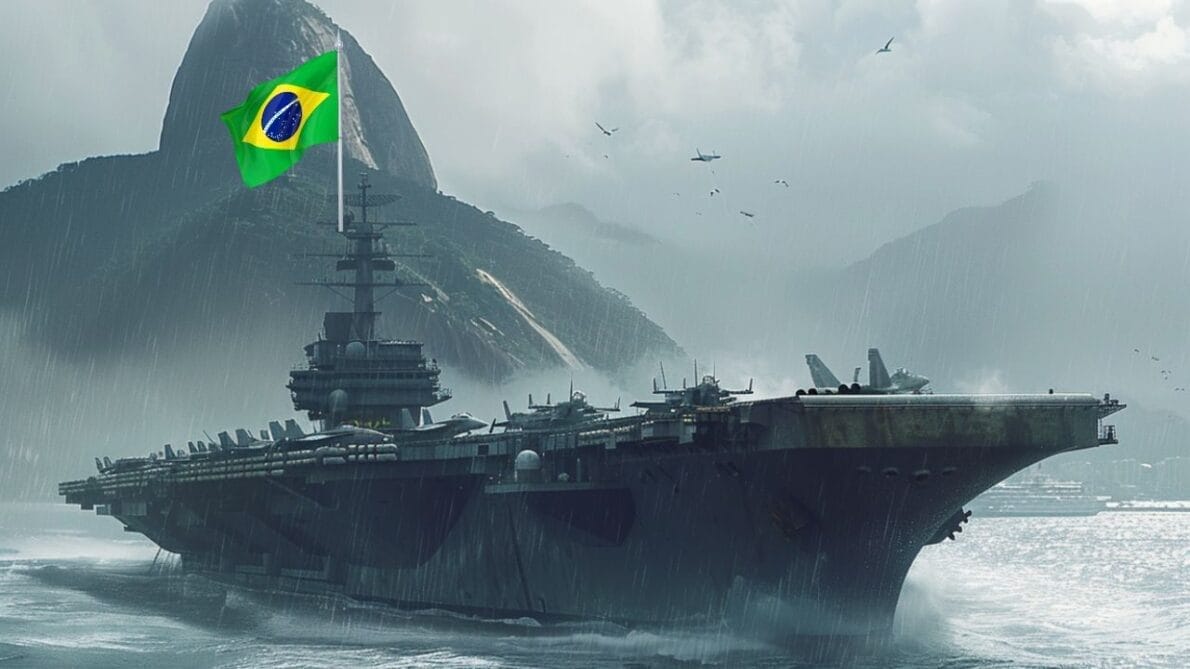


This Nuclear Aircraft Carrier Would Not Only Expand The Operational Reach Of The Brazilian Navy But Also Position The Country As One Of The Main Naval Forces In The Region. The Project, Which Follows The Development Of Nuclear Technology For Submarines, Faces Significant Challenges, Including The Need For A Robust Budget To Cover The High Costs Of Maintenance And Operation.
Brazil announces ambitious plans to integrate a nuclear aircraft carrier into its fleet by 2040, marking a significant advance in naval power projection in Latin America. This decision aims to expand Brazil’s military presence in the oceans and elevate the country’s status in the global defense scenario.
The nuclear aircraft carrier project emerges as a continuation of Brazil’s nuclear military capability development, initiated with the construction of a nuclear submarine. This aircraft carrier would represent a new phase of power projection, with the capability to operate independently in any ocean area, without the need for land support for its aircraft.
Brazilian Navy Has Missed An Aircraft Carrier Since The Deactivation Of São Paulo In 2018


The Brazilian Navy has missed an aircraft carrier since the deactivation of São Paulo in 2018, following a series of technical problems. The country, which has an extensive coastline and responsibilities in the Blue Amazon, sees the renewal of its air projection capability as essential for the defense and control of its waters.
-
They exchanged the idea of a large house for a 35 m² warehouse, spent US$ 12,000 on the structure, and created a tiny house in Colorado with space to live and work.

-
While modern cities rely on pumps and electricity, in Iran, ancient tunnels carried water through the desert using only slope and gravity.
-
Instead of sending families far from the city, a project in Chile intentionally created incomplete houses on expensive urban land and left technical space for each to grow.
-
General Motors Replaces Over a Thousand Workers with 50 Cobots at Electric Vehicle Plant, UAW Union Criticizes Move Amid Industry’s Automation Push


The Admiral of the Squadron Marcos Sampaio Olsen, the current commander of the Navy, highlighted the importance of a robust budget to sustain the operation of an aircraft carrier. He emphasized that, in addition to the acquisition of the vessel, substantial resources are needed for ongoing maintenance and operation, including fuel and repairs.
Brazil Plans Its Future Nuclear Aircraft Carrier
As Brazil plans its future nuclear aircraft carrier, there are debates about its feasibility and effectiveness. The strategy includes the development of versatile national aircraft to maximize the defensive capability of the aircraft carrier. There is a discussion on the type of propulsion that will be used, with a leaning towards nuclear technology due to its autonomy and power.
The investment for a nuclear aircraft carrier is significant, estimated at up to US$ 5.25 billion. This amount reflects the cost of advanced technology and the development necessary to support a vessel of such magnitude and capability.
The Brazilian Navy’s plan to have a nuclear aircraft carrier by 2040 is an audacious step that reflects the country’s ambitions to strengthen its military influence globally. The realization of this project will depend on Brazil’s ability to overcome technical and financial challenges, consolidating its position as a naval power in the southern hemisphere.









Piada. A MB colocou no ex Porta Aviões São Paulo ( popular sucatão) um monte de sucatinhas ( ultrapassados Skyhawks fabricados nos anos 70 do século passado)… Para ter um Porta Aviões é necessário uma forte frota naval que o defenda, coisa que o Brasil infelizmente não destina orçamento para isto. Seria melhor a MB triplicar o número de submarinos diesel elétricos ( uma frota de 15 ou 20 seria melhor para a defesa) e terminar logo o submarino nuclear do que querer um elefante branco que vai consumir um orçamento que ela não tem.
O Brasil deveria parar de comorar sucata de outros países e começar estruturar sua própria indústria naval militar, 2040, esse suposto porta aviões já terá quase trinta anos de atividade e ao invés de ser desativado, por superação tecnológico, nos vendem como modernização da força naval.
Com uma extensão tão grande de oceano, fragatas e corvetas não são suficientes para defesa e manutenção dessa área territorial. A tendência global e cada um proteger o seu quintal, quem for despreparado vai ver seu jardim na mão alheia. É preciso uma Marinha forte e equipada, bem como um exército e aeronáutica, isso inclui investimentos em tecnologia, pesquisa, treinamento e equipamentos. Não é a toa que países como EUA, Rússia, China, Índia, Inglaterra, Alemanha e França são respeitados e ditam os rumos do mundo. Ninguém quer ser vassalo, então porque nós seríamos?