Portuguese
  Spanish


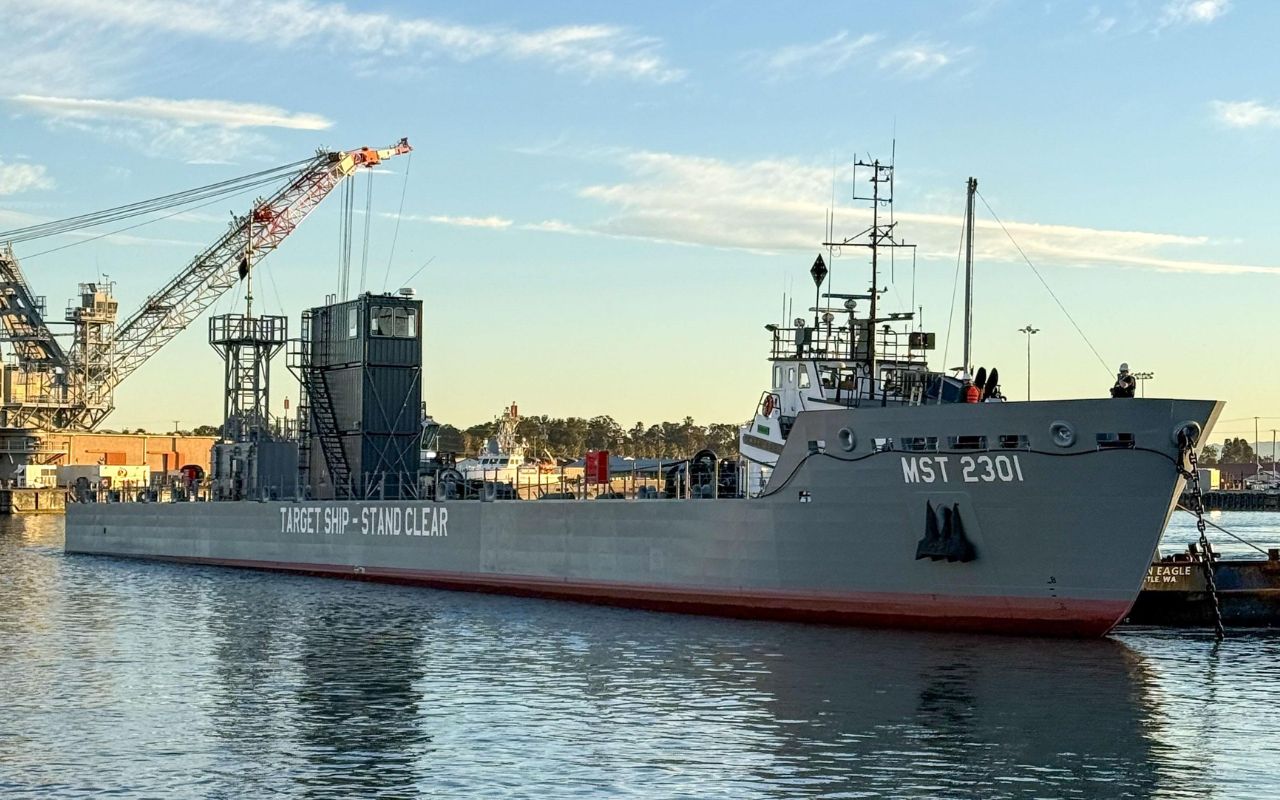


The Mobile Ship Target MST-2, New Test Ship of the United States Navy, Begins Preparation in Port Hueneme to Conduct Advanced Weapons Testing with Remote Operation and Realistic Targets.
The new MST-2 test ship of the United States Navy arrives at Port Hueneme to begin the outfitting phase that will enable remote operations in weapons testing.
Unlike smaller or expendable vessels, the MST-2 offers realistic and reusable surface targets, making live-fire exercises safer and more accurate.
“When completed, the MST will provide us a safe and repeatable way to conduct some of the most demanding weapons testing that the fleet relies on,” said Kevin Gross, director of the Threat Targeting Systems Department.
-
U.S. Military Intervention Risk in Brazil Raises Alarm, Highlights National Sovereignty Amid Tensions Over Washington’s Terrorist Designation of PCC and Comando Vermelho

-
Brazilian Air Force’s Sole KC-30 Aircraft Completes Strategic Mission to Spain for 105mm Anti-Tank Ammunition for Leopard 1A5 Tanks

-
Brazilian Air Force Seeks to Acquire More Gripen Fighter Jets
-
U.S. Air Force Launches Air-to-Air Missile Project with Range of Up to 1,850 km for Indo-Pacific Operations




New MST-2 Test Ship: Technological Preparation for Remote Operation
The Naval Air Warfare Center Weapons Division (NAWCWD) team will be responsible for outfitting the MST-2 with remote control systems developed by the government.
With this, the vessel will be able to operate without crew onboard, ensuring safety during high-risk tests and allowing realistic combat simulations.
The ship will participate in sensor evaluations and live-fire exercises with weapons launched from both ships and aircraft.
Its reconfigurable design and speed adjustment capability make the MST-2 a highly flexible platform for future testing.
A Leap Over the MST-1
The MST-2 replaces the Advanced Target Launch System (MST-1 / MST 9301), which operated for decades assisting the Navy in testing exercises.
The new ship is designed for prolonged and repetitive use, ensuring more realistic and reliable targets for training and weapon validation.
“It’s about instilling confidence in sailors and Marines,” said Rear Admiral Keith Hash, commander of NAWCWD. “When they enter high-risk areas, they need to have full confidence in their systems. The MST allows us to validate that confidence under as realistic conditions as possible.”

Construction and Launch of the MST-2
The MST-2 was built by the Gunderson Marine shipyard and launched in July 2025, in Portland, Oregon.
After completing sea trials, the vessel proceeded to Port Hueneme, where preparations for operational testing will be finalized. At 260 feet (79 meters), the ship is a durable and reusable platform ready to face multiple live-fire exercises.
Docked alongside the MST-1, the MST-2 symbolizes the technological evolution of the United States Navy’s mobile target ships.
Its remote operation will enable the simulation of combat scenarios that are closer to reality, reducing risks for sailors and increasing accuracy in the assessment of weapon and sensor systems.
The ship will be used in tracking tests, live-fire exercises, and sensor evaluations, ensuring that future naval capabilities are assessed in a safe and repeatable manner.
Strategic Impact of the MST-2 Test Ship
With operational rollout planned for early 2026, the MST-2 promises to transform the United States Navy’s weapons testing.
The vessel offers durable targets and remote operation, allowing for more complex and safer exercises.
The MST-2 is an important step for the fleet, ensuring that sailors and Marines have full confidence in the systems they use in critical missions while preparing the Navy to test next-generation naval technologies.