Portuguese
  Spanish


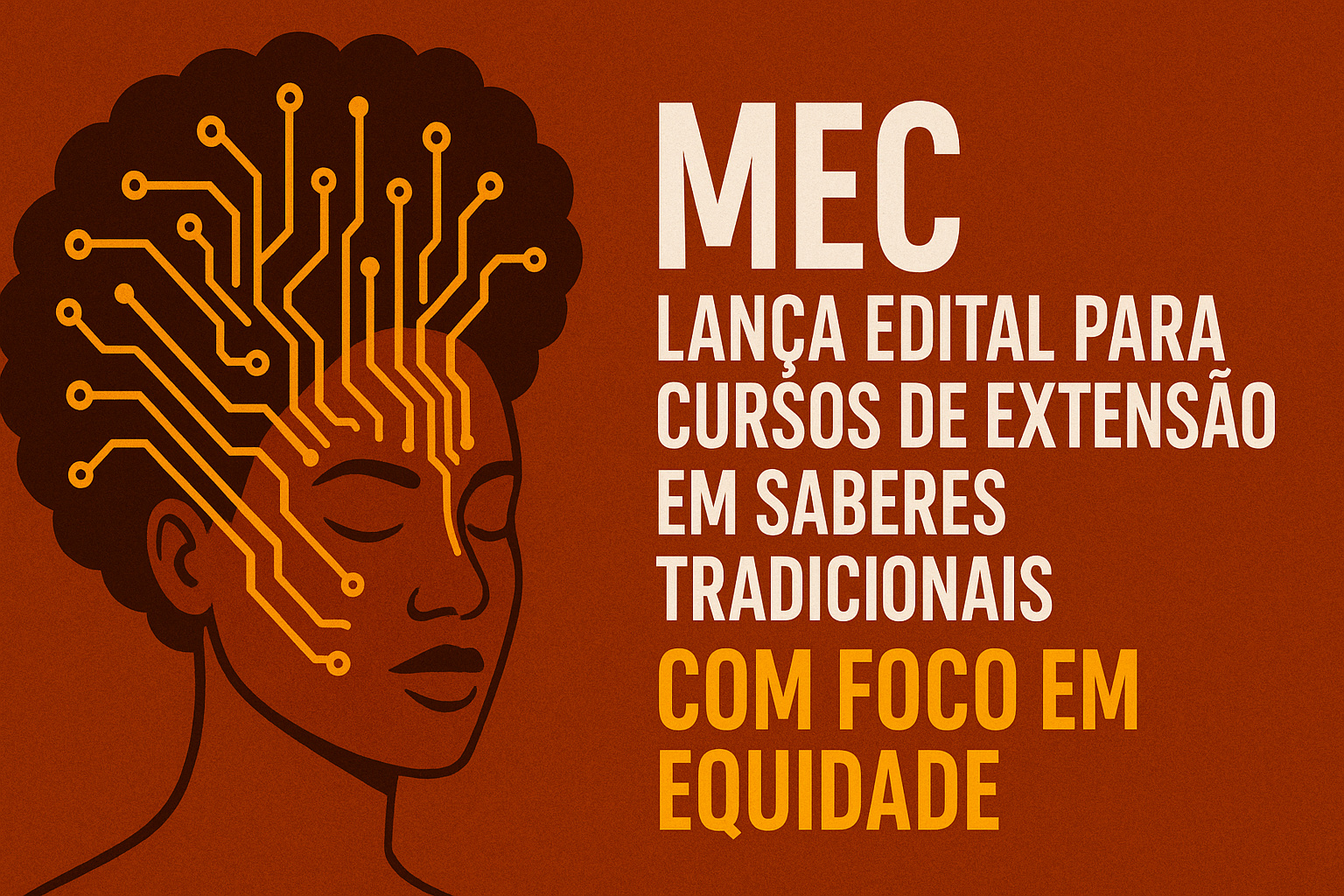

MEC Opens Call for Proposals for Traditional Knowledge Courses with Up to R$ 41.6 Thousand. Initiative Promotes Equity and Continuing Education.
MEC Opens Applications for Extension Courses in Traditional Knowledge
The Ministry of Education (MEC) announced, on September 17, the launch of the National Nego Bispo School Program, which will fund up to 100 extension courses focused on traditional knowledge.
The selected projects will receive up to R$ 41.6 thousand each and will be primarily aimed at undergraduate students in public educational institutions. Applications remain open until October 16, on the website of the Federal Institute of Bahia (IFBA), a partner in the initiative.
The action seeks to promote equity in the distribution of resources among states and regions, ensuring that the impact reaches the entire national territory. In this way, MEC reinforces its commitment to the appreciation of cultural diversity and the expansion of educational opportunities.
-
Surprising opportunity in the railway sector: MRS offers a free course for assistant train driver and shunter in Juiz de Fora with a R$ 1,600 scholarship, specialized training, and the chance to join one of the largest railway operators in Brazil.

-
It’s official: IFMS opens spots in free courses on artificial intelligence, drones, and app creation, expanding technological education in 2026 and preparing students for areas with high professional demand and accelerated digital transformation.
-
Senai launches an unprecedented program with Petrobras and opens 2,000 spots in free courses with recognized certification, a monthly allowance of R$ 600, and training for industrial professions that continue hiring across the country.

-
Petrobras and SENAI open 480 spots in free technical courses with a scholarship of up to R$ 858, meal allowance, and training in Mechanics, Welding, Metallurgy, and Industrial Automation to meet the growing demand of the industry and the oil and gas sector.


Who Can Participate and How Selection Works
The courses must be executed by teams from Federal Institutes, composed of a master or mistress of knowledge, an assistant, and a collaborator. Only effective staff from the IFs, linked to teaching or technical careers, can submit proposals.
The call for proposals also recommends that the proposers have a background in undergraduate education, strengthening the integration between higher education and traditional communities.
Traditional Knowledge as the Central Focus of the Courses
The call for proposals divides the submissions into three major areas:
- Afro-Brazilian Knowledge
- Indigenous Knowledge
- Quilombola Knowledge
Furthermore, the courses should consider sub-themes such as arts and crafts, languages and narratives, memories and oral traditions, and cosmologies. These categories expand the space for different cultural and epistemological expressions, connecting tradition and academic education.
Continuing Education and Impact on Basic Education
The Nego Bispo School integrates masters and mistresses of traditional knowledge into teaching, research, and extension activities, enriching the training of undergraduate students. The program strengthens the continuing education of future teachers while contributing to the effectiveness of Law No. 10,639/2003 and Law No. 22,645/2008, which make the teaching of Afro-Brazilian and Indigenous cultures mandatory in basic education.
Thus, MEC reinforces its commitment to a plural and inclusive education, where cultural diversity plays a prominent role in the curriculum.
National Equity Policy as the Basis of the Program
The call for proposals is aligned with the National Equity Policy, Education for Ethnic-Racial Relations and Quilombola School Education (Pneerq), created by Ordinance No. 470/2024. This policy seeks to overcome ethnic-racial inequalities in education, confront racism, and increase the presence of the quilombola population in educational programs.
The target audience goes beyond students: the Pneerq also involves managers, teachers, technicians, and the entire school community, expanding the reach of the actions.
Opportunities and Strengthening of Trajectories
The Nego Bispo School Program is not limited to the provision of resources. It encourages the protagonism of traditional communities, values historical trajectories, and ensures that previously invisible territories have greater representation within academic education.
By promoting extension projects based on traditional knowledge, MEC expands the opportunities for Brazilian higher education to be more diverse, inclusive, and connected to local realities.
Traditional Knowledge as the Central Focus of the Courses
The call for proposals divides the submissions into three major areas:
- Afro-Brazilian Knowledge
- Indigenous Knowledge
- Quilombola Knowledge
Furthermore, the courses should consider sub-themes such as arts and crafts, languages and narratives, memories and oral traditions, and cosmologies. These categories expand the space for different cultural and epistemological expressions, connecting tradition and academic education.
Continuing Education and Impact on Basic Education
The Nego Bispo School integrates masters and mistresses of traditional knowledge into teaching, research, and extension activities, enriching the training of undergraduate students.
The program strengthens the continuing education of future teachers while contributing to the effectiveness of Laws No. 10,639/2003 and No. 22,645/2008, which make the teaching of Afro-Brazilian and Indigenous cultures mandatory in basic education.
Thus, MEC reinforces its commitment to a plural and inclusive education, where cultural diversity plays a prominent role in the curriculum.
National Equity Policy as the Basis of the Program
The call for proposals is aligned with the National Equity Policy, Education for Ethnic-Racial Relations and Quilombola School Education (Pneerq), created by Ordinance No. 470/2024.
This policy seeks to overcome ethnic-racial inequalities in education, confront racism, and increase the presence of the quilombola population in educational programs.
The target audience goes beyond students: the Pneerq also involves managers, teachers, technicians, and the entire school community, expanding the reach of the actions.
Opportunities and Strengthening of Trajectories
The Nego Bispo School Program is not limited to the provision of resources. It encourages the protagonism of traditional communities, values historical trajectories, and ensures that previously invisible territories have greater representation within academic education.
By promoting extension projects based on traditional knowledge, MEC expands the opportunities for Brazilian higher education to be more diverse, inclusive, and connected to local realities.