






 Portuguese
  Spanish


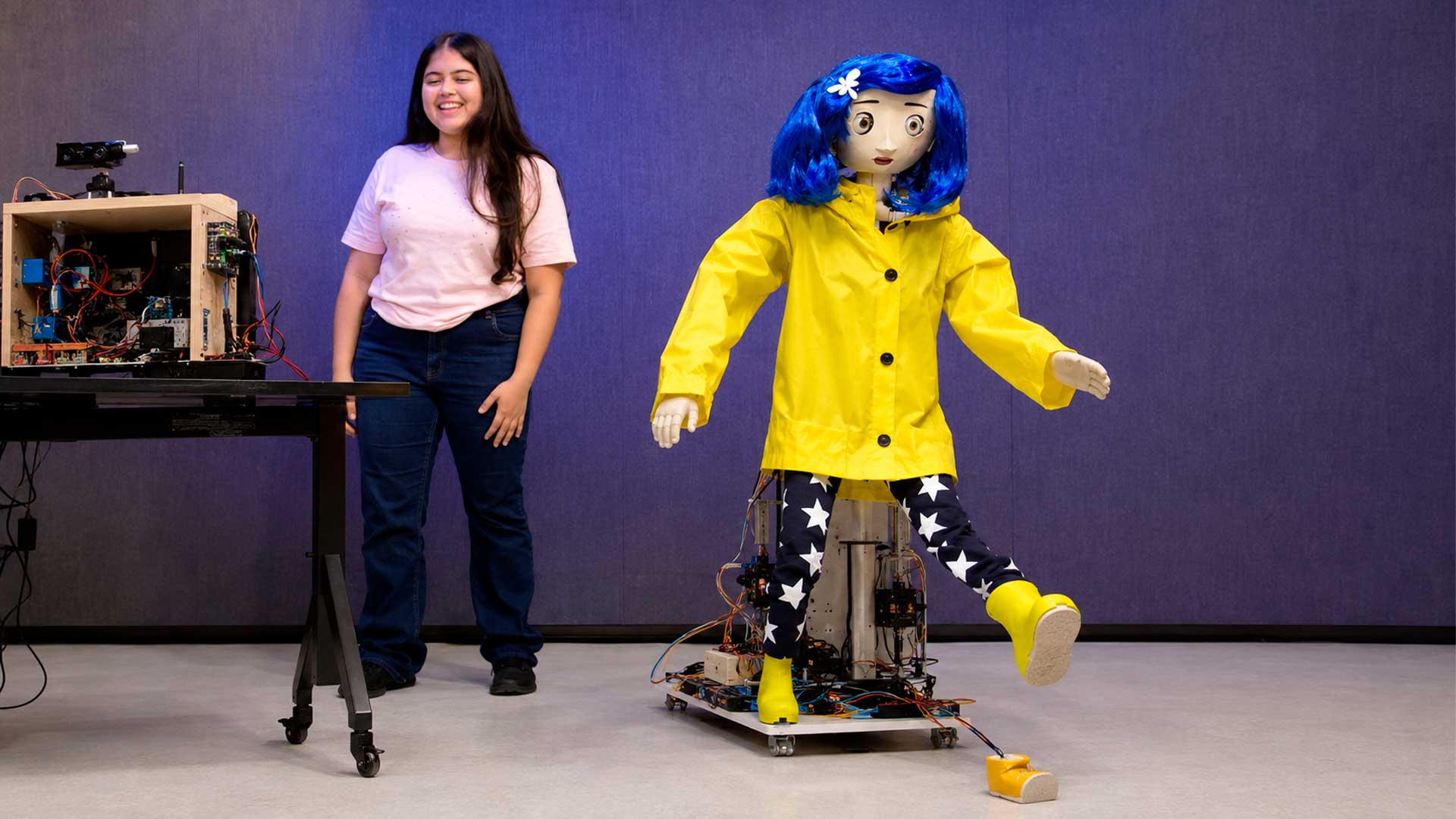

Coraline was born from a school project and caught attention for combining simple materials, electronics, programming, and body expression into an animatronic capable of moving its arms, simulating human gestures, and following an object with the camera. The project entered the radar of artistic robotics, a category in which students need to prove that the robot works on stage and also explain the engineering behind it.
The animatronic robot Coraline was created to mimic human movements, express emotions, and interact with the environment using motors, control boards, and camera vision. In the video posted on YouTube, the student presenting the project shows the internal structure of the animatronic, explains the use of circuits to regulate the power supply to the motors, and activates the robot with an on-off switch.
The most attention-grabbing detail is in the locomotion. Coraline can walk by following a small boot used as a visual reference, as the position of the object appears in the camera. From this point, the system decides where the robot should move, a solution simple in appearance but requiring integration between software, sensors, motors, and physical structure.
According to the presentation, the robot uses 20 servomotors to move body parts and perform gestures like waving goodbye or raising its arms over its head, simulating a reaction to rain.
-
769 BMWs Arrive in Brazilian Port, Boosting Vehicle Imports to 16,200 in 2026 Amid Cargo Operations Resumption

-
Track&Field: From a School Project in São Paulo to a Leading Premium Sportswear Brand with Over 360 Stores and $270 Million in Revenue

-
From Humble Beginnings to Industry Leader: How Dudalina Became Brazil’s Top Shirt Exporter with $416 Million in Revenue
-
Brazilian Brothers Turn $100 Investment into Wildlife, Latin America’s Most Valuable Game Studio Worth $3 Billion, with Global Hits like “Sniper 3D”


To an outside observer, it seems like just a robotic doll moving. Inside, the challenge is to prevent energy, weight, commands, and movements from conflicting during the presentation.
Inside Coraline, the electrical part became almost a “circulatory system”


The student compares Coraline’s electronics to a circulatory system. The analogy makes sense because the motors depend on stable power supply to perform repeated movements, while the boards need to send commands without failures. In a robot with 20 actuators, a power drop or a bad connection can stall the entire performance.
The differential cited by the team is in the electromechanical system, designed to keep the robot safe and functional. The structure needs to accommodate the equivalent of the animatronic’s “bones” and “muscles,” while wires, boards, and regulators work as an internal control network.
The construction took about six months until Coraline could walk and operate on battery during presentations. This timeline shows a less visible part of educational robotics: before the robot appears on stage, there are tests of weight, balance, power supply, programming, and mechanical resistance.
The boot used as a target reveals the more technical side of the project
The idea of making the robot follow a boot seems curious, but it helps explain the logic of the system. The object functions as a visual reference. When the camera identifies the boot’s position, the robot adjusts its movement to follow the target.
This type of solution places Coraline at an interesting frontier of school robotics. She not only performs pre-programmed gestures but also reacts to information captured in the environment. Even on a simple scale, this involves computer vision, decision-making, and motion control.
In practice, the challenge is not just to “see” the boot. The robot needs to transform the position captured by the camera into commands compatible with motors, wheels, or locomotion mechanisms. If the calculation is unstable, Coraline may walk crookedly, lose the target, or fail in the middle of the presentation.
Artistic robotics requires creativity, but also technical evaluation
Coraline appears in the context of artistic robotics, a category in which students build robots for performances with dance, theater, magic, stories, or other performances. According to the Brazilian Robotics Olympiad, the modality became part of the OBR in 2024 and involves creative and autonomous physical robots, with classification through state and national stages.
The format changes the common perception of robotics competitions. It’s not enough to create a fast or efficient machine on a track. In artistic robotics, the robot needs to communicate something, interact with people, and function in sync with the presentation’s proposal.
This requirement explains why an animatronic like Coraline draws attention. She was not designed just to perform a mechanical task. The project tries to bring engineering and expression closer, using body movements to create a recognizable character on stage.
The Pinguberry team took Coraline to the OBR with 17-year-old students
According to information from Jornal Cruzeiro do Sul, Coraline was presented by the Pinguberry team during the regional stage of the Brazilian Robotics Olympiad in Sorocaba, on August 14, 2025. The report stated that students Catarina Morais and Giovanna Lacerda, both 17 years old, participated in the development of the animatronic over six months.
The same coverage showed that the regional gathered more than 130 students in about 40 teams. In the artistic category, projects were evaluated in a technical interview and stage presentation, which requires the students themselves to explain choices of programming, electronics, sensors, and mechanics.
This point is central to understanding the weight of the project. Coraline does not rely solely on an eye-catching shell. To advance in competitions, the team needs to demonstrate mastery over what was built, including the reasons behind the choice of materials, motors, boards, and power system.
Interest in robots that mix stage and engineering has grown in Brazil
Brazilian educational robotics has started to treat art and technology as connected areas, not as separate worlds. As reported by the Industry News Agency on February 28, 2024, more than 2,000 students aged 9 to 19 participated in the SESI Education Festival in Brasília, with robots, music, accessories, and projects linked to the theme of art.
This environment helps explain why projects like Coraline gain visibility. A school animatronic allows for working on programming, electronics, design, manual construction, body expression, and narrative in a single prototype.
There is also a practical factor. Materials like PVC and cardboard reduce costs and allow for rapid prototyping, while servomotors and control boards make it possible to test movements without relying on an industrial structure. The result may not have the finish of commercial robots, but it delivers real technical learning for the team.
Do you think animatronic robots like Coraline should appear more in Brazilian schools, or is this type of project still far from the reality of most students? Leave your opinion in the comments and tell us if you have seen any similar robotics projects.


