





 Portuguese
  English
  Spanish
  4 min of reading
  10 comments


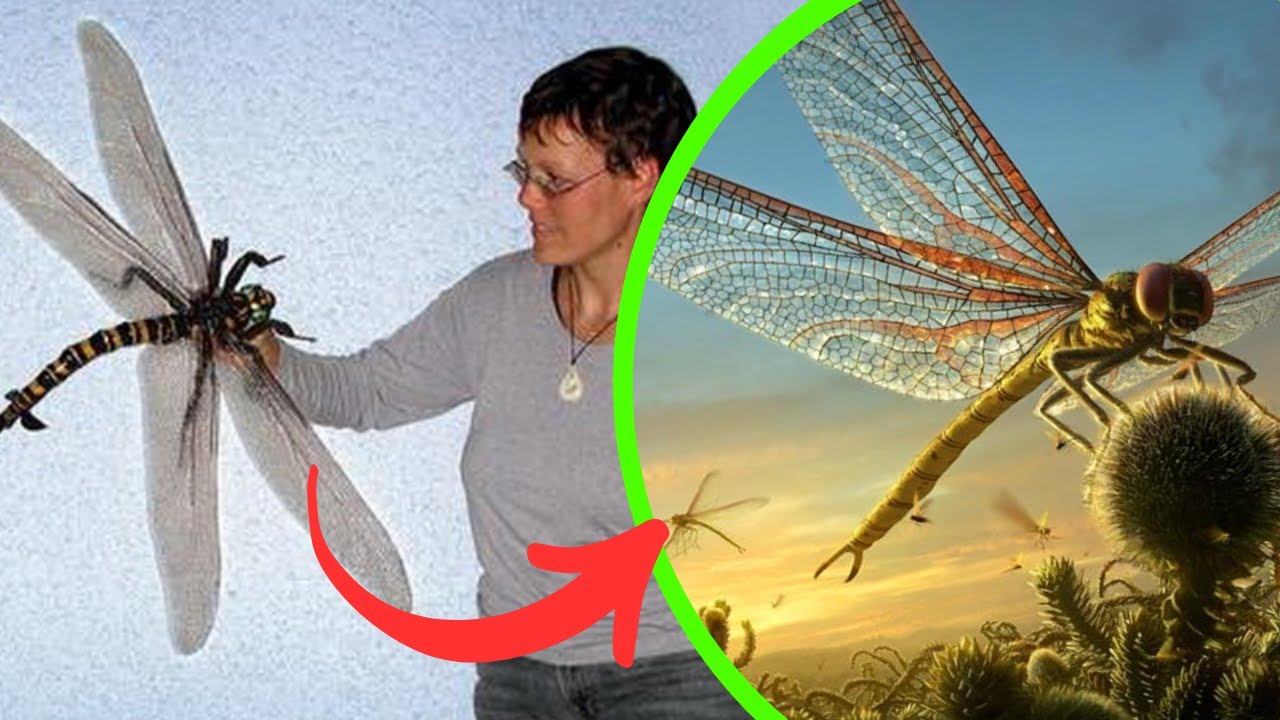


Carboniferous Giant, The Meganeura Reached Almost 75 Cm Wingspan and Reveals How Extreme Oxygen Levels Allowed Colossal Insects.
Long before birds ruled the skies and millions of years before the first dinosaurs appeared, the planet was the stage for a biological phenomenon that now seems impossible: insects the size of medium birds crossing swampy forests. The Meganeura, often compared to a giant dragonfly, was not just large — it represented the maximum limit that a winged insect has ever achieved in the history of life on Earth.
This animal lived approximately 305 to 299 million years ago, during the Late Carboniferous period, an era marked by dense forests, a warm and humid climate, and atmospheric conditions radically different from today’s. The Meganeura was not an isolated evolutionary accident, but rather the extreme product of an environment that favored the gigantism of arthropods.
Dimensions That Challenge the Logic of Modern Insects
The most complete Meganeura fossils indicate a wingspan ranging between 65 and 75 centimeters, with some specimens estimated to be close to this upper limit. For comparison, this places its wings at the same level — or even larger — as those of hawks, medium owls, and small raptors.
-
Chinese drone BZK-005 receives new technology capable of locating radars, mapping communications, identifying radio frequency emitters, and conducting electronic intelligence missions in strategic areas near Japan, Taiwan, and the Western Pacific.

-
Slimming pen still unapproved becomes a global topic after study indicates weight loss similar to bariatric surgery, while clandestine versions of retatrutide appear at the border.

-
Brazilian dengue vaccine from Butantan temporarily suspended after two suspicious deaths, putting Anvisa and the Ministry of Health on national alert
-
Leak reveals that Xiaomi’s new phone, the Redmi K100 Pro, may feature the same processor as the Samsung Galaxy S26 Ultra: the Snapdragon 8 Elite Gen 5 from Qualcomm. The device may also come with a battery of over 8,000 mAh, a 200 MP camera, and a display with a refresh rate of 185 Hz.





The body was robust for an insect, with elongated segments, powerful thoracic musculature, and a highly developed wing system. Unlike modern dragonflies, which are already efficient predators, the Meganeura operated on a completely superior scale, occupying the top of the aerial food chain in its ecosystem.
The Secret of Gigantism: When Air Allowed Flying Monsters
The decisive factor for the existence of the Meganeura was not only anatomical evolution but atmosphere. During the Carboniferous, oxygen levels in the atmosphere reached estimated values between 30% and 35%, compared to about 21% today.
Insects breathe through a system of tracheae, microscopic tubes that deliver oxygen directly to tissues, without lungs or blood circulation for gas transport. This system works well in small organisms but imposes a strict size limit in oxygen-poor atmospheres. In the Carboniferous, this limit simply did not exist as we know it today.
With more oxygen available:
- The metabolism could sustain larger bodies
- The flight musculature could be more powerful
- The risk of respiratory collapse was reduced
The Meganeura is thus a living — albeit fossilized — proof that the maximum size of insects is directly linked to the composition of air.
A Dominant Predator in Primitive Forests
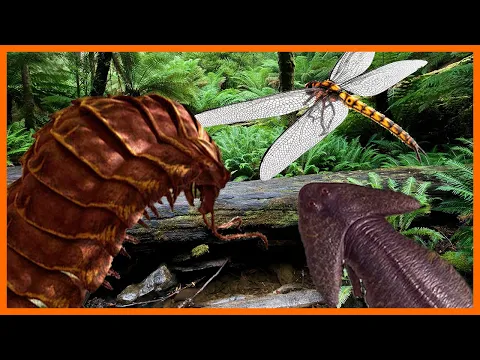
The Meganeura was not a passive animal. It was an active predator, with strong jaws, sharp vision, and extremely stable flight. Its compound eyes occupied a large part of its head, providing a wide field of view, essential for hunting in dense environments full of obstacles.
Its diet likely included:
- Other large insects
- Smaller flying arthropods
- Small primitive vertebrates, such as young amphibians
In the absence of birds, bats, or flying reptiles, the Meganeura reigned without direct competition in the airspace.
Meganeura Was Not a Dragonfly, But Something Even More Ancient
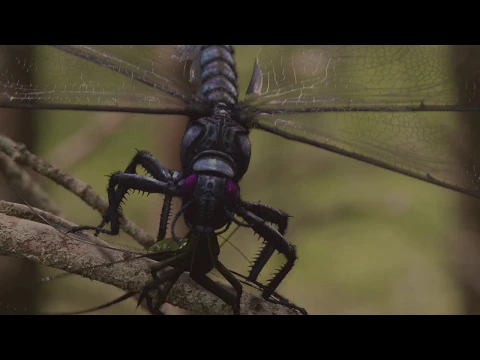
Despite the visual resemblance, the Meganeura does not belong to the group of modern dragonflies (Odonata). It is part of an extinct group called Protodonata, also known as “griffinflies.” These insects represent an ancestral lineage, with characteristics that have completely disappeared in modern insects.
This means that:
- There is no direct descendant of the Meganeura
- Its lineage was extinct before the appearance of dinosaurs
- It represents an evolutionary experiment that has never been repeated
Why Giant Insects No Longer Exist Today
The disappearance of the Meganeura was not caused by a single catastrophic event, but by gradual and profound changes on the planet. With the end of the Carboniferous, there was:
- Significant drop in atmospheric oxygen levels
- Global climate changes
- Collapse of vast swampy forests
With less oxygen available, the respiratory model of insects began to impose increasingly strict limits on body size. Giant insects became metabolically unviable, and gigantism disappeared definitively.
Direct Comparison with Current Insects
To understand how extreme the Meganeura was, just compare:
- A large modern dragonfly has a wingspan of 10 to 12 cm
- The Meganeura could be six times larger
- The estimated body weight was several orders of magnitude higher
No current insect comes anywhere near this limit, even in extreme tropical environments.
The Scientific Impact of the Meganeura Today
The Meganeura is frequently cited in scientific articles, paleontology books, and international documentaries as one of the clearest examples of the relationship between environment and body form. It is also used as a reference in studies on:
- Biological limits of flight
- Evolution of the respiratory system in insects
- Influence of the atmosphere on biodiversity
More than just a curiosity, it serves as a theoretical landmark for understanding why certain organisms can only exist under very specific conditions.
A Giant That Will Never Return
The Meganeura was not only the largest flying insect in history. It was the symbol of a radically different planet, where the air allowed winged monsters, forests engulfed continents, and life experienced forms that are unimaginable today.
If it existed today, its mere presence would rewrite everything we know about insects, ecology, and air safety. Fortunately — or unfortunately — it remains confined to the fossil record, as proof that the Earth was once much stranger, denser, and wilder than any modern scenario can imagine.





I can’t comment because there’s to many f***ing advertisements covering the text. I never buy ANYTHING that has irritating adverts.
Almost 30 inches (29-17/32″) That was a BIG ONE for sure !!
Nonsense!
Dinosaurs are faker than moon travel LoL 😂🤡
you sound like a trump supporter 🤡
And I suppose you also think the world is flat 😂🤣🤣