






 Portuguese
  Spanish


Panama plans to build a railway bridge over the Panama Canal as part of the 450 km Panama-David high-speed line. The Spanish company Renfe has been chosen to validate the project, which is budgeted at US$ 4.5 billion just for the bridge, promising to generate more than 50,000 jobs in the country.
The Panama wants to make a historic leap in its transportation infrastructure, and at the center of this plan is a bold railway bridge that will cross the famous Panama Canal. The crossing is part of the Panama-David project, a 450-kilometer high-speed rail line that aims to connect the country from north to south, reaching speeds of up to 180 km/h. To ensure everything works, the Panamanian government has entrusted the technical validation of the project to Renfe, the Spanish state railway company.
The railway bridge is both the most ambitious and the most challenging piece of the entire venture. Its construction is estimated to cost around US$ 4.5 billion, and it represents the point that most concerns engineers, precisely because it crosses one of the most strategic and busy maritime routes on the planet. The complete project promises to generate more than 50,000 jobs for Panamanians, according to official government information.
What is the Panama-David project
The Panama-David is the flagship project of the current Panamanian government, described by the official site itself as the country’s great railway bet. The proposal is to connect the entire national territory by rail, crossing it longitudinally with a high-speed line capable of reaching 180 km/h for passenger transport and 100 km/h for freight transport.
-
How Much Does Starlink Satellite Internet Cost for Cars, Trucks, and RVs? Prices for Antenna, Accessories, and Plans

-
Scientists Convert Food Waste into Aviation Fuel, Successfully Test 50% Blend with Conventional Kerosene to Cut Emissions and Promote Sustainable Flights
-
OnePlus N6 Smartphone to Launch in India with 8,000mAh Battery and 45W SuperVOOC Charging, Lasting Up to Three Days
-
Scientists Plan to Release Air Bubbles Underwater to Protect Antarctica’s “Doomsday Glacier” from Melting





The line will have 14 stations along the route and is designed to move both people and goods, expanding the logistical capacity of a country that is already a world reference in maritime trade because of the canal. The government’s plan is to start construction this year, and Renfe’s participation is considered essential to unlock this stage, validating whether what has been designed is indeed feasible.
The railway bridge that concerns engineers
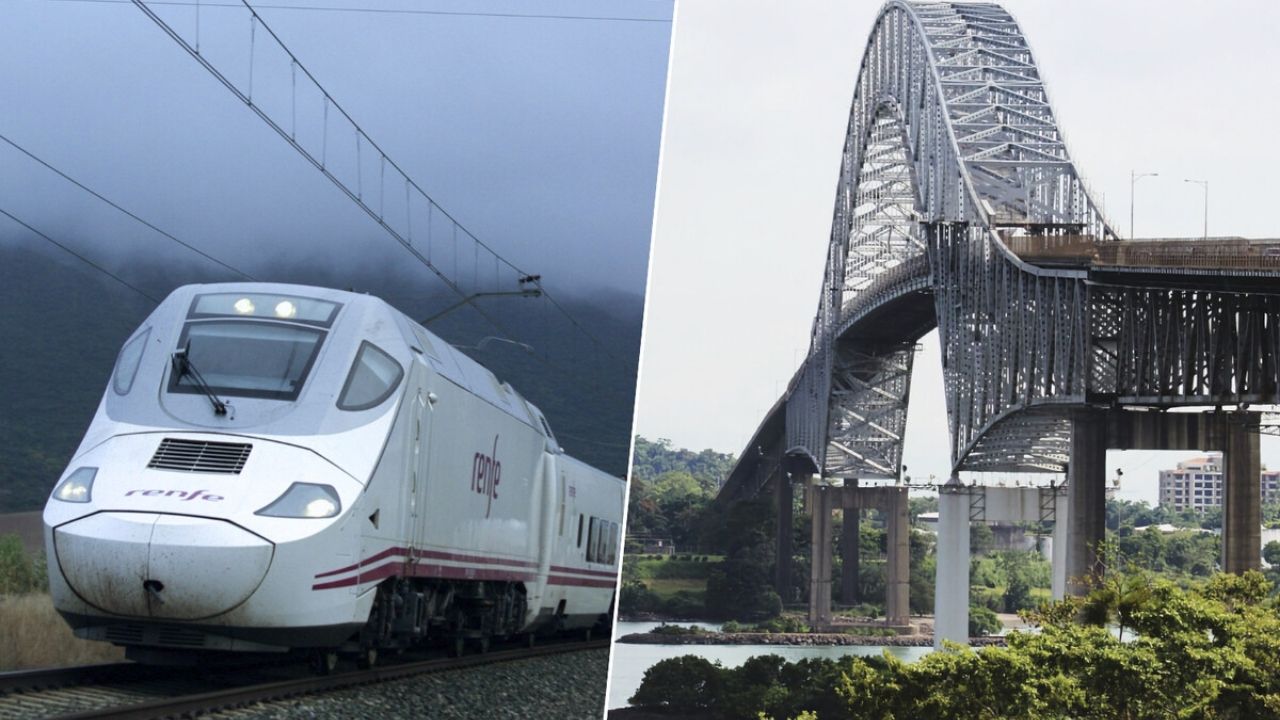
At one end of the line, the construction of the fifth bridge over the Panama Canal is planned. This new crossing will take the railway to the border with Costa Rica, where the project ends, and it is the element that concentrates the greatest technical challenges of the entire work. The estimated budget for this railway bridge reaches an impressive US$ 4.5 billion.
Based on the information available so far, the structure would be built parallel to the Centennial Bridge, the second erected over the canal, which was designed to alleviate traffic from the Bridge of the Americas, the first of all. Building a railway crossing over a canal through which a significant part of global maritime trade passes is an engineering challenge of the highest complexity, involving precise calculations to not compromise the operation of the most strategic waterway in the Americas.
Why Panama chose Renfe
The choice of Renfe was not by chance. According to the local newspaper La Prensa, the Panamanian government opted for the Spanish company because of the prestige it has in evaluating technical railway projects. The mission was entrusted to Renfe Proyectos Internacionales, the division of the company responsible for providing services and consultancy outside Spain.
Renfe’s task will be to certify whether the preliminary report is feasible and if the railway bridge can indeed be built as planned. The company will analyze points such as future expansion possibilities, underwater work to be carried out, and evacuation routes. According to the National Railway Society of Panama, this work will allow reducing technical and operational risks and strengthen decision-making to ensure the viability, efficiency, and sustainability of the project.
The technical role of validation
It is worth clarifying that Renfe will not build the railway bridge or the line. The company’s role is to validate and certify the technical reports already prepared by AECOM, an American company hired by Panama in 2024 to evaluate the project. In other words, Renfe acts as a kind of technical auditor that will give or not the go-ahead for the work to proceed.
This type of validation is a crucial step in mega infrastructure projects, as it is the moment when independent experts confirm whether the plans are truly executable before billions of dollars are invested. The feasibility of the planned railway stations and workshops will also be studied, but it is the bridge over the canal that concentrates most of the concerns and requires the most rigorous scrutiny.
A Billion-Dollar Gamble with Known Risks
Railway megaprojects are often high-risk bets, and Panama is not unaware of this. Projects of this magnitude involve gigantic budgets, long timelines, and engineering challenges that only fully emerge during execution. The very hiring of a company the size of Renfe to validate the project is a sign that the government seeks to minimize uncertainties as much as possible before laying the first stone.
For Renfe, the contract also has strategic weight, even if financially modest compared to the scale of the project. The company’s international division earned 20 million euros last year, and the Panamanian project is expected to yield more than US$ 300,000, according to the local press. More than the value, what is at stake is the prestige of participating in one of the most ambitious infrastructure projects in the Americas, at a time when the company seeks to expand its operations across different countries.
Do you believe Panama will be able to build this railway bridge over the Panama Canal without compromising maritime traffic? Do you think megaprojects like this are worth the billion-dollar investment or do they bring too many risks? And what do you think about the choice of a foreign company to validate the project? Leave your opinion in the comments and tag that friend who loves great engineering works.






Who better to execute a project like this than the Chinese?.. I guess the Panamanian goverment threw themselves under the bus when they bowed to American demands
Forget it, this is one of the most corrupt project for USA-Panama government project of all time. Eventually the project will either failed or the Panama government will begged for China for help to finishing off. However, the Chinese government will not help in this corrupt project.