






 Portuguese
  Spanish


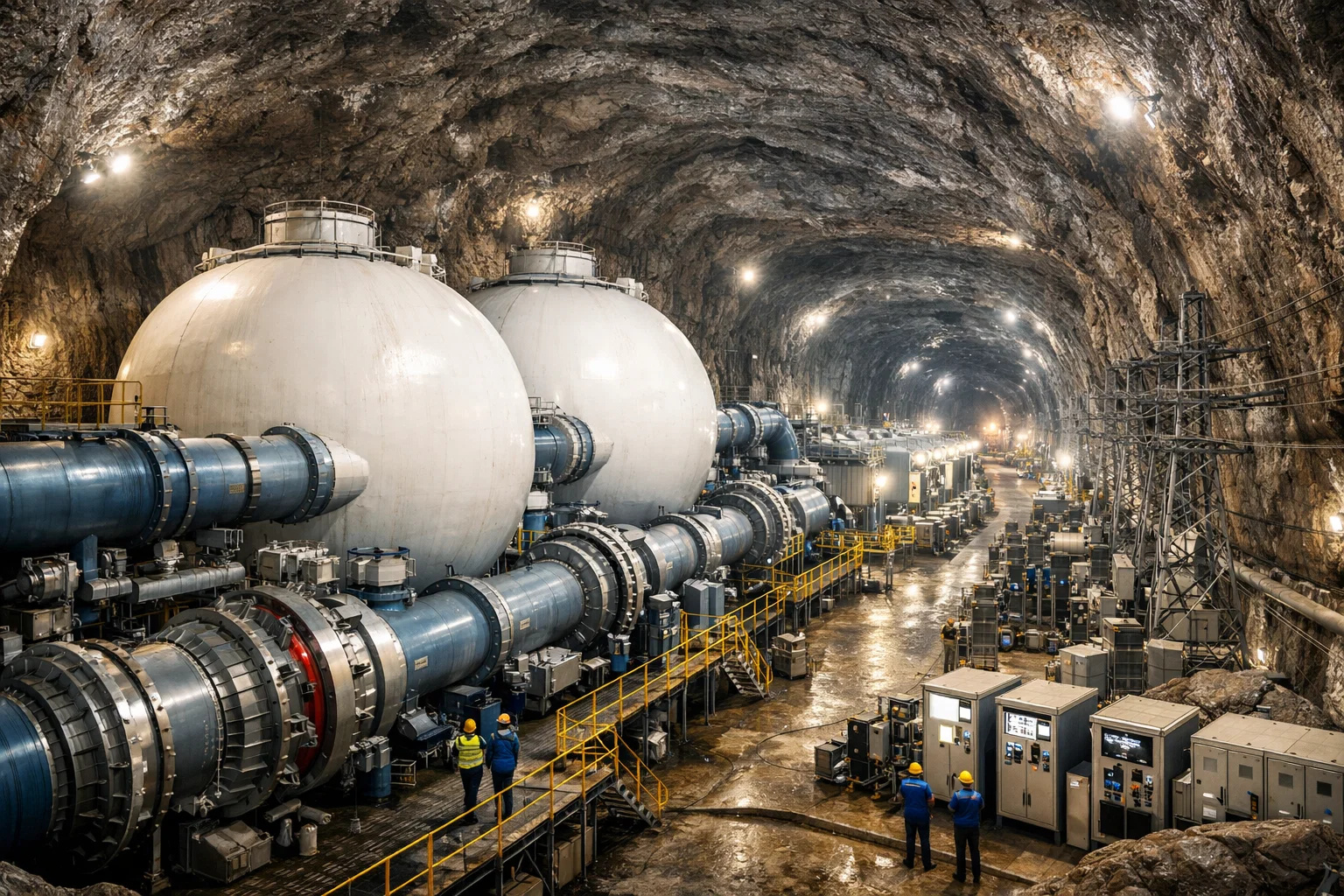


In Jiangsu, China, A Mega Engineering Project Transformed Deep Salt Caverns Into A Giant Energy Reservoir That Generates 792 Million kWh Per Year And Helps Stabilize The Country’s Electric Grid
An abandoned salt mine in the subsoil of China has just gained a new role that has caught the attention of the global energy industry. Instead of extracting ore, the space now stores electricity, with a mega engineering project. The country has put into operation the largest compressed air energy storage plant on the planet, installed in Jiangsu province.
The project functions as a huge underground battery capable of releasing electricity when the electric grid needs it most.
The second unit of the complex was recently connected to the electric grid and is already operating at full capacity. As a result, the system has officially entered full operational status.
-
A fossil kept for years in a small museum in Montreal concealed 450-million-year-old soft tissue, a discovery that has only happened once before in history.

-
Three teenagers transform cut cardboard into Japanese origami-style packaging that promises to retire styrofoam and bubble wrap, win a $12,500 prize, and target giants like Amazon, FedEx, and Home Depot after a robot motor arrived broken.

-
The large jar blender has a rival: Oster Ultra Power bets on 1,000 W, six stainless steel blades, and two portable cups with leak-proof lids.

-
Tesla injected an additional $250 million into the German factory, doubled the battery cell target, and opened its own production line for startups.



Behind the project lies an investment of about US$ 520 million and engineering that transforms compressed air into energy to supply around 600 thousand households per year.
The Underground Mega Engineering Project That Transformed Salt Caverns Into A Giant Battery For The Electric Grid
The heart of the project is hidden more than a kilometer deep. The caverns used to store energy are located between 1,150 and 1,500 meters below the surface.
These natural spaces emerged within an old salt mine. Instead of being abandoned, they have been repurposed as compressed air reservoirs.
When the system is fully charged, the plant operates with numbers that impress even energy experts.
The installation has 600 MW of installed capacity and can store 2,400 MWh of energy. According to data released by the companies involved, the complex is expected to generate about 792 million kWh per year.
This amount of energy is enough to supply approximately 600 thousand homes.
The Engineering Method That Allows Storing Energy Underground And Releasing It When Consumption Soars
The system’s operation seems simple on the surface, but it involves a sophisticated process of energy engineering.
During times when electricity consumption decreases, part of the energy available on the grid is used to compress large volumes of air.
This compressed air is sent to the underground caverns, where it is stored under high pressure.
When the demand for electricity increases, the process is reversed. The pressurized air returns to the surface and drives turbines that generate electricity again.
In practice, the installation functions as a huge energy bank, capable of storing electricity when there is a surplus and returning it when there is a shortage.
The Technical Detail That Put This Plant At The Top Of The World Storage Ranking
The project has also caught attention for a technology used within the system.
The plant uses a method of high-temperature adiabatic compression, which reuses the heat generated during the air compression.
This heat is stored and reused in the electric generation process. In this way, the system eliminates the need for burning fossil fuels to operate.
According to the responsible companies, the project’s conversion efficiency reaches about 70 percent.
Among installations of the same type built in salt caverns, this combination of power, storage capacity, and efficiency has placed the complex in first place globally.
Why The Energy Industry Is Watching This Project With Increasing Interest
In recent years, the growth of renewable sources has created a technical challenge for electric grids.
The production of solar and wind energy fluctuates throughout the day. At times, there is an excess of electricity. At others, there is a shortage.
Storage systems have become strategic pieces for balancing this scenario.
Compressed air plants like the one built in China allow for storing excess energy and using it during peak consumption times.
This type of technology helps to stabilize the electric grid and also reduces waste in renewable energy generation.
The Environmental And Energy Impact That Could Multiply In The Coming Years
The project also presents significant environmental effects.
Estimates released by the companies involved indicate that the plant could save about 250 thousand tons of coal per year.
The reduction in emissions could reach approximately 600 thousand tons of carbon dioxide annually.
With the commissioning of the second unit of 300 MW, the complex has reached its full capacity.
Energy sector experts are closely monitoring this type of technology because it could become one of the main alternatives for storing energy on a large scale in the coming decades.
The transformation of an abandoned mine into an underground battery capable of powering hundreds of thousands of homes explains why this project has been circulating among the greatest recent advances of the mega energy engineering project.
If such projects spread around the world, energy storage could gain a new protagonist in the global electric sector.
What do you think of this technology that stores electricity underground for later use? Do you believe solutions like this can accelerate the expansion of renewable energy worldwide? Share your opinion in the comments.




Essa ideia não é nova. Já há projetos similares na Alemanha. O que é inusitado, certamente, é a escala do projeto chinês; como tudo na China. E quem deve estar às gargalhadas lá na China, porque trabalha lá, presidindo o Banco dos BRICS, é Dilma Roussef, que foi chacotada pela ignorantada brasileira, ao usar a imagem “guardar vento”, quando presidia o Brasil. Pois é isso que esse projeto é: guardar excedentes de energia quando a demanda cai, como de madrugada, por ex. No caso do Brasil, ela foi visionária, pois previa que haveriam grandes excedentes de oferta na geração eólica anos à frente do governo dela e que, portanto, o País precisava se preocupar com o “armazenamento desse vento”. Mas, como o Brasil é um celeiro de ignorantes iletrados pobres de espírito, deu no que deu.
A Dilma até que não estava errada.
Na verdade ela estava certíssima. E ainda reconhecerão sei acerto na história da valorização da mandioca, pois esta é uma das bases da alimentação popular brasileira.