Portuguese
  Spanish


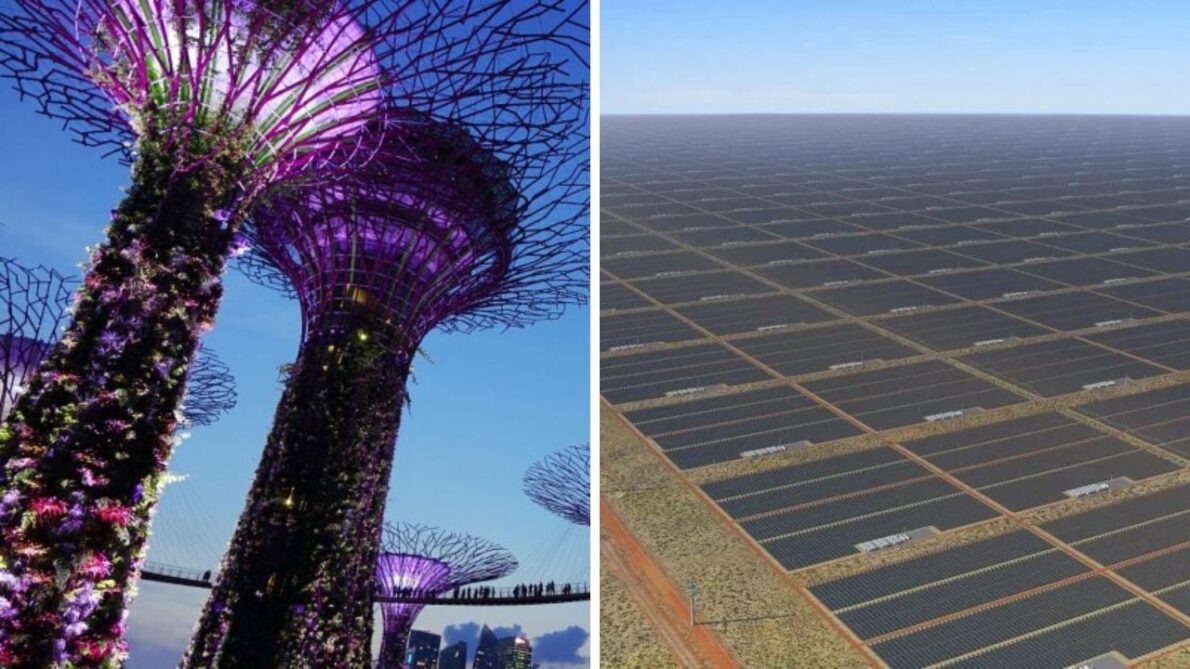


Singapore Launches World’s Most Ambitious Solar Energy Project to Overcome Territorial Challenges
Singapore, a city-state with one of the highest population densities in the world, faces a significant hurdle in its journey towards sustainability: the lack of available land for renewable energy installation. With 8,000 people per square kilometer, the country has no space for large energy farms, but has found an innovative and ambitious solution: importing solar energy from Australia through one of the boldest projects ever conceived in the renewable energy sector.
Valued at $20 billion, the AAPowerLink project, led by the Australian company SunCable, promises to provide up to 20 GW of renewable capacity to Singapore, using a 4,300-kilometer underwater electric cable that will traverse Indonesia’s islands and the Indian Ocean. This project is part of a massive initiative that includes the installation of millions of solar panels and 42 GWh of battery storage, ensuring a continuous and reliable supply of solar energy.
Solar Power Plant Will Occupy an Area of 12,000 Hectares
To understand the magnitude of this endeavor, it’s important to emphasize that the solar power plant will occupy an area of 12,000 hectares in the Northern Territory of Australia. This area will be equipped with 4 GW of photovoltaic capacity in the first phase of the project, connected to an 800-kilometer high-voltage line to the city of Darwin, and from there, an underwater cable will carry the electricity to Singapore.
-
Island in Brazil Innovates by Installing 184 Solar Panels on Urban Lagoon to Generate Clean Energy

-
Japanese Island of 417 Residents to Test Living Half the Year Solely on Solar Power, Reducing Dependence on Diesel Brought by Ship
-
Brazilian Fishermen Use Solar Power to Produce Nearly One Ton of Ice Daily, Preventing Fish Spoilage Before Reaching Market
-
Brazil, known for its river-powered energy, installs solar plant in mountains to boost winter electricity production


It Will Be the Largest Solar Installation in the World
The Australian Minister for the Environment, Tanya Plibersek, highlighted the importance of the AAPowerLink: “This enormous project is a piece of infrastructure that defines a generation. It will be the largest solar installation in the world and will position Australia as a global leader in green energy.” The statement underscores not only the environmental impact but also the economic and geopolitical significance of the project.
SunCable Is Confident and Focused on Securing Necessary Funding
The Australian government’s environmental approval has already been obtained, but the solar energy project still needs the endorsement of Australian Indigenous groups, in addition to approvals from the Indonesian and Singaporean governments. However, SunCable is confident and focused on securing the necessary funding to start exporting electricity to Singapore in 2030. It is estimated that the AAPowerLink will generate more than $20 billion in economic value for the Northern Territory of Australia, as well as create approximately 14,300 direct and indirect jobs.
Singapore Is Utilizing Its Financial Resources and International Cooperation
This project is a clear demonstration of how Singapore is utilizing its financial resources and international cooperation to overcome space challenges that limit local renewable energy implementation. By connecting with Australia, Singapore not only diversifies its energy matrix but also reduces its reliance on fossil fuels, becoming a global example of innovation and sustainability in the solar energy sector.
The Australia-Singapore connection will be a milestone in energy history, proving that with vision and investment, it is possible to overcome even the most challenging geographical hurdles to achieve a more sustainable future.
What do you think of this bold initiative by Singapore to bet on the largest solar energy project in the world? Do you believe that this type of solution can be replicated in other parts of the world facing similar challenges?