






 Portuguese
  Spanish




A Detailed Investigation Explains How The Curious Method Of Wells That Sink On Their Own Helps Understand The Wells Of The Northeast, Revealing Speed In Digging, Adaptation To Fragile Soil And The Use Of Giant Rings That Expose The Aquifer
The construction of wells and water pits accompanies the history of communities that rely on simple solutions to access water in dry regions.
Each location develops its own methods, shaped by culture, soil type, and daily needs.
When we compare practices adopted in Pakistan with those common in the Brazilian Northeast, we understand that, although different at first glance, both follow the same essential principle: to safely, efficiently, and inexpensively reach the aquifer.
-
Former Atacadão Employee Turns Online Cake-Baking Lessons into a Confectionery Brand with Factory, Store, Delivery, and Nearly $400,000 in Revenue

-
Brazilian Startup Sells Nearly 9 Million Surprise Bags of Near-Expiry Food, Prevents Thousands of Tons of Waste, Aiming for $42 Million Revenue by 2026
-
How to Prevent Brown Recluse Spider Bites: Common Hiding Spots and Free Tips to Reduce Risks

-
Natto: The Unusual Japanese Superfood Gaining Popularity on Social Media and Driving Record Exports




The Pakistani technique draws attention for its speed and peculiar structure, while the Northeastern water pit represents the traditional effort of the Sertão populations to secure water during long periods of drought.
The Pakistani Technique And Its Initial Structure
The method used in Pakistan and other countries in the region, such as India and Bangladesh, sparks curiosity for seeming unusual, but its internal logic reveals a process adapted for soft and sandy terrains. There, they know this technique as Sink Method.

It all starts with the construction of a large ring that will serve as the initial wall of the well.
This piece is assembled on the surface before any deep excavation begins.
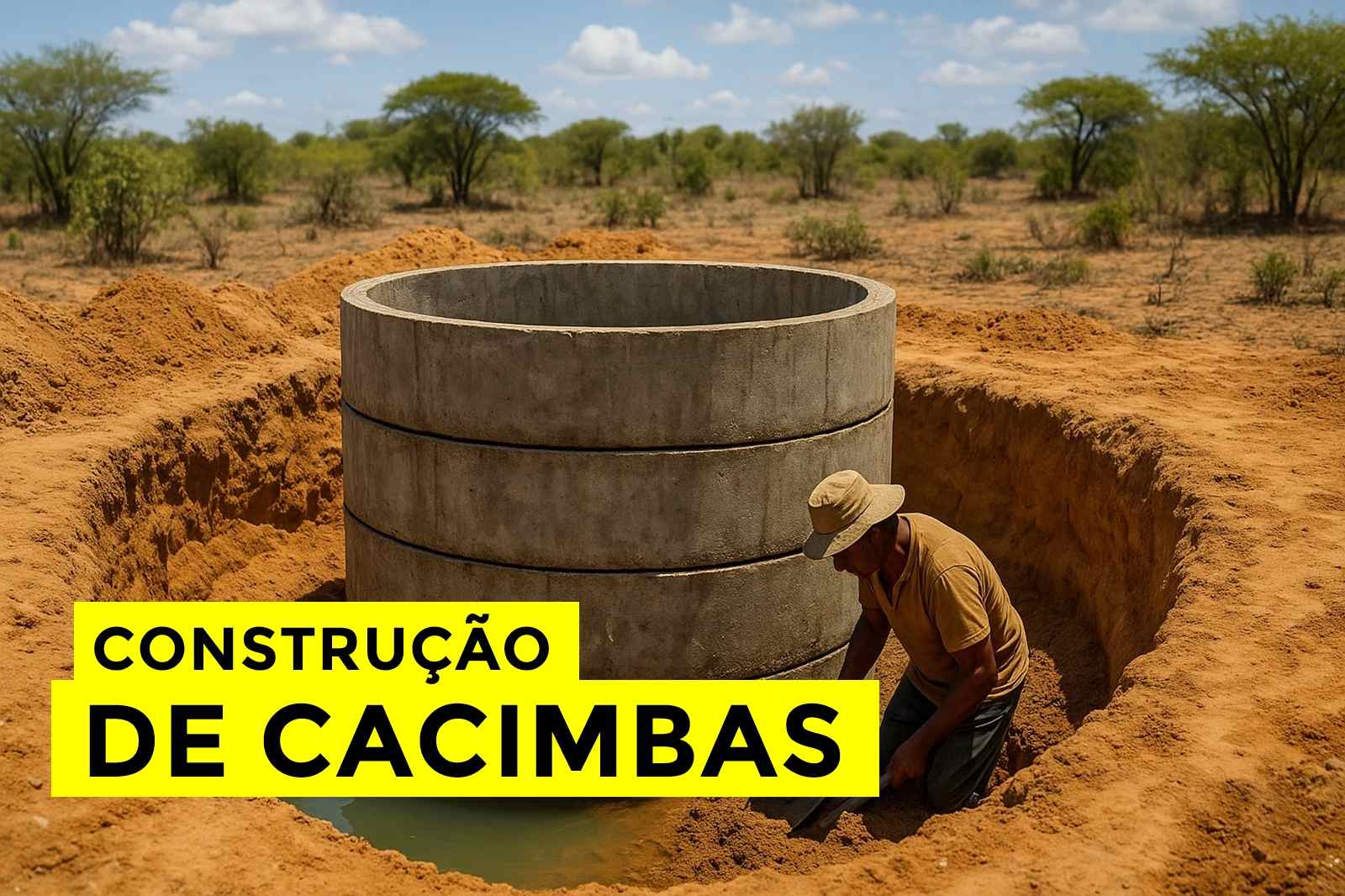
Its function is to create the structure that will descend as the earth is removed, maintaining the circular shape and protecting the worker who will be inside the well.
Once the ring is completed, a worker descends into the structure to begin removing the soil located under the base.
This step is crucial for everything to work, as removing the earth eliminates the natural support that sustains the ring, allowing the piece to slide slowly downward.
The weight of the ring itself becomes an ally, creating continuous movement that dispenses with complex equipment.
The Process Of Continuous Descent

As the worker digs and removes the earth, the ring loses support and begins to descend, as if it were a cable-free elevator.
This gradual movement makes the process safer, as it prevents collapses, keeping the walls stable while the well deepens. The worker repeats the cycle: digs, removes the soil, observes the structure sink, and continues working.
Meanwhile, another team remains on the surface. As soon as the first ring descends a few centimeters, another ring is fitted over it. This practice ensures that the well grows upward while deepening downward.
Each new ring increases the height of the wall and reinforces the structure, ensuring alignment, stability, and resistance to collapses. The sum of these actions makes the Pakistani method recognized for its fast pace and adaptation to the type of soil found in the region.
Advantages Of The Technique In Soft Soils
This method is especially advantageous in places where the soil is fragile, such as sandy areas and regions with little cohesion.
In such environments, open excavations can easily collapse, jeopardizing the safety of workers and hindering progress.
With the sinking ring technique, the well’s own wall accompanies and protects the excavation, reducing risks and ensuring that the work is done swiftly.
The structure that descends and grows simultaneously creates an interesting balance. On one side, the well advances vertically, breaking through soil layers with precision.
On the other, each ring added to the surface maintains the integrity of the set, preventing the wall from collapsing. This transforms a job that could be extremely dangerous into a safe and efficient process.


The Northeastern Water Pit And The Traditional Method
When we look at the Brazilian Northeast, especially in the Sertão’s interiors, we find another reality, marked by the strength of manual labor and the tradition of water pits.
These small structures are dug directly into the ground, usually with a diameter of about one meter, until the water is reached.
Their purpose is to capture water from the aquifer without piercing the impermeable layer, utilizing natural infiltration to store the resource.
The process begins with selecting the location, a step that depends on the observation and experience of the residents.
People who have lived for decades in the Sertão identify signs such as greener vegetation, wetter areas, and natural depressions in the terrain called “baixios.” These signs reveal where the aquifer is closest to the surface.

Steps For Excavating A Water Pit
With the location decided, manual excavation begins. It is a task that requires patience and physical effort, as the dry soil of the upper layers tends to be harder.
As depth increases, moisture grows, making excavation easier and indicating proximity to water.
When the aquifer is reached, water starts to spring up naturally through the walls and bottom, marking the ideal point to finish or expand the excavation.
Unlike the Pakistani method, the Northeastern water pit usually does not use rigid structures from the start. In firm terrains, the walls remain with the natural compaction of the earth.
However, when there is a risk of collapse, residents may line the walls with stones, bricks, or specific rings made for wells and pits. This reinforcement helps extend the lifespan of the water pit and prevents the water from becoming turbid due to internal soil slippage.
Importance Of Protection And Maintenance
Although it is an economical and accessible alternative, the water pit requires important care. The opening must be protected to prevent accidents involving children, the elderly, or animals.
Furthermore, the water in a water pit can be easily contaminated if the well is close to livestock pens, pits, roads, or areas using pesticides. Therefore, choosing the location should take into account not only the search for water but also public health factors.
Periodic cleaning is another essential care. As the water pit receives water through infiltration, it also accumulates materials such as sand, leaves, roots, and sediments. Without maintenance, water quality declines, and the well loses efficiency. In many regions, cleaning is performed annually, before the rainy season, to ensure good functioning.
Differences That Reveal Similarities
When comparing the Pakistani method with the construction of water pits in the Northeast, we see that each technique meets specific needs.
In Pakistan, the soft soil requires a solution that combines safety and speed. In the Brazilian Sertão, the relatively shallow depth of the aquifer allows traditional manual excavation to remain efficient.
Although the structure of the Pakistani well may seem sophisticated, its basic principle is simple: to use the weight of the rings to gradually sink, protecting the worker. Meanwhile, the water pit uses the soil itself as an ally and relies more on the empirical knowledge of the residents.
Solutions Created By Necessity

Despite cultural and geographical differences, both techniques reveal human creativity in the face of water scarcity.
The self-sinking well in Pakistan and the manual water pit in the Northeast are direct responses to harsh realities where survival depends on the ability to access underground resources with limited tools.
These solutions show that there is no single path to ensuring water, but rather methods adapted to the conditions of each people.
If you wish, I can turn this article into a journalistic version, create a 400-word version, produce catchy titles, add tags, meta, or create realistic images to illustrate wells and water pits in your writing style.








Falaram em anel de concreto mas colocaram revestimento de tijolos que é um metido totalmente fifetente