Portuguese
  Spanish



In Total, Brazilian Mining Will Receive Investments of US$ 38 Billion. Bahia, Minas Gerais, and Pará Are the States That Will Receive the Largest Contributions
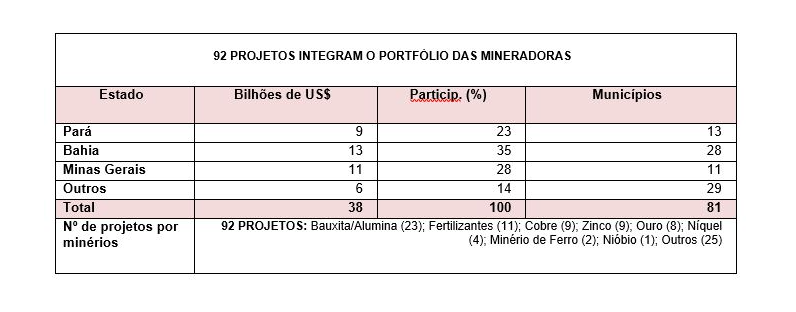
According to data from the Brazilian Mining Institute (Ibram), Brazil is expected to receive investments totaling US$ 38 billion between the years 2021 and 2025. The state of Bahia will receive 35% of the investment, Minas Gerais will receive 28% of the contribution, followed by Pará with 23%; the respective investments in the states will be US$ 13 billion, US$ 11 billion, and US$ 9 billion.
- Thermal Power Plant in Mato Grosso do Sul Will Be Reactivated and Operations May Resume in June
- Cryptocurrency Broker Mercado Bitcoin Offers Hundreds of Home Office Job Openings with Salaries Up to R$ 17,000
- Hydrogen Blend with Ethanol Promises to Revolutionize Power and Reduce Fuel Consumption in Flex Engines
- Shell Oil Spill Floods Entire Community in Nigeria
- Wind and Solar Power Plant Built in the Sahara Desert Will Transmit Energy to the UK via Submarine Cable
Investments in Brazilian Mining
The total contribution to the sector will be divided among the 81 cities in Bahia, Minas Gerais, Pará, and the rest of Brazil, across 92 different projects, according to a survey by Ibram. Of all the mining projects that will receive investments, about 23 will be for the production of alumina and bauxite; 11 for potassium and phosphate inputs; 9 for zinc; 9 for copper; 8 for gold; 4 for nickel; 2 for iron ore; and another 25 for other minerals.
The state of Bahia will divide the contribution among 28 municipalities, Minas Gerais among 11 cities, and Pará among 13 municipalities. The remaining 29 cities will receive investments of US$ 5 billion.
-
Brazil’s BNDES Funded Metro and Steel Plant Projects in Venezuela with Brazilian Support

-
Abandoned Building in Brazil to Become Biotechnology Unit with $10 Million Investment, Bridging Science, Industry, and Public Health
-
Company Offering “Stones to Diamonds” Scheme Sells Ruined Italian Homes to Brazilians for 1 Euro, Disappears with Promised Renovations, Leaving Buyers in Debt to Italian Tax Authorities Until 2028 Without Property

-
Plastic Packaging Drives Santa Catarina Industry to 230% Growth, Aiming for R$ 500 Million by 2030 Amid Sector Crisis, with New Gearless Line Expanding in Southern Brazil to Compete in South America



-

Table Showing Mining Projects / Source: Ibram
Contribution Could Be Greater in the States of Bahia, Minas Gerais, and Pará
According to Wilson Brumer, president of the Council of the Brazilian Mining Institute, investments in Brazilian mining could be even greater, as he states that the country still does not know its mineral potential. Wilson also says that it is necessary to understand Brazil’s geology more deeply, stating that investments in mining projects in the states of higher production (Bahia, Minas Gerais, and Pará) could have been larger.
The Ibram revealed that with the numerous investments in mining projects in Brazil, the sector can become one of the main areas to positively contribute to socioeconomic indicators.
Mining: Production, Revenue, and Job Creation
According to Ibram’s estimate, mineral production in the first quarter of 2021 may have grown by 15% compared to the same period last year. Regarding the export of production, the total revenue in this first quarter was R$ 70 billion, with the revenue largely coming from the following products: iron ore – 70%, gold – 11%, copper – 5%, and bauxite – 2%.
Once again, in the first quarter, the trade balance of mining played a decisive role in the positive performance of Brazil’s trade balance, which was close to US$ 8 billion. Thus, the contribution of the mineral balance to Brazil’s balance in the first quarter was 135%. In dollars, iron ore exports increased by 102%.
In terms of revenue by state, Minas Gerais had the highest revenue variation in the first quarter of 2021 compared to the same period last year, with R$ 28 billion, followed by Pará with R$ 31 billion and Bahia with R$ 2 billion. In job creation, Brazilian mining opened about 11,000 new direct jobs in the first quarter of 2021, which, compared to the same period last year, represented a 6% increase, according to data released by the federal government.