Portuguese
  Spanish


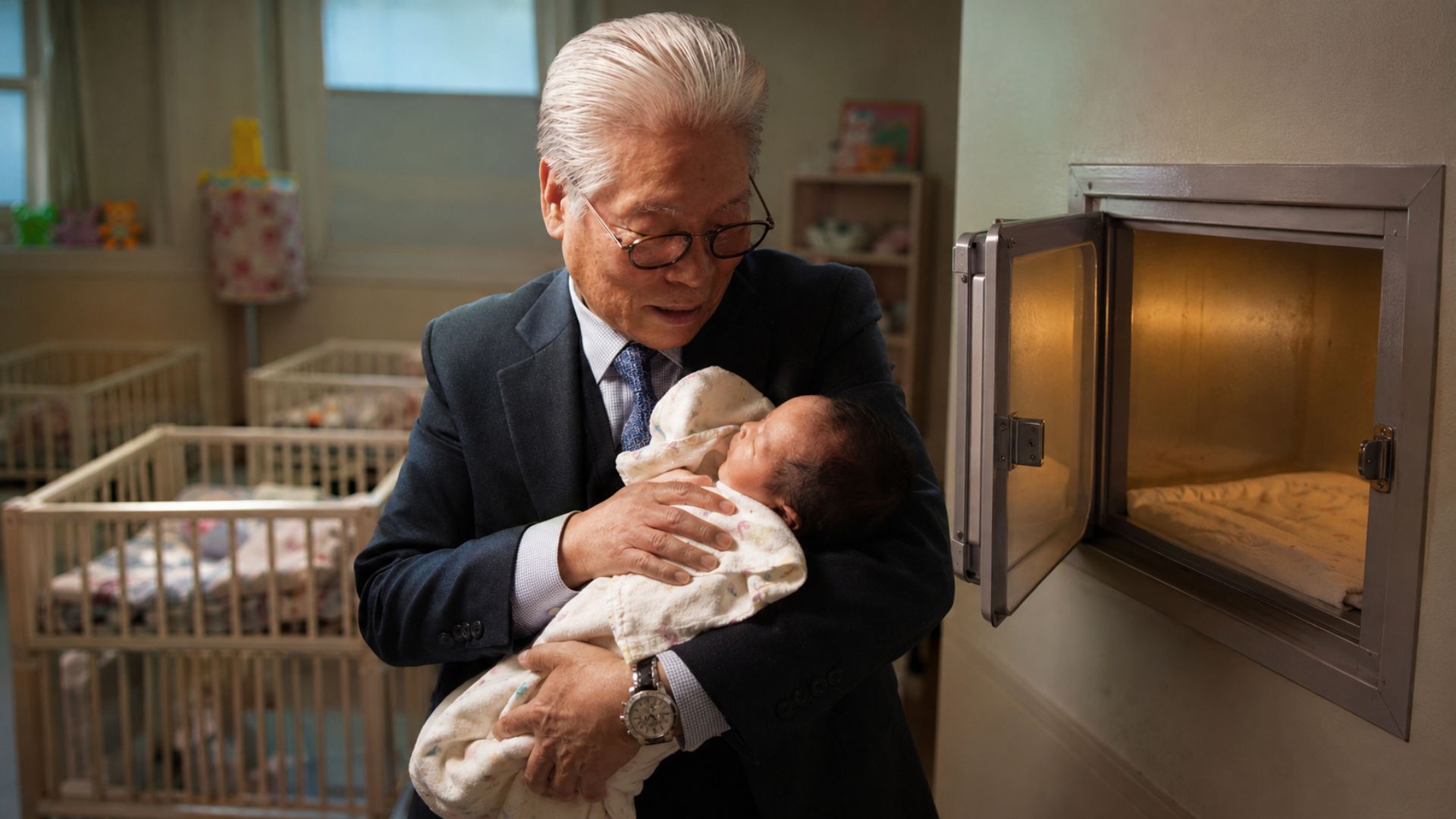


Lee Jong-rak is over seventy years old, has nine adopted children with disabilities, and a box in the wall that remains heated twenty-four hours a day on a street in Seoul. Since 2009, it has received more than two thousand babies whose mothers left without leaving even a name behind.
In 2009, a pastor named Lee Jong-rak built, with the help of a friend who owned a hardware store, a small opening embedded in the wall of a building in Seoul. The box in the wall remained heated, lit, and watched from that day on. Any parent could open it, place a newborn inside, and leave without revealing their own name, without registration, without judgment. The alarm would go off as soon as the door closed, and someone would rush there in seconds.
What started as a solitary initiative turned, over seventeen years, into something South Korea had not seen before. More than two thousand babies passed through this box in the wall, according to the documentary “Korean Next Door,” produced by Howdy Korea. Many had disabilities. Some came from desperate teenage mothers. Others arrived at dawn, wrapped up, left by women whom society had expelled even before the baby was born. Lee Jong-rak stood at the door of each one.
A box, an alarm, two or three seconds
The mechanism is simple, but what it represents is not.
-
Wave Rock: Australia’s Giant Granite Wave Stands 15 Meters Tall, Spans 110 Meters, and Showcases 2.7 Billion Years of Erosion in the Australian Desert

-
How to Unclog Showerhead Holes Blocked by Limescale and Hard Water Without Replacing or Hiring a Technician

-
Award-Winning Korean Electric Scooter Concept Folds to Briefcase Size, Eases Transport Challenges

-
YouTuber Discovers Surreal Collection in 400-Year-Old Italian Fortress Near Florence: 419 Anvils, Giant Walruses, Ancient Church, and WWII Tunnels



The opening is embedded in the wall of the building where the pastor lived for years. When someone places a baby and closes the door, an alarm goes off immediately.
The staff who watch the place all night run outside, not only to collect the child but also to try to reach the parent before they disappear.
The aim is not to punish. It is to offer a last chance to change their mind.
According to the documentary, the pastor describes the response time as two or three seconds after the baby is placed inside the box.
It’s a small detail, but it says everything about how this place was designed. It is not a depository. It is a listening post with human warmth embedded in the masonry wall.
Who are the mothers who come here
Lee Jong-rak lists them without hesitation: high school students, migrant workers, women pregnant with children conceived in situations of violence within their own families.
Women who tried to send resumes to support a child and were not hired because the pregnancy was on record.
Women who heard from their own parents that they were no longer their daughters.
One of the cases the pastor cannot forget is that of a student in her second-to-last year of high school.
She climbed a mountain behind the school with the intention of burying the baby as soon as it was born. She dug a hole in the ground, but the more she tried, the more the newborn cried.
She descended the mountain, carrying the child in her arms, and walked to the box. The baby arrived healthy, according to the pastor’s account in the documentary.
The law that the pastor helped to create
Before the box existed, and before specific legislation, birth in a hospital automatically linked the child to the mother’s record.
For women in vulnerable situations, this meant exposure, social pressure, and, in many cases, the death of the newborn due to abandonment in unsafe conditions.
Lee Jong-rak identified this problem before any official instance and was the first to publicly raise the need for change.
He pressured legislators for years until a law guaranteed the right to anonymous childbirth, according to the narrative of the Howdy Korea documentary.
With the measure in effect, fewer babies were left in the box, which, for the pastor, is exactly the expected result.
The goal was never to increase the number of children placed there, but to reduce the number of deaths. The law and the box work together, as two responses to the same problem.
The children he did not let go


Over the years, Lee Jong-rak adopted nine children with disabilities. Not symbolically. He raised them, lived with them, lost some of them, and cried for each one.
On the wall of his building, there are photographs of children who passed through there, some adopted by other families, some he himself took in, some who did not survive.
Hanna’s story is the most present. She did not arrive through the box. She came in the early days when doctors brought babies with no destination.
She had anencephaly, a condition where the brain does not develop. The doctors did not expect her to live.
The pastor could not part with her. When Hanna died, he says he stopped the car in the middle of the road and cried so much he couldn’t drive.
It was at that moment, according to him, that he decided to legally adopt all the children he had taken in.
Lee Eun-man: the son who came before everything
Before the box, before the ministry, there was a biological son named Eun-man.
The name means “full of God’s grace.” He was born with total paralysis and lived his entire life bedridden. He died in 2019, at the age of 32.
It was Eun-man who transformed Lee Jong-rak. The pastor says that before that, he only thought about personal success. The idea of becoming a minister was the last thing he considered.
The Eun-man Foundation, named after his son, was created to expand the work that began with the box in the wall.
It maintains a temporary shelter for children in emergency situations, awaiting evaluation for adoption or referral to institutions.
The pastor repeats his son’s name several times during the documentary. It’s a name he never seems to tire of pronouncing.
A full house, a wife with Alzheimer’s, and no retirement
Today, Lee Jong-rak lives with more than thirteen adopted children, some legally, others in spirit, as described in the documentary.
The routine includes bathing, dinner, visits to the rooms of bedridden children, and checks on the foundation’s new facility.
He no longer dines with the children frequently. He dedicates that time to caring for his wife, who suffers from Alzheimer’s.
The building does not receive government funding. It operates with donations, volunteers, and prayers, according to the pastor himself.
When the documentary team asks if he is not tired, he responds that it is just his daily routine.
And when asked how he wants to be remembered by the children, he says he would prefer not to be remembered for the effort.
“I hope our children become people needed by society and those who are going through difficulties”, he stated, as recorded in the Howdy Korea documentary.
What the box in the wall says about South Korea
Mes Aynak is a mine. The baby box is something else: a mirror.
It exists because South Korea, despite rapid economic development, maintains rigid cultural structures that punish certain women with total exclusion.
Being a single mother, young, a migrant, or a victim of domestic violence still carries a social cost high enough to lead someone to climb a mountain with a newborn in their arms.
Pastor Lee does not solve this problem. He addresses its most extreme consequences.
But the existence of the box and the law that he helped create show that an individual can move structures, even if slowly.
Seventeen years later, the box remains heated. The alarm keeps working. And Lee Jong-rak continues to appear.
Does the baby box created by Pastor Lee Jong-rak save lives or cover up a social problem that Korean society needs to address differently? Should the model be replicated in other countries? Leave your opinion in the comments.