Portuguese
  Spanish


Without chlorine, without sand filter, and without that chemical smell, the natural pool of an ecological lodge in Bali functions like a small ecosystem. Stone cascades, plant roots, and a population of fish and shrimp do the work that would normally be done by a machine.
The scene that opens the report from the Thriving with Nature channel looks like that of any modern backyard: a pool of clear water, with stone edges, next to a restaurant. The detail is that no chlorine enters there. Presented by Haley Weatherburn, the episode shows the natural pool built by Norm van Hoff at the Bali Eco Lodge, an ecological lodge on the Indonesian island of Bali. Instead of chemical treatment, the water is kept clean by plants, cascades, and creatures that live inside it.
The proposal reverses the logic of the common pool. Instead of chemicals, the system uses gravel and root filtration, aeration by the cascades, and constant water circulation, as van Hoff explains in the interview. He states that he always rejected the idea of a chlorine pool and recalls that even saltwater pools contain the product. The lodge already had a clean stream on the property, but it was distant, and the pool was born from the desire to have a place to swim without giving up the natural appeal.
How a pool without chlorine works
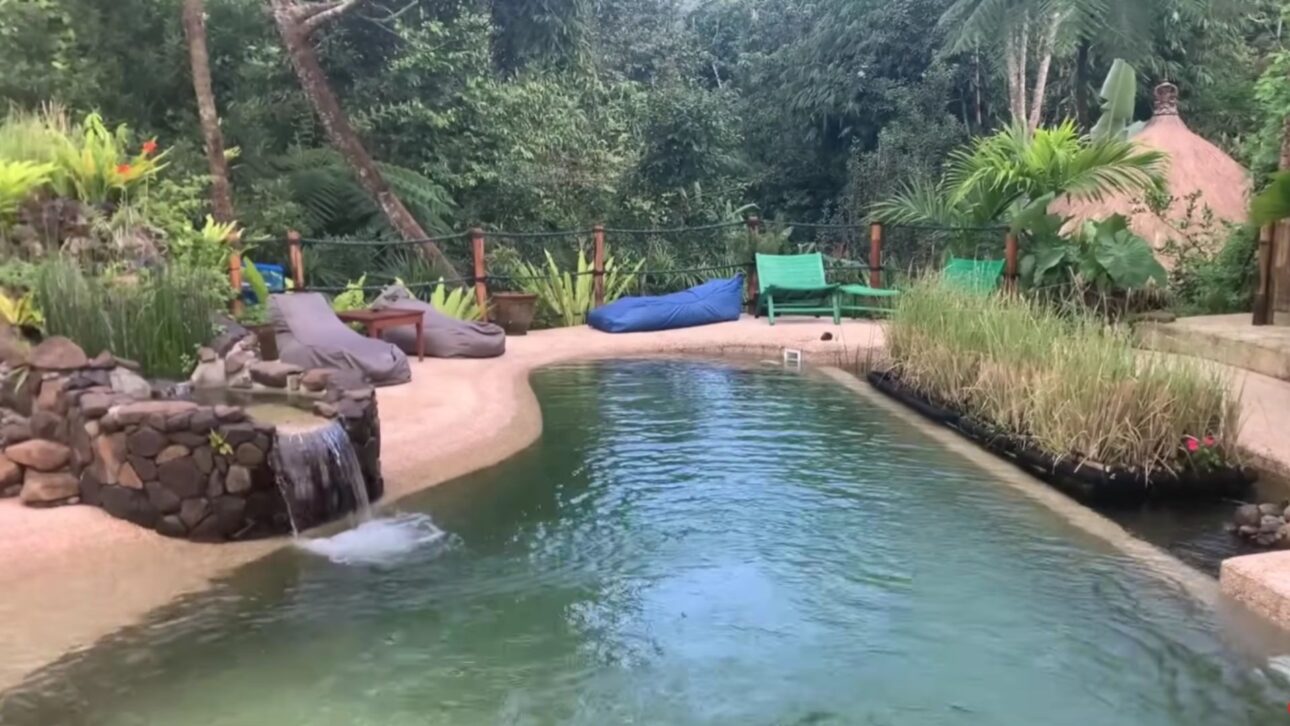
According to the builder’s description, the constantly moving water mimics a stream, the gravel retains particles, and the plant roots absorb the nutrients that would feed the algae.
-
Affordable Housing Project in Brazil’s Mato Grosso Aims for 700 Deliveries and $34 Million in 2026, Outpacing Major Developers in High-Demand Areas

-
Brazil’s Largest Port to Accommodate Bigger Ships by October as Ibama Approves Non-Explosive Removal of Hidden Rocks and Sediments
-
Mexico Develops 3D-Printed Concrete from Corn Waste, Cutting Emissions by 70% and Reducing Construction Waste by 90%
-
Traditional Mortar to Decline by 2026: ACIII-E Solution for Large Porcelain Tiles Offers Better Adhesion and Reduces Risk of Loose Pieces in Floors and Facades


Keeping the nutrients low is the central point of the system because it is their excess that clouds the water and favors algae growth.
Van Hoff summarizes the philosophy by saying that you just need to provide the basics for life, and it takes care of the rest.
The setup relies on two treatment systems running in parallel.
One of them is a sequence of five waterfalls, where the water rises through gravel beds and is filtered and oxygenated at each drop.
The other is a wetland, a kind of controlled swamp, with rafts where plants with long roots grow and dive into the water.
Both paths pull particles and nutrients out, keeping the set transparent with little intervention, according to what was shown in the video.
Vetiver and the Roots that Filter the Water
The plant star of the project is vetiver, a deep-rooted grass widely used in wastewater treatment.
Van Hoff states that the plant adapts well to nutrient-poor environments, precisely the case of a clean pool, and therefore thrived there where more common swamp species, like papyrus and reeds, did not succeed.
The roots of the vetiver form a dense mesh beneath the rafts, which functions as a living filter for particles and nutrients. These same roots also serve as a shelter for the shrimp and fish in the system.
The fauna is not just for decoration. Small fish, shrimp, and frogs inhabit the pool and participate in the balance, says the builder.
The frogs, in particular, are treated as bioindicators: their presence usually signals good quality water, as these animals are sensitive to pollution.
It’s an arrangement where each element, from the plant to the amphibian, fulfills a function within the cleaning cycle.
The So-Called “Fish Manicure”
The most curious detail of the system led to the joke that becomes the hook of the report.
The small fish nibble on the skin of anyone who stands still in the water, in an effect similar to the fish immersion spas popular in Southeast Asia.
Van Hoff jokes that the guest gets a free fish manicure, just by staying still for a while in the pool.
The comparison is with those paid tanks where people put their feet for the little fish to clean the skin.
For those who wrinkle their noses at the idea of sharing the water with schools of fish, there is a logistics in favor.
According to the builder, most of the fish retreat to the wetland during the day and only circulate more at night, when no one is swimming.
At night, by the way, with the lights on, the pool resembles a large aquarium, describes the presenter.
During the day, it functions like a conventional pool, with the difference of not leaving anyone smelling of chlorine.
The Controversial Inspiration of Viktor Schauberger


A good part of van Hoff’s ideas comes from a controversial name.
He cites Viktor Schauberger, an Austrian naturalist who lived between 1885 and 1958 and studied the movement of water.
Schauberger argued that water containers should not have sharp corners because water moves in curves and sharp angles accumulate sediment and bacteria.
For this reason, the pool was designed with rounded edges, avoiding dead zones where dirt would deposit.
A note of caution is warranted here. Although the practical recommendation to round corners makes sense in the design of tanks and reservoirs, some of Schauberger’s theories on “revitalization” and “implosion” of water are classified as pseudoscience and do not have established scientific support.
Similarly, statements appearing in the video about water “revitalizing cells” or being so pure as to be drinkable should not be read as proven fact, but rather as the interviewees’ impressions of their own experience.
The sensitive point of sunscreen
Living off the ecosystem has its demands, and one of them involves the guests.
Van Hoff acknowledges that sunscreen can harm life within the pool and says he prefers to advise people to avoid the product before swimming.
Even so, he considers that the system needs to be robust enough to withstand small disturbances, as some visitors will use sunscreen or other substances on their skin.
The idea is that nature absorbs small aggressions, and the problem only appears when there is an overload.
This balance between human use and ecosystem preservation is what makes the project more delicate than a regular pool.
It is not an inert tank, but a living ecosystem that reacts to what enters the water.
The builder himself admits that discovering which plants worked there was a process of trial and error over time, and that vetiver ended up being one of the biggest successes.
The natural pool at Bali Eco Lodge, shown by the channel Thriving with Nature, is an example of how design and ecology can combine to dispense with chlorine.
Waterfalls, gravel, vetiver, and an active fauna keep the water clear with low maintenance, according to the system’s builder.
It’s worth separating what is applicable technique, such as root filtration and design without sharp corners, from the more enthusiastic claims about the powers of water, which remain unproven.
And you, would you swim in a pool with fish, frogs, and shrimp instead of chlorine? Do you find the idea of a natural pool appealing or do you prefer conventional treatment? Share your opinion in the comments and, if you already know a similar system, share your experience. We want to read different points of view on the subject.