Portuguese
  Spanish


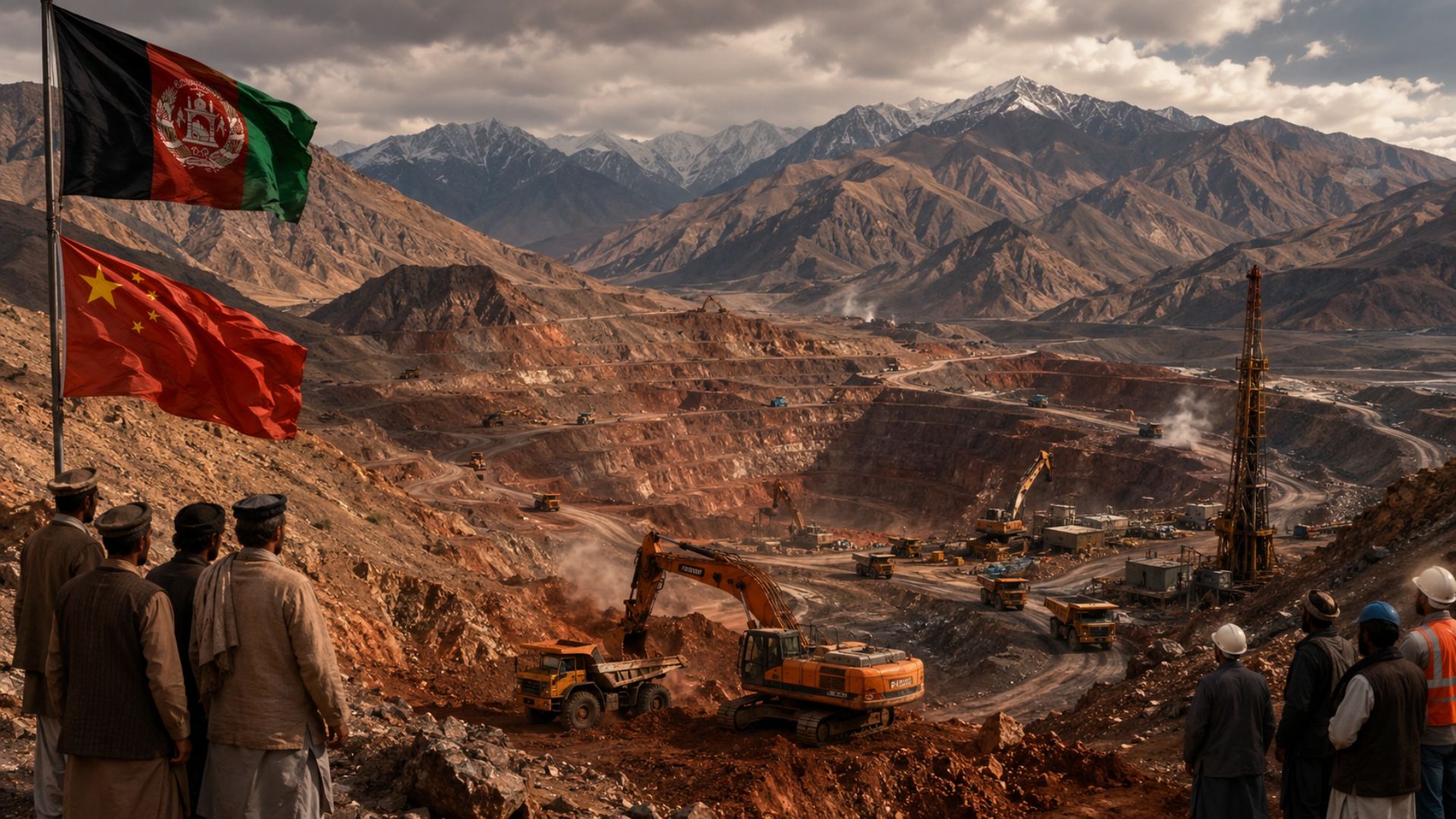

The Mes Aynak mine, located 40 km from Kabul, holds one of the largest intact copper reserves in the world. China entered this game in 2007 and, almost two decades later, the project remains stalled between billion-dollar promises, political instability, and a Buddhist archaeological site that no one quite knows how to preserve.
In 2007, a Chinese consortium led by the Metallurgical Corporation of China (MCC) signed a contract with the Afghan government to exploit the Mes Aynak copper deposit in Logar province. The deal was announced at the time to be worth around 2.8 billion dollars, with economic projections reaching much higher figures depending on the actual size of the reserves, according to a report published by Global Voices. It was supposed to be a game-changer for the poorest country in Asia. Almost twenty years later, the mine has yet to start operations.
The project returned to the radar in 2024 and 2025, when Taliban authorities and Chinese representatives resumed practical negotiations and announced the start of access works to the site. The movement reignited the debate about what Mes Aynak represents: a real development opportunity for Afghanistan or another case where a poor country exports its mineral wealth without seeing concrete changes in the lives of its population. China, in turn, plays a long-term game on a board where other major powers have simply left the field.
The copper the whole world needs

It has no aesthetic appeal nor function as a store of value. It is valuable because it works: it is in power cables, electric motors, wind turbines, data centers, electric vehicles.
-
WHO Warns of Unnecessary Interventions in Natural Births Worldwide, Advocates for More Human-Centered Care, Reigniting Debate on Medicalization

-
World War II American Bombs Discovered in German City Prompt Evacuation of 20,500 Residents

-
World’s Largest Ice Cave Extends 42 km Beneath Austrian Alps, Revealing a Vast Frozen Realm Preserved by Natural Air Currents

-
Volcanic Soils from Destructive Eruptions Turn into Million-Dollar Crops: Ashes Nourish Grapes in Lanzarote, Bananas in the Canary Islands, Blood Oranges on Mount Etna, and Cacti in Mexico, Showcasing How Lava-Formed Lands Sustain Rare Harvests in Seemingly Barren Regions


A combustion car uses a reasonable amount of copper.
An electric vehicle consumes much more. And the more the global economy moves towards electrification, the greater the pressure on available reserves.
It is in this context that Mes Aynak ceases to be just an Afghan problem and becomes a geopolitical knot.
Afghanistan may be sitting on one of the largest untapped copper deposits on the planet, according to estimates cited by Global Voices, while global demand for the mineral continues to rise.
For China, which is the largest consumer of industrial raw materials in the world, securing access to this resource is not just convenient. It’s strategic.
What China Wants with Afghanistan
China already imports copper from Chile, Peru, the Democratic Republic of the Congo, and other countries. But what Beijing seeks is not just to buy on the open market.
The logic is different: to build supply chains that China can directly influence, with long-term agreements, transport corridors, and infrastructure connected to its own factories.
Mes Aynak fits perfectly into this equation.
It is close to Kabul. It is in a country where Western companies hesitate to enter.
And it offers a huge resource at a time when China can gain regional influence without direct competitors, as pointed out by the Global Voices analysis.
What seems like a risk for other investors is, for Beijing, a rare window of opportunity.
Almost Two Decades of Promises and Delays
The 2007 contract was ambitious. It included roads, energy supply, worker accommodations, and local processing capacity.
The Afghan government expected royalties, jobs, and infrastructure.
The Chinese consortium looked at the numbers and saw an equation that didn’t add up so easily: without roads, without energy, without security, and with archaeological ruins in the way, the project became too expensive to move quickly.
Insurgent attacks created constant risk.
Corruption and the institutional fragility of the Kabul government complicated negotiations. Year after year, Mes Aynak remained practically frozen.
The contract existed. The deposit existed. The copper, however, was not coming out of the ground.
In 2021, with the Taliban takeover, the scenario changed but the structural problems remained the same.
A Buddhist City Buried Under the Mine


There is an obstacle that rarely appears in economic analyses about Mes Aynak, but it is central to understanding the delays: the archaeological site.
The area houses the remains of an important Buddhist settlement with over a thousand years of history.
Archaeologists have found monasteries, stupas, statues, murals, coins, and manuscripts scattered throughout the site. Some of the structures date back to the 5th and 6th centuries, according to historical records.
An open-pit mine on this scale cannot coexist with archaeological sites. It removes entire layers of earth and rock, permanently altering the landscape.
Before any large-scale extraction, teams needed to document, excavate, map, and recover what was possible.
This work took time and money, and it is not yet completely finished.
The open question is how much of Afghanistan’s historical heritage will be sacrificed in the name of the copper the world wants.
The project in 2024 and 2025: cautious steps
In 2024, Taliban authorities and Chinese representatives marked the beginning of the construction of the access road connecting Mes Aynak to the regional transport network.
In 2025, discussions advanced to topics of actual mining, according to Global Voices, fueling expectations that the project may finally go beyond roads and enter a more serious development phase.
But the slow pace also reveals something. If China fully trusted the stability of the environment, the project would advance faster.
The roadworks serve as a test phase: they allow the project to progress without taking on the full risk of an immediate large-scale extraction operation.
It is a smart move, but it also shows how fragile the project still is. Mines are slow, expensive, and technical. One obstacle delays the next step.
What Afghanistan truly gains
This is the most difficult question. In theory, Mes Aynak can bring jobs, roads, tax revenue, and the beginning of a real mining industry in a country that has never had one.
Afghanistan has no manufacturing base, no major export industries, and has depended for decades on foreign aid and agriculture. Mining would be a possible way out.
In practice, the history of poor countries with mineral resources and external investors does not always end well for the local population.
The risk of Afghanistan exporting its wealth without transforming the lives of those who live there is real and deserves more attention than it usually receives in public debate.
Local jobs, participation in the processing chain, and monitoring of contracts are variables that will determine whether Mes Aynak becomes development or just extraction.
A long-term bet without guarantees
What the case of Mes Aynak ultimately reveals is the logic of how China thinks about natural resources and geopolitical influence.
It is not a short-term strategy.
It is a careful positioning in a country that everyone else preferred to abandon, made in small steps to test the ground before committing larger resources.
For Afghanistan, the scenario is more ambiguous. The country needs revenue, infrastructure, and employment. Mes Aynak can provide part of that.
But the way contracts are structured, how royalties are defined, and how the archaeological heritage is treated will determine if this project will be remembered as a turning point or as another episode where a poor country ended up losing.
The copper is down there. What no one knows yet is who will benefit when it finally comes out.
Is China making a smart strategic move by investing in Afghan copper, or are the risks too great for this project to go anywhere? Does Afghanistan have real conditions to use mining to build a more independent economy? Leave your opinion in the comments.