Portuguese
  Spanish




The New Phase Of NASA’s Lunar Program Foresees The Launch Of The Space Launch System Rocket In February And Marks A Decisive Step For Human Return To The Moon After More Than Five Decades
The new bet from NASA (National Aeronautics and Space Administration) to resume human presence in deep space is called Space Launch System (SLS). The huge rocket is scheduled for launch on February 6, a date that officially marks the opening of the launch window for the Artemis II mission, considered one of the most ambitious projects of the U.S. space agency in recent decades.
The mission will send four astronauts to orbit the Moon, on a crewed flight lasting approximately 10 days, without landing on the lunar surface. The information was disclosed by CNN Brazil, as detailed in a special report on NASA’s preparations for the new cycle of space explorations, based on official data from the agency.
Before heading to Earth’s natural satellite, the crew will conduct a series of critical checks. Among them are tests of the Orion capsule systems, as well as a target practice demonstration relatively close to the planet, a step considered essential to validate the spacecraft’s safety before the journey toward the Moon.
-
AI Video Generator Automatically Creates Subtitles and Animated Captions

-
São Paulo Unveils Latin America’s Largest Underground Reservoir, Holding 900 Million Liters, in the Greater São Paulo Area

-
Chinese Teen Wins Gold in Germany for Invention Turning Air Moisture into Underground Irrigation in Drought-Stricken Areas

-
Desertification Threatens Brazil’s Caatinga: 85% of Semi-Arid Region Affected, 30 Million at Risk, and Efforts Underway to Restore 10 Million Hectares by 2045




The SLS Rocket And The Artemis II Mission
The Space Launch System is touted as the most powerful rocket ever built by NASA. It will be launched from the Launch Complex 39B, located at the Kennedy Space Center in Florida, the same site used in the historic Apollo program missions.
The Artemis II represents the first crewed flight of the Artemis program and aims to test systems, trajectories, and operational procedures in a deep space environment. Unlike Artemis I, which took place without astronauts on board, this mission will feature a full crew, allowing for real-time human evaluations.
Furthermore, the success of Artemis II will be crucial for the next stages of the program, including future lunar landing missions and the establishment of a sustainable human presence beyond low Earth orbit.
Who Are The Selected Astronauts For The Mission
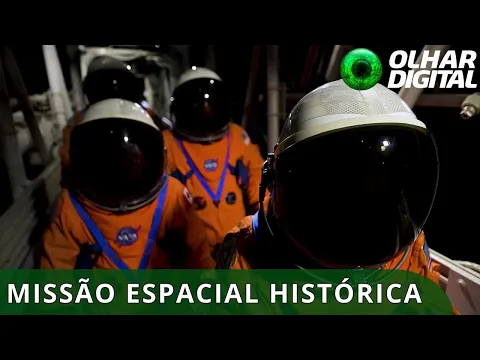

The Artemis II crew brings together highly experienced professionals, with a strong background in space missions, flight testing, and operational leadership.
Reid Wiseman, selected as a NASA astronaut in 2009, has been assigned as the mission commander. A native of Baltimore, in the state of Maryland, he holds a degree in Computer Engineering and a Master’s in Systems Engineering. Throughout his career, Wiseman participated in missions aboard the International Space Station (ISS) and served as the head of NASA’s Astronaut Office from 2020 to 2022.
Victor J. Glover, chosen as the mission pilot, has been part of NASA’s astronaut corps since 2013. He served as the pilot for the SpaceX Crew-1 mission, participating in Expedition 64 of the International Space Station. Born in Pomona, California, Glover has a background in General Engineering and master’s degrees in Flight Test Engineering, Systems Engineering, and Military Operational Arts and Sciences.
Glover’s experience also includes over 3,500 flight hours in more than 40 aircraft, as well as over 400 landings on aircraft carriers and 24 combat missions. In Artemis II, he will become the first Black person to fly farther into space, a historic milestone for space exploration.
Female And International Participation Marks The Crew

The only woman on the mission, Christina Koch will serve as mission specialist. Selected as an astronaut in 2013, she was a flight engineer on the Expeditions 59, 60, and 61 of the International Space Station. Graduating in Science, with a degree in Electrical Engineering and Physics from the University of North Carolina, Koch holds the record for the longest single spaceflight completed by a woman, with 328 consecutive days in space.
Additionally, Christina Koch participated in the first spacewalks conducted exclusively by women, cementing her position as one of the most experienced astronauts of the current generation.
Completing the crew is Jeremy Hansen, an astronaut from the Canadian Space Agency (CSA), who will make history as the first Canadian to be part of a crewed mission to the Moon. Recruited in 2009, Hansen participated in the CAVES program of the European Space Agency in 2011, spending six days in a subterranean environment in Sardinia, Italy.
In 2017, he became the first Canadian to lead a class of NASA astronauts, responsible for training candidates from both the United States and Canada. He holds a degree in Space Sciences and a master’s degree in Physics, focusing on research in widely-viewable satellite tracking.
Source: CNN Brazil