






 Portuguese
  Spanish
  7 min of reading
  1 comment


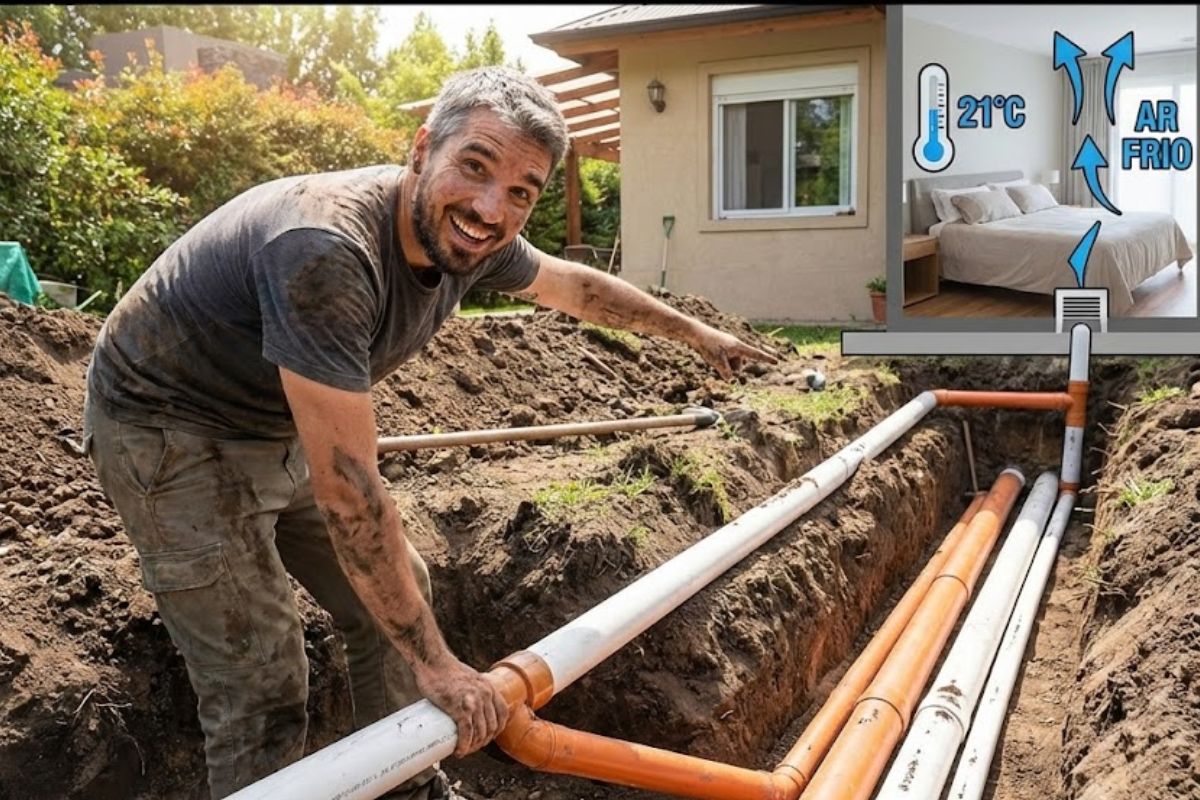


Since 2022, Martin has buried a PVC pipe in a trench of about 6 meters, up to 70 cm deep, to bring fresher air, without spending energy, to his children’s rooms. The entrance receives a rain hat, a mosquito net, plants around, and drainage with a T-connection.
The cooling system that Martin set up at home starts from a simple idea: to make the air pass through the soil before entering the rooms, using the earth itself as “thermal mass” to soften the heat. Instead of machines, he invested in buried pipes, branching the flow to two rooms where Facundo and Uma sleep.
What stands out is not just the result described by users of the system as “pleasant and fresh” on the hottest days but the path to get there: a project done gradually, starting in 2022 and completing slowly, with meticulous details of sealing, drainage, and water and insect protection, precisely where many similar projects tend to fail.
When The Soil Becomes Part Of Cooling, The House Changes Its Role

The principle that Martin follows is the same associated with the Canadian or Provençal well: external air enters through a specific point, travels through an underground section, and reaches the rooms after passing through a “corridor” of earth.
-
A 10-year-old girl in Manaus created a styrofoam buoy with a sensor to detect trash in streams, became the sole representative from Latin America in an international challenge in London, and turned the pollution she saw near her home into a sustainable invention.

-
It was neither a crash nor abandonment; this retired plane left the airport in parts, crossed Costa Rica on trucks, and ended up becoming a suite in the heights with daily rates exceeding R$ 2,000.

-
She panicked when she saw her daughter fall from the crib; years later, she turned the experience into a factory generating R$ 9 million per year.

-
At 75 years old, João José de Carvalho, known as Mr. Janjão, was accepted for the second time by Sisu after overcoming distance, physical limitations, and years away from school, to fulfill his dream of studying Biological Sciences at UFPI.



The logic does not depend on ice or “miracles”: it depends on how the underground environment tends to be more stable than the air exposed to the sun.
In practice, the cooling is born from the design of the pathway. It is not the pipe alone that works magic: it is the combination of “well-chosen entry + buried duct + exit in the rooms + drainage path” that creates conditions for the air to arrive with a different thermal sensation.
The resident himself makes a point of framing it as a passive climate control system, designed to lower the temperature during the hottest periods.
The Air Entry: Where What No One Sees Inside Begins

The starting point is on the side of the house, where the air entry point is visible. He describes that the air “falls,” going about 70 cm below the surface and following through a duct that later branches into two: one feeds Facundo’s room and the other goes to Uma’s room. This branching choice is crucial for the cooling not to be concentrated in just one room.
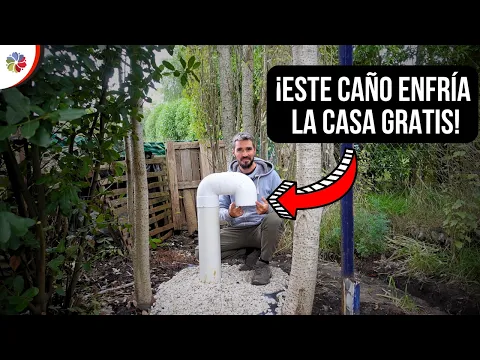
The protection of this entry is also part of the system, not just an aesthetic detail. Martin uses a “hat” to prevent water from entering and a mosquito net to avoid insects, treating the intake point as a sensitive interface between the external environment and the house’s interior. If the air enters dirty, too hot, or with water, the whole system starts working against you and the entry is where this is defined.
Sealing, Humidity, And Drainage: The Less “Instagrammable” Side Of Cooling
When cooling the air, an effect that he considers inevitable arises: humidity can condense on the walls of the pipe, forming water that needs to be conducted in a controlled manner. That is why he emphasizes that projects with PVC usually foresee drainage points and that he preferred a design where the entry does not make a curve but enters with a “T,” so that the accumulated water has a way to drain.
In addition to the “T,” the buried section was designed with a negative slope toward this point, precisely to facilitate drainage. He also describes a small drainage “well” and the continuity of the water pathway to another exit point. Without drainage, what seems like just a duct turns into a problem collector: accumulated water, odor, performance loss, and infiltration risk.

The sealing of the crossings was also treated as a critical step. To take the ducts inside, the resident drilled holes in the building’s cement base, placed a can as a passage element, applied polyurethane foam to seal joints, and finished with cement.
The intention was to keep the interior “organized” and well-finished, reinforcing that cooling does not have to be visible improvisation; it can be integrated and clean.
Materials, Reuse, And The Trench As A Home Engineering Work
The trench of approximately 6 meters became a workshop of practical creativity. He shows that he used recycled materials like bricks, porcelain tiles, ceramics, metal sheets, and whatever was available as a type of “fork” or base to later cover with soil.
The covering layer does not appear as mere closure, but as part of the package that protects, shapes, and sustains the system over time.
In a specific section, he reports that he covered the trench with a kind of “Roman” arch made with a wooden structure and bags with a mixture of earth and cement, creating a firm cover.
The empirical proof, for him, came with time: he started implementing it in 2022 and, even while still finishing details, he claims to have gotten stuck in the trench and the arch held up. Passive cooling, in this case, is not separate from civil work: it depends on it.
Where To Catch The Air: Hemisphere Orientation And The Strategy Of Plants
Martin treats the air entry location as a fine adjustment that can define performance and air quality. He recommends that the intake be in a cool place and, when discussing hemispheres, suggests: in the Southern Hemisphere, entries to the south of the house; in the Northern Hemisphere, to the north.
The idea is simple: position where direct sunlight and heating of the surroundings are minimized.
He adds a detail that reveals a dual concern temperature and the feeling of “pure air”: having plants near the entry.
He cites species and describes the environment as a green spot, with vegetation around, arguing that plants help lower the air temperature in that microclimate and make the air more pleasant even before it descends underground. It’s not just cooling: it’s choosing where the air comes from.
Convection, Optional Fan, And The “Motor” Invisible To The System
When explaining why it works, Martin places convection at the center. He describes the displacement of a fluid from cold to hot as a mechanism that creates a kind of “suction,” linked to the temperature differences inside the house. In other words: the warm air “pulls” the system, and the air coming from the underground pathway occupies the space, creating flow.
He also dismantles a common reading that “cold rises” as the main cause and insists that the perceived effect is a consequence of the thermal gradient and the air movement associated with the heating of certain areas of the house, especially those receiving more sun.
That’s why he mentions the next step: creating a solar chimney on the roof, above heated areas, to increase convection and promote air renewal. Passive cooling is not just about burying pipe; it’s about designing the air’s journey from start to finish.
Even while defending the passive nature, he admits a possible boost: adding a fan. He mentions another “miniature” system that already uses a strong fan to cool a room and two offices, and says he intends to add one to the bedrooms’ system as well.
Here, the proposal is not to “betray” the concept but to provide control when natural flow is insufficient as if the cooling were gaining an accelerator for extreme days.
Depth: The Myth Of 2 Meters And What He Tested On His Own Land
One of the most repeated points in discussions about Canadian/Provençal wells is the “ideal” depth. Martin directly confronts the rigid rule of 2 meters and states that he does not consider it mandatory for the cooling to work.
He cites experiences with trenches at different depths 40, 50, 60, and 70 cm saying that, in all cases, he obtained functionality.
At the same time, he recognizes a limit: when it comes to a truly large system, with 2 meters of depth, the logic would change, requiring much larger pipes (he mentions larger diameters) and, if possible, materials like cement.
He criticizes the idea of just digging deep and throwing a PVC pipe of a certain size, considering this ineffective for significantly altering temperature. The practical message is less “manual” and more “project”: depth matters, but it does not replace sizing, pathway, flow, and drainage.
What Worked, What Was Left For Later, And The Real Risk Of Water Ingress

In the end, the resident himself opens up about the side that often gets left out of the “nice” cuts: “not everything is rosy.”
He anticipates that there was a problem with water ingress in the room and intends to explain what happened and how to avoid it, relating the incident to the long construction time — a system initiated in 2022 and completed gradually, in stages, with adjustments along the way.
This final point is important because it removes cooling from the realm of the perfect promise and places it in the territory of real use: buried pipes, by definition, coexist with humidity, rain, soil, sealing, and maintenance.
The comfort gain may come with the obligation to think about drainage, inspection points, and finishing, especially when construction is handmade and evolves over time.
The cooling with buried tubes, inspired by the Canadian/Provençal well, appears here as an intelligent design of air flow: protected intake, underground pathway, branching for rooms, careful sealing, and drainage designed so that condensation does not turn into infiltration. The result, according to those who use it, is a more pleasant room on hot days with the honesty of recognizing that adjustments and unforeseen events are part of the package.
If you could test such a cooling system in your home, where would you place the air entry: near plants, in a shaded area, or at another point? And, being very honest, would you trust a completely passive system more or would you add a fan from the beginning to ensure flow on stuffy days?







Ele vai conseguir uma redução bem expressiva na temperatura se passar a utilizar os tubos (manilhas) de cerâmica (barro), além da redução nos custos, por serem mais baratos. E para incrementar um pouco mais a eficiência da entrada de ar no ambiente é so colocar um exaustor na parede posterior a entrada da tubulação alimentado por energia solar.