






 Portuguese
  Spanish


Articulated Chassis, Inclined Wheels, Swing Circle, Moldboard, and Rear Tandem Work Together to Make Any Terrain Truly Flat, Stable, and Finely Finished on Site, Road, or Farm.
When we see a grader working, it looks like it just passes the blade on the ground and that’s it, as if that alone would make any terrain truly flat. But behind that “simple” pass is a machine full of coordinated systems, all operating at the same time to control direction, traction, blade height, and stability.
In practice, the blade is just the tip of the iceberg. For the terrain to be genuinely smooth, the grader needs to maintain a constant speed, with all wheels firmly on the ground, correct the lateral force of the material, absorb terrain irregularities, and also allow very fine adjustments to the blade all the time. It’s the sum of all this that makes the grader deliver a finish that other earthmoving machines cannot achieve.
It’s Not Just Passing the Blade: the Real Role of the Grader

What everyone sees first is the blade, but the final result depends on the whole machine working in harmony.
-
A fossil kept for years in a small museum in Montreal concealed 450-million-year-old soft tissue, a discovery that has only happened once before in history.

-
Three teenagers transform cut cardboard into Japanese origami-style packaging that promises to retire styrofoam and bubble wrap, win a $12,500 prize, and target giants like Amazon, FedEx, and Home Depot after a robot motor arrived broken.

-
The large jar blender has a rival: Oster Ultra Power bets on 1,000 W, six stainless steel blades, and two portable cups with leak-proof lids.

-
Tesla injected an additional $250 million into the German factory, doubled the battery cell target, and opened its own production line for startups.



While the blade cuts, pulls, and spreads the material, the articulated chassis keeps the machine aligned in the right direction, the front wheels help counter the lateral force that arises when the material flows to the side, and the rear assembly ensures constant traction so the grader doesn’t “slip” on the terrain.
That’s why no component works alone. The grader was designed precisely to transform raw power into fine control.
The goal is not just to remove dirt, but to control the material in a way that truly makes any terrain truly flat, with the right slope, no bulges, and no waves.
Blade, Swing Circle, and Moldboard: The Trio That Commands the Cut

The grader’s blade is not just made to push dirt forward. It cuts, grades, and finishes.
The operator can tilt the blade forward or backward, change the angle of attack, and adjust the height with minimal movements of the controls.
Thus, when the ground is hard and compacted, the blade operates more aggressively. When the idea is just to finish, it works more level, taking the minimum material.
Additionally, the blade can move laterally without the machine moving, which is essential for working near curbs, road edges, slopes, and ditches.
Between the blade and the chassis is the swing circle, a large toothed ring that allows the blade to pivot in various directions while still working and pushing weight.
What makes this happen is an assembly with a hydraulic screw mechanism, capable of generating high torque and holding position even under stress.
To prevent damage when the blade hits something very hard, the slip clutch protection system activates, which slips when the force exceeds a safe limit.
In practice, this absorbs part of the impact and protects the internal mechanism, allowing confident operation even on surprise-filled terrain.
Between the chassis and the swing circle is the moldboard, an “A”-shaped structure that transmits the machine’s effort to the blade. It ensures stability when the blade encounters resistance in the ground.
At the end of the bar, the famous “moldboard ball” allows the assembly to move at various angles at the same time, without locking the movement and without losing strength.
It’s a relatively small piece compared to the machine, but it allows the blade to work freely while providing enough grip to cut the terrain in the right line.
Inclined Wheels and Oscillating Axle: How the Machine Maintains the Line

When the blade starts to cut the soil, the material flows to one side. In this flow, a lateral force arises trying to push the grader to the opposite side. If nothing was done, the machine would go off course and the finish would be crooked.
To compensate for this, the front wheels can be tilted toward the side where the material is flowing. This tilt helps overcome the lateral force and keep the machine on the correct trajectory.
At the same time, the front axle is oscillating, allowing each wheel to follow the terrain’s irregularities while maintaining contact with the ground.
This means that even on uneven surfaces, the wheels remain grounded and the tilt remains effective.
It’s not just the hydraulic steering that keeps the course steady. It’s the combination of wheel geometry, oscillating axle, and tilt that helps the grader hold the work line firmly, while the blade performs its job below.
Articulated Chassis: Giant That Maneuvers in Tight Spaces
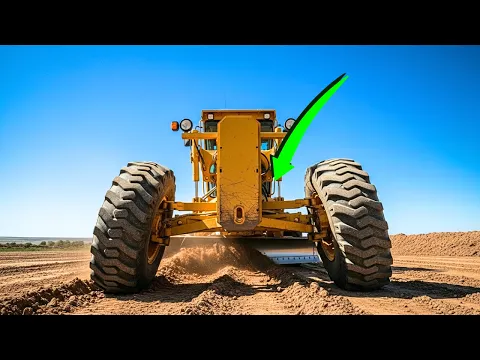

Another detail that goes unnoticed is that the grader is not a rigid block from beginning to end. It is divided into two parts connected by a reinforced central pin.
With hydraulic cylinders, the machine can “break” in the middle, changing the alignment between the front and rear.
This greatly reduces the turning radius and allows maneuvering in tight spaces, road edges, and approach areas near curbs and slopes.
In practice, this articulation enables the front part, where the blade is located, to come closer to the work area, without pushing the rear off the path.
Combined with wheel steering and blade adjustments, this feature provides positioning freedom that makes a significant difference in delivering fine finishes in challenging sections.
Rear Tandem: Where the Power Meets the Ground

At the back of the grader, it’s the tandem that transforms power into real traction. It is there that the movement generated by the engine and transmission reaches the four rear wheels.
In many classic designs, the transfer is done through internal chains working inside the housing, bathed in oil, transferring movement from the central axle to the wheels. This ensures constant traction even when the machine faces uneven terrain.
The tandem itself can oscillate slightly. This “rocking” is not a defect; it is by design. It serves to ensure that the rear wheels follow the ground undulations, maintaining constant contact with the ground.
In total, there are six wheels, with the four rear ones responsible for keeping the grader firm on the terrain. This stable base allows the blade to work safely without the machine losing line or slipping in the middle of the cut.
Engine, Transmission, and Cabin: Fine Control in the Operator’s Hands
To make any terrain truly flat, strength alone is not enough; the grader needs control. This is where the engine, transmission, and cabin come in.
Many models use PowerShift transmissions with multiple gears, allowing for precise speed adjustments during both heavy cutting and finishing.
More gear options mean finer control in forward movement, which is crucial in a machine where half a centimeter more or less makes a difference in the result.
In the cabin, the operator needs to clearly see the blade and have controls that respond quickly. Therefore, it’s common to see electronic controls, joysticks, and a layout designed for ergonomics and visibility.
In the end, the grader is a combination of heavy mechanics with simple controls, translating a lot of articulation, hydraulics, and transmission into smooth movements in the operator’s hand.
Why It Can Make Any Terrain Really Flat
When you combine an adjustable blade, swing circle, moldboard, inclined wheels, oscillating axle, articulated chassis, and rear tandem with firm traction, the result is one thing: real capability to make any terrain truly flat and well-finished.
While other equipment removes or moves material in a more brute way, the grader is designed to refine, correct, align, and provide the final finish.
That’s why it appears on road construction, yards, farm access roads, internal farm tracks, and anywhere the floor needs to be stable, smooth, and with the correct slope.
And you, which part of the grader surprised you the most when it comes to making any terrain truly flat: the inclined wheels, the articulated chassis, or the tandem in the back doing concealed work?


