Portuguese
  Spanish


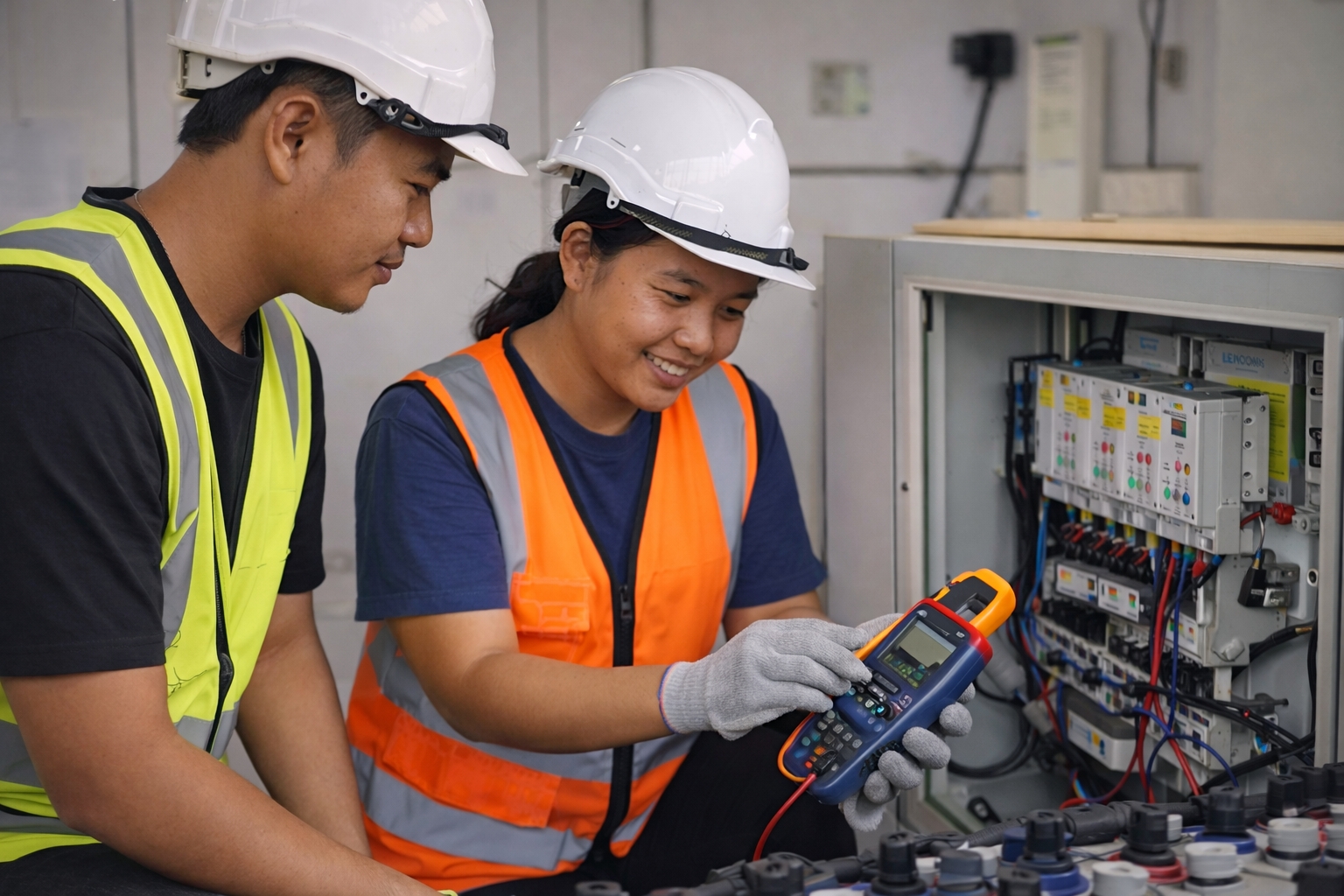

A Program In Sarawak Puts Residents At The Center Of Renewable Energy, Creates Local Workforce And Turns Stable Electricity Into Routine For Villages That Once Depended On Diesel And Kerosene.
Two young people from Sarawak, on the east side of Malaysia, entered a solar energy project like someone taking a side job and came out with a profession, a certificate, and a responsibility that changes the life of an entire village. Unjam Anak Makam and Maja Anak Mabang did not grow up thinking about rural electrification, power grids, or maintaining solar systems. But that is exactly the path they took.
Their story begins when the construction of small solar plants came close to home. The Sarawak state government set up a program to bring electricity to rural areas using renewable sources, and along with the project came the decision that changed everything: to hire people from the community, train them, and keep the knowledge there, instead of forever relying on outside teams.
Unjam and Maja started with basic tasks, transporting materials, installing cables, and construction support. But with good performance, their routine changed. New stages came, such as electrical wiring, installing solar systems, and hands-on training with battery technologies. In a short time, what seemed like temporary work turned into a permanent job and career.
-
Exceptionally Rare 3rd Century AD Discovery Unveils Bronze Surgical Tool for Bladder Stone Surgery Near the Temple of Hercules in Ancient Roman City Heraclea Sintica

-
Astronauts Returning from Space Show Altered Gut Bacteria and Loss of Protective Microbes, Highlighting Potential Risks for Mars Missions

-
Electrolux Unveils Smart Washing Machine Line with 12kg Capacity, 45-Minute Cycle, Automatic Dosing, Dirt Sensors, Sanitizing Steam, App Control, and User-Guiding Display
-
Realme Launches Affordable 16x 5G Phone with Military Certification, 6,600 mAh Battery, 50 MP Camera, and 6.8-Inch Screen Starting at $320




SARES: Rural Electrification That Does Not End When The Truck Leaves
The project that organizes this turnaround is the Alternative Rural Electrification Program of Sarawak, known by the acronym SARES. It is implemented by the state-owned company Sarawak Energy Berhad and carried out by designated companies to develop the plants, such as Ecogreen Solar Engineering, which also hires locally.
The logic is simple and brutally efficient. Power arrives and the ability to maintain that power comes along. This avoids the classic infrastructure problem in remote areas: the system works until it breaks, and when it breaks, no one knows how to fix it, no one has parts, no one has training, and everything goes back to darkness.
In the SARES model, residents receive basic maintenance training, learn how to operate the system day-to-day, and begin to solve some problems without waiting for an external team. Unjam and Maja, after being hired and certified, also started helping with these community trainings, creating a domino effect of knowledge.
This type of strategy fits into a larger challenge of the energy transition. It is not enough to promise megawatts. There needs to be qualified people to install, operate, and maintain what has been installed. And the cost of this workforce is high.
Lack Of Green Professionals Became A Bottleneck And The Transition Depends On Training
Estimates from the Malaysian government indicate that to reach the national goal of up to 70% renewable energy by 2050, 62,000 qualified workers will be needed. However, the supply does not keep pace. This is where technical and vocational education comes in as a central piece. The proposal is to integrate green skills into curricula, accelerate certifications, and place hands-on training as a bridge between school and work.
Maja went through a training program linked to the construction sector and describes the leap very directly: first job, new skills, learning on the job site, and then a professional path that did not exist before. This is the face of a people-centered energy transition, with workforce planning, skill development, community resilience, and energy literacy.
And there is another point that makes this story bigger than it seems. Malaysia is not only talking about rural electrification. The country also plays a significant role in the global solar module market, which makes local training an economic, industrial, and geopolitical issue, not just a social one.
Amid this discussion, a snapshot from the IRENA report highlights Malaysia’s position in the solar supply chain and points to a relevant volume of modules sent, as well as a significant number of jobs in the photovoltaic solar sector.
Solar Energy In Small Villages Changes Study, Food, And Wallet At The Same Time

The most viral part of this story is not the big number; it is the small and everyday effect.
In the villages where Unjam and Maja worked, the systems installed have a capacity of around 12.5 kilowatts peak in one village and 13.8 kilowatts peak in another, serving about 25 households in total. Not a giant plant. It’s a life-changing difference.
With constant electricity, children can study later. Families can store food in refrigerators. Spending on fuel for diesel generators and kerosene lamps decreases. And what was once an energy improvisation routine becomes normality.
This normality has a weight that many people only understand when the power goes out for days. Stable energy is not just comfort. It’s time, it’s safety, it’s health, it’s functional schools, it’s food lasting longer, it’s money that stops being burnt on fuel.
The Size Of The Potential Shows Why This Model Can Scale Quickly
Even with an estimated potential of 337 gigawatts in photovoltaic solar energy, the country had installed only 2.3 gigawatts cumulatively by 2024. That is a huge gap between what can be done and what has already been accomplished.
That is why a program like SARES draws attention: it does not just deliver panels and batteries. It provides a way to scale without becoming dependent on external teams. When the community learns to maintain the system, the implementation ceases to be an event and becomes an ongoing process.
And when the ongoing process turns into local employment, the story closes a rare cycle: energy that comes in, work that remains, knowledge that spreads, and infrastructure that does not die at the first failure.
In the end, what Unjam and Maja represent is not a romantic exception. It is a model. A model where electrifying is not just connecting wires; it is creating technical autonomy. And this type of autonomy, when it becomes public policy, tends to yield what every country wants in the energy transition: less dependency, more resilience, and more people earning a living within their own region.