Portuguese
  Spanish


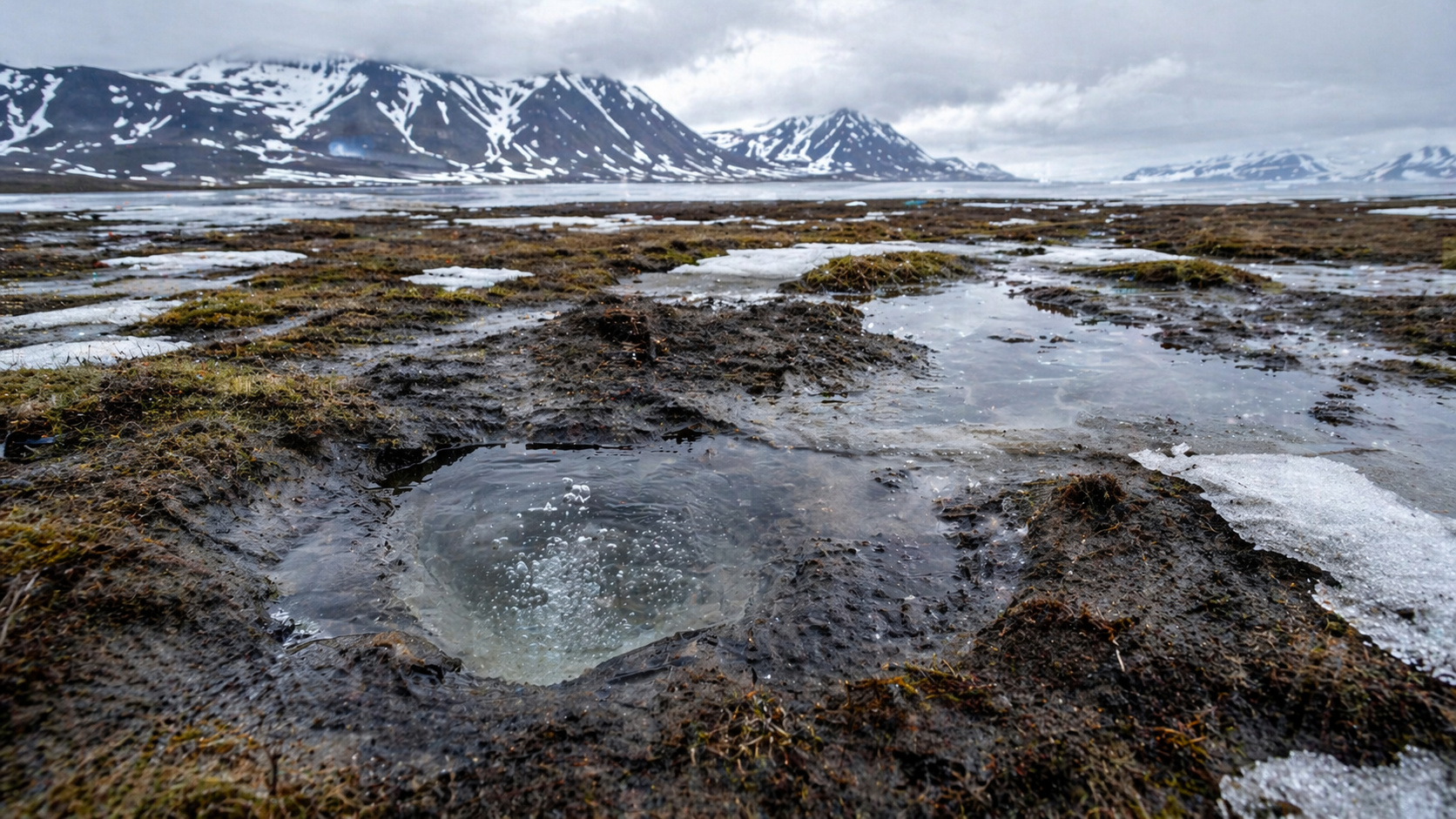

Arctic permafrost stores more carbon than the atmosphere and has already become a source of greenhouse gases, creating a difficult-to-reverse warming cycle.
In October 2024, analyses released by NASA, based on international studies including researchers from Stockholm University, confirmed a critical shift in the planet’s climate balance: the Arctic permafrost is ceasing to act as a carbon reservoir and is beginning to function as a net source of greenhouse gases. The central data supporting this concern is the scale of carbon stored. Scientific estimates indicate that permafrost contains about 1.4 to 1.6 trillion tons of carbon, more than double the carbon currently present in the Earth’s atmosphere.
This carbon has been frozen for thousands of years in soils rich in organic matter. However, with rising temperatures, this “climate vault” is starting to open, releasing carbon dioxide (CO₂) and methane (CH₄), two of the main gases responsible for global warming.
What is permafrost and why does it function as a “frozen carbon pump”
Permafrost is defined as soil that remains frozen for at least two consecutive years, but in practice, it can remain frozen for thousands or even hundreds of thousands of years.
-
Artist’s 15-Meter Lighthouse in the Mojave Desert, 160 km from the Sea, Intrigues Visitors with 19 km Range After Years of Bureaucracy

-
Bluetti AC70 Solar-Powered Station: Powers Fridge and Wi-Fi During Blackouts, Delivers 1,000W, 3,000 Charge Cycles, Priced at $900

-
Enormous Black Hole Phoenix A* Challenges Scientific Understanding with Mass of 100 Billion Suns, Surpassing Famous TON 618 in One of the Largest Known Galaxy Clusters
-
Say Goodbye to Storing Wine in a Regular Fridge: Midea’s Climate-Controlled Cellar Holds 34 Bottles, Maintains 5-18°C, and Uses Only Half a kWh Daily


Over this time, plants, animals, and organic matter have accumulated in these frozen layers without fully decomposing. This created a gigantic stockpile of carbon that remained stable while temperatures stayed low.


The problem begins when the ice melts. As it thaws, microorganisms start to decompose this organic matter, releasing gases into the atmosphere. Depending on soil conditions, carbon can be released as:
- Carbon dioxide, in oxygen-rich environments
- Methane, in oxygen-poor environments
And it is precisely the methane that makes the scenario even more concerning.
Methane released by the Arctic intensifies warming in a feedback loop
Methane is a greenhouse gas that is much more potent than CO₂ in the short term. Studies indicate that it can be dozens of times more effective at trapping heat in the atmosphere, accelerating global warming.
This creates a phenomenon known as positive climate feedback, where:
- Global warming melts permafrost
- Permafrost releases gases
- These gases further increase the temperature
- The cycle continuously intensifies
This mechanism transforms permafrost into a self-accelerating system, making the control of global warming even more difficult.
Arctic regions already emitting more carbon than they absorb
Recent studies published in scientific journals such as Nature Climate Change show that this transformation is no longer theoretical.
Research indicates that more than 30% of Arctic areas have already become net sources of carbon, potentially reaching 40% when emissions from wildfires are included.
This represents a historical reversal. For thousands of years, these regions acted as carbon sinks, helping to stabilize the global climate. Now, these same areas are contributing to the increase in emissions.
Furthermore, the Arctic is warming between two and four times faster than the global average, which further accelerates this process.
Craters in Siberia and methane release reinforce physical signs of the phenomenon
One of the most visible signs of this process occurs in Siberia, where giant craters have begun to appear in recent years. These formations are associated with the release of methane accumulated beneath the permafrost, which can generate enough pressure to cause explosions in the frozen ground.
In addition to the craters, scientists have also documented the formation of lakes and flooded areas where methane escapes directly into the atmosphere, often in the form of visible bubbles on the surface. These phenomena reinforce that the process is already underway and is not just a future projection.
Wildfires in the Arctic and increased emissions worsen the problem
Another factor that intensifies carbon release in the Arctic is wildfires. With rising temperatures, more frequent and intense fires are releasing large amounts of carbon directly into the atmosphere, in addition to accelerating the thawing of the soil.

Data indicates that emissions associated with permafrost are already comparable to those of large emitting countries, potentially reaching hundreds of millions of tons per year.
This combined effect — fires + thawing — creates a scenario in which the Arctic ceases to be a climate regulator and instead acts as an amplifier of global warming.
Why permafrost carbon represents a hard-to-control risk
Unlike industrial emissions, which can be reduced through public policies and technology, permafrost carbon presents an additional challenge: once released, it cannot be easily “refrozen”.
Even if human emissions are reduced, the carbon already stored in permafrost can continue to be released for decades or centuries.

Projections indicate that thawing could release between 55 and 232 billion tons of carbon by 2100, depending on the climate scenario.
This means that permafrost may continue to contribute to global warming even in mitigation scenarios.
Global impact goes beyond the Arctic and affects the whole climate system
Although the phenomenon is concentrated in the Arctic, its consequences are global. The increase in CO₂ and methane emissions directly affects:
- Global average temperature
- Extreme weather events
- Sea level
- Stability of ecosystems
What happens in permafrost does not stay in the Arctic — it influences the climate of the entire planet. Moreover, changes in the Arctic also have geopolitical, economic, and environmental implications, including new shipping routes, resource exploration, and impacts on local communities.
Have you ever imagined that a frozen soil for thousands of years can accelerate global warming
The case of permafrost reveals one of the most complex aspects of climate change: not all threats come directly from current human activity — some are stored in the planet’s natural system itself.
What used to function as a mechanism of stability is transforming into a source of instability. And this raises a central question:
to what extent can the planet continue to absorb impacts without triggering processes that escape human control.
The thawing of permafrost is not just another effect of climate change — it may be one of the elements that make this process faster, more intense, and more difficult