Portuguese
  Spanish


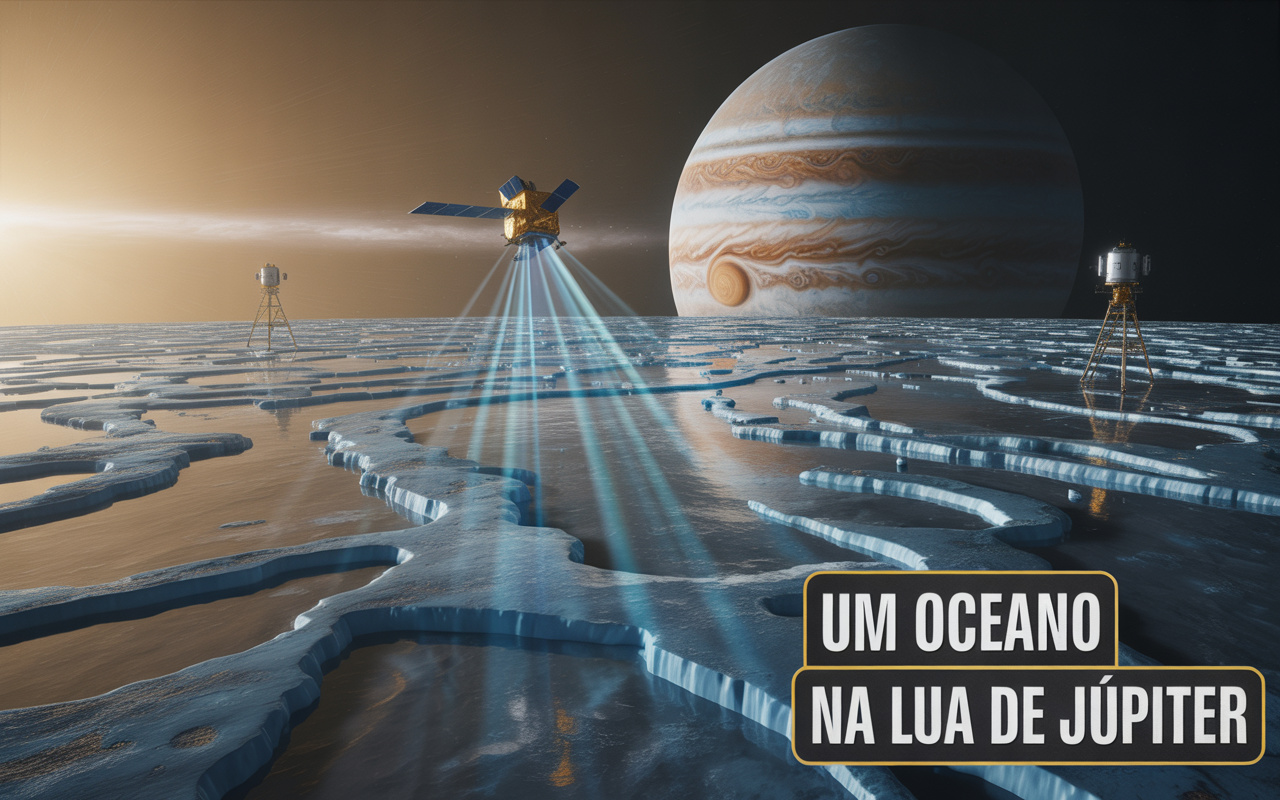


NASA Confirms That Europa, Jupiter’s Moon, Has Subsurface Oceans Larger Than All of Earth’s Combined — A Potentially Habitable Environment and Promising Place in the Search for Extraterrestrial Life.
Among the more than 90 known moons of Jupiter, one has been fascinating scientists for decades. It is Europa, a celestial body about 3,100 kilometers in diameter — slightly smaller than our Moon — whose icy surface hides a colossal secret: a subsurface ocean containing more water than all of Earth’s seas and oceans combined.
The latest data from NASA confirms that this vast ocean, kept liquid by thermal energy generated by gravitational friction with Jupiter, may be up to 100 kilometers deep. And it is precisely in this frozen abyss that one of the greatest discoveries in history could reside: the presence of life beyond Earth.
Europa is not just a frozen moon — it is a natural laboratory that combines three of the main ingredients for life as we know it: liquid water, energy, and organic compounds. And that is what makes it the primary target of upcoming interplanetary missions.
-
Brazilian Researcher Develops Protein Supplement from Tilapia Waste, Combining Innovation and Sustainability with Economic Potential

-
Women in São Paulo Unknowingly Tracked by Coin-Sized Tags Hidden in Cars and Belongings, Raising Stalking Concerns
-
Near a $750 million AI data center in Brazil, a resident’s well runs dry, leaving her unable to afford the $25,000 needed for repairs.

-
16-Year-Old from Brazil’s Sertão Wins Young Scientist Award for AI Predicting Rainfall with 94.5% Accuracy to Aid Farmers


An Ocean Hidden Beneath Kilometers of Ice
The first evidence of the existence of liquid water on Europa emerged with observations from the Galileo spacecraft, from NASA, in the 1990s. Since then, a series of magnetic field measurements and observations from the Hubble telescope have reinforced the hypothesis: beneath a crust of ice about 15 to 25 kilometers thick, there is a global ocean encompassing the entire moon.


This subsurface ocean could contain up to 2.5 times the volume of all Earth’s oceans, spread out in a liquid layer kept warm by tidal forces and chemical interactions with the rocky core.
What is most impressive is that the ice covering Europa is constantly being “recycled”: cracks and cryovolcanoes (ice volcanoes) allow some of the subsurface water to be expelled into space, creating water vapor plumes that were detected by Hubble in 2012. This allows scientists to study the ocean’s content without ever drilling through the surface.
Water, Energy, and Organic Chemistry: The Recipe for Life
The presence of liquid water is the first requirement for life, but not the only one. On Europa, the gravitational tides exerted by Jupiter create enough friction and heat to keep the ocean below freezing point. This internal heat also promotes chemical reactions between the water and the rocky floor, releasing molecular hydrogen and energy-rich compounds — the same type of reaction that, on Earth, fuels entire ecosystems in hydrothermal vents on the ocean floor.
Therefore, many astrobiologists consider Europa one of the most promising places for the existence of extraterrestrial life in the Solar System. If there are microorganisms there, they may live similarly to the bacteria and archaea that inhabit thermal vents in the depths of Earth’s oceans — without sunlight, but with abundant chemical energy.
Furthermore, spectroscopic observations have detected signs of organic compounds on the surface, suggesting that the ice may be enriched with molecules that are precursors to life. It is as if Europa is a time capsule preserving the conditions that gave rise to the first organisms on Earth billions of years ago.
NASA and ESA Missions Aim to Drill Through the Mystery
Faced with this extraordinary potential, two major missions are about to make Europa one of the most studied destinations of the 21st century.
The first is the Europa Clipper mission from NASA, scheduled to launch in October 2025. The spacecraft will be equipped with high-resolution cameras, ice-penetrating radar, spectrometers, and magnetometers to map the chemical and structural composition of the moon. The goal is to identify areas where the ice is thinner and where there is geological activity or water plumes — strategic points for a future landing.

The second is the JUICE (Jupiter Icy Moons Explorer) mission from the European Space Agency (ESA), launched in 2023 and already en route to Jupiter. JUICE will study not only Europa but also the moons Ganymede and Callisto, comparing their internal and atmospheric structures.
These missions represent the boldest step in modern astrobiology: attempting to detect life not through telescopes, but by going to where it can exist.
Europa and the New Horizon of Human Exploration
The discovery of life, even microscopic, on Europa would be as profound a milestone as humanity’s arrival on the Moon. It would confirm that biology is not a terrestrial exclusivity, but a natural consequence of cosmic chemistry.
More than a scientific dream, Europa symbolizes the next frontier for humanity — an icy world, 628 million kilometers away, where the most vast ocean in the Solar System lies in the silence of an abyss covered by ice.
If the Europa Clipper mission finds evidence of biological activity, it will be the first proof that the universe is indeed inhabited by multiple forms of life — and that Earth is just one among many living worlds.
Like Titan and Enceladus, Europa shows that the cosmos is more fertile than we imagined. But unlike the others, it is here that humanity places its greatest hope of finding real life beyond Earth.