






 Portuguese
  Spanish


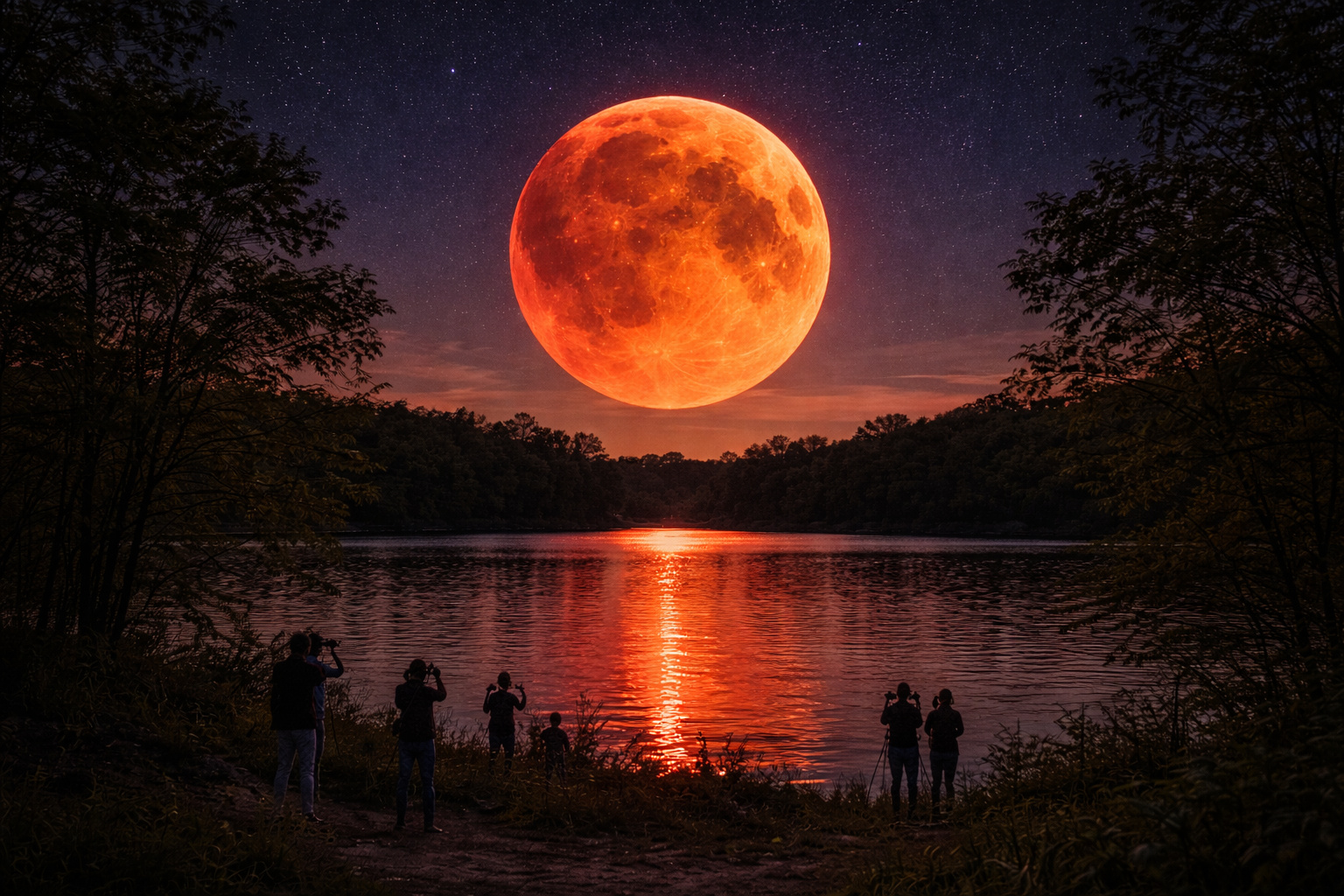


Phenomenon Occurs in the Early Hours of 03/03, Coincides with the Full Moon in March and Can Be Observed with the Naked Eye Across Brazil
A total lunar eclipse will be recorded in the early hours of March 3, according to astronomical data widely shared by institutions like NASA. The phenomenon will last around 58 minutes of totality and will coincide with the full moon in March, traditionally referred to as the Worm Blood Moon.
According to the schedule released by ND+, based on astronomical information, the alignment between Sun, Earth, and Moon will cause the gradual darkening of the natural satellite. During the maximum phase, the Moon will take on a characteristic reddish hue.
Understand How the Total Lunar Eclipse Occurs
The lunar eclipse occurs when the Earth positions itself between the Sun and the Moon, projecting its shadow on the satellite. At this moment, direct sunlight is blocked.
-
Northern Lights May Be Visible in 19 U.S. States Tonight as Solar Ejection Approaches Earth, Potentially Triggering Geomagnetic Storm

-
Energy-Efficient Upgrade: Brazilian Utility Offers Discounts to Replace Old Fridges and Bulbs with New Models in Paraná Homes
-
World’s Fastest Tractor, the JCB Fastrac Two, Hits Nearly 247.5 km/h with Over 1,000 Horsepower

-
At 86, mountaineer Carlos Soria becomes the oldest person ever to summit an 8,000-meter peak, reaching the top of Manaslu in Nepal.





As a consequence, part of the light is filtered through the Earth’s atmosphere. While the blue tones are scattered, the reddish wavelengths manage to pass through the atmosphere.
Therefore, during totality, the Moon takes on a reddish color. It is this optical effect that gives rise to the term Blood Moon.
Origin of the Name Worm Moon
Additionally, the nickname Worm Moon has historical origins. The term originated in indigenous and rural traditions of the Northern Hemisphere.
In March, the end of winter and the arrival of spring prompt the thawing of the ground. As a result, worms start to appear on the surface again.
Thus, the full moon of this period became associated with the natural phenomenon of thawing and the renewal of the seasonal cycle.
Official Eclipse Schedule on March 3
According to ND+, which compiled astronomical data for Brasília time, the eclipse will follow this sequence in the early hours of 03/03:
Start of penumbral eclipse: 3:44 AM
Start of partial eclipse: 4:50 AM
Start of totality: 6:04 AM
End of totality: 7:03 AM
End of partial eclipse: 8:17 AM
End of eclipse: 9:23 AM
Thus, the totality will last approximately 58 minutes, during which the Moon will be completely immersed in the Earth’s shadow.
How to Observe the Phenomenon Safely
Unlike solar eclipses, lunar eclipses do not pose a risk to vision. Therefore, they can be observed with the naked eye without any special equipment.
Nonetheless, experts recommend choosing a location with low light pollution. This way, the viewing is likely to be clearer.
Additionally, it is essential to check the weather forecast, as the presence of clouds may hinder observation.
Transparency and Accuracy in Astronomical Disclosure
The disclosure of events such as the total lunar eclipse on March 3 follows technical criteria established by scientific institutions. In this context, information is based on predictable and widely verified astronomical calculations.
Thus, the phenomenon does not represent any risk or abnormality. It is, therefore, a natural, periodic, and scientifically explained event.
Consequently, those who watch the sky in the early hours will be able to observe each phase of the alignment between Sun, Earth, and Moon, culminating in the so-called Worm Blood Moon.
Do you plan to watch this total lunar eclipse and capture the moment when the Moon turns completely red?


