Portuguese
  Spanish


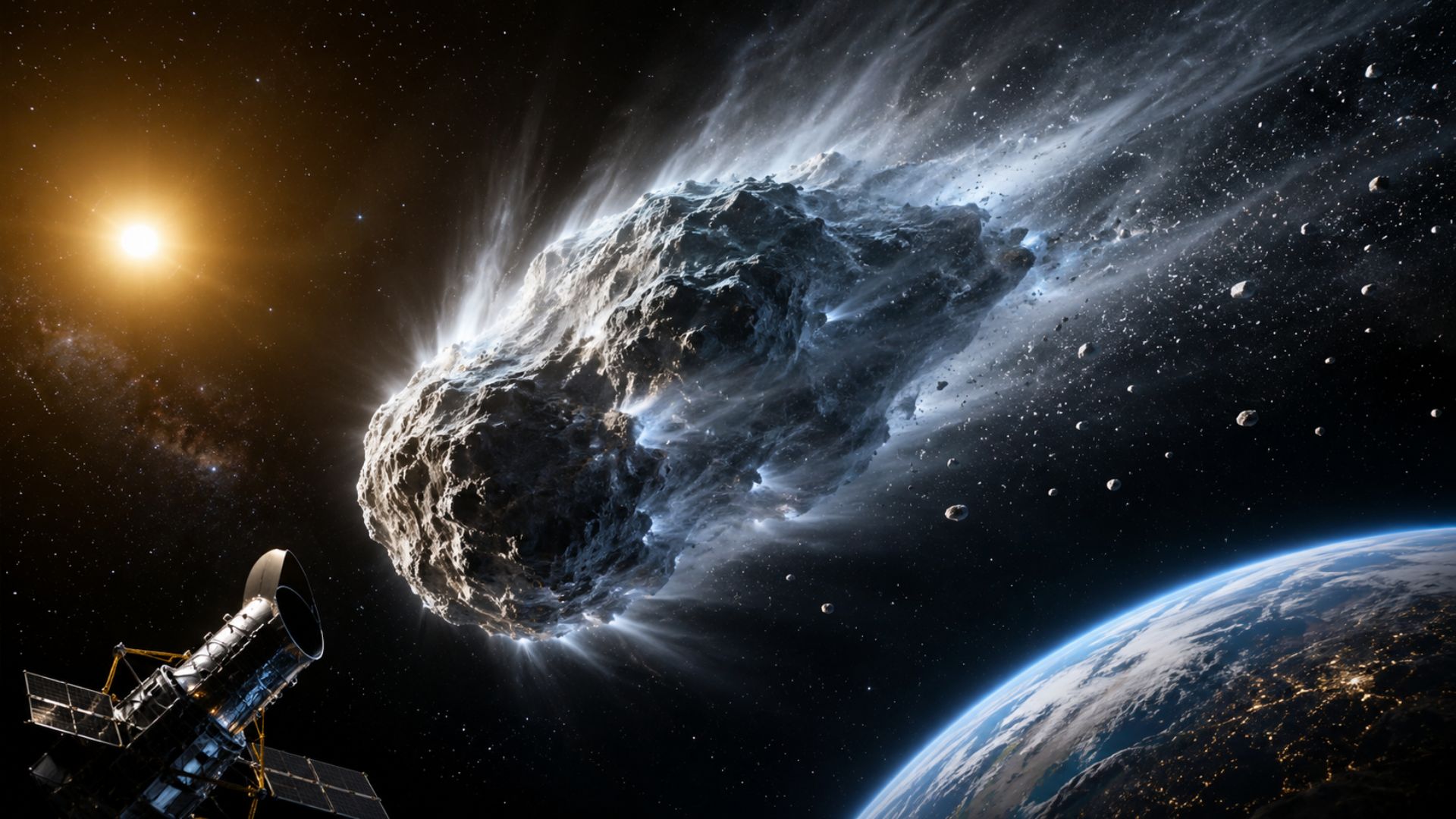

Visitor from outside the Solar System mobilized space telescopes and ground observatories, revealed unusual chemical signals, and expanded studies on the formation of comets in other stellar systems, with data that still need to be analyzed by scientific teams.
NASA gathered data from different missions to study the interstellar comet 3I/ATLAS, the third confirmed object coming from outside the Solar System to pass through our cosmic neighborhood.
Discovered on July 1, 2025, by the ATLAS system in Rio Hurtado, Chile, the body followed a hyperbolic trajectory and was not gravitationally bound to the Sun, a characteristic used by astronomers to confirm its interstellar origin.
The scientific interest around the object is due to the fact that such bodies carry material formed in other stellar systems, allowing the observation, albeit indirectly, of traces of chemical environments different from the Solar System.
-
Chinese Robot Dog Equipped with Wheels Can Cross Rivers, Ice, and -30°C Cold, Aiding in Power Grid Inspections and Disaster Areas

-
Researchers Develop “Electronic Nose” to Detect Spoiled Food and Allergen Traces

-
Massive Leak Puts iPhone 18 Pro in Spotlight Months Before Launch as Hackers Release Over 200,000 Confidential Apple Documents

-
Ghost Particle Travels Billions of Years Through Deep Space, Detected in Antarctic Ice, Leads Scientists to Hidden Galaxy 11 Billion Light-Years Away


Unlike comets associated with the Oort Cloud or the Kuiper Belt, 3I/ATLAS offers researchers an opportunity to analyze matter from another region of the galaxy through space telescopes, ground observatories, and probes.
The passage also allowed comparison of the comet with the two previously identified interstellar visitors: 1I/ʻOumuamua, observed in 2017, and 2I/Borisov, detected in 2019.
Among the three, 3I/ATLAS exhibited clear cometary activity and was accompanied by a greater number of instruments, according to information released by NASA about the observation campaign of the object.
What NASA confirmed about 3I/ATLAS
According to NASA, the comet posed no risk to Earth, as its closest approach to the planet occurred at about 1.8 astronomical units, a distance equivalent to approximately 270 million kilometers.
The closest approach to the Sun occurred around October 30, 2025, at about 1.4 astronomical units, according to orbital data released by the American space agency.
Until September 2025, the object remained visible to ground-based telescopes before getting too close to the apparent position of the Sun in the sky, making further observations from Earth difficult.
In early December 2025, 3I/ATLAS was again monitored by observatories after reappearing on the other side of the star, once more in favorable conditions for monitoring.
Size estimates are still presented with caution by researchers, because the dust and gases around the nucleus make it difficult to directly and accurately measure the comet’s central structure.
Observations made by Hubble on July 21, 2025, helped astronomers calculate that the nucleus could be up to 5.6 kilometers in diameter, although the lower estimated limit is about 440 meters.
James Webb detects methane in the interstellar comet
One of the measurements released by NASA came from the James Webb Space Telescope, which identified gaseous methane in 3I/ATLAS in observations used to study the object’s internal composition.
In an analysis published by the agency on June 1, 2026, the observatory recorded gaseous methane directly in an interstellar visitor for the first time, information treated by researchers as relevant data to characterize the comet.
Methane is a highly volatile molecule, capable of easily transitioning from ice to gas when it receives enough heat, a condition that helps explain part of the activity observed in cometary bodies.
According to the interpretation presented by NASA, the late appearance of this molecule indicates that part of the material was protected under surface layers and was only released when solar heating reached more internal regions of the nucleus.
Combined data from the agency’s missions also indicated that the relative production rates of water, carbon dioxide, and carbon monoxide differed from the pattern observed in many Solar System comets.
This comparison alone does not allow the identification of the origin system of 3I/ATLAS, but it shows that the composition measured in the object does not exactly follow the most common chemical repertoire in comets already studied locally.
Hubble, SPHEREx, and other missions expand the portrait
Images obtained by Hubble recorded a drop-shaped envelope, composed of dust released from the comet’s icy nucleus during its passage through the inner region of the Solar System.
This type of observation helps astronomers delineate the dimension of the central body and monitor the evolution of the coma, the cloud of gas and dust formed when the ice is heated by solar radiation.
In addition to Hubble and James Webb, NASA cited observations made by TESS, Swift, SPHEREx, Perseverance, MRO, MAVEN, Europa Clipper, Lucy, Psyche, Parker Solar Probe, PUNCH, and the ESA/NASA SOHO mission.
The combination of these instruments allowed for the recording of different aspects of the object, from the release of gases and dust to adjustments in its trajectory, without relying on a single observation technique.
The European Space Agency also used data obtained from Mars to refine the trajectory of 3I/ATLAS, in work complementary to the observations made by ground-based and space telescopes.
Observations from the ExoMars Trace Gas Orbiter, conducted between October 1 and 7, 2025, helped improve the prediction of the comet’s position by a factor of ten, according to ESA.
ALMA finds signs of a very cold origin
The ALMA radio telescope in Chile added data on the composition of 3I/ATLAS by measuring compounds associated with ice and molecules present in the object’s coma.
In a statement from April 2026, the observatory reported the first measurement of deuterated water, known as semi-heavy water, in an interstellar object, with a ratio at least 30 times greater than that found in comets of the Solar System.
According to the interpretation of researchers associated with ALMA, this abundance suggests that 3I/ATLAS may have formed in an extremely cold environment, different from the conditions associated with many known comets in our vicinity.
In March 2026, the observatory also reported a large amount of methanol relative to hydrogen cyanide, another data point used by astronomers to discuss the object’s unusual chemical composition.
These measurements do not allow us to state from which star or planetary system the comet came, because the complete origin depends on orbital reconstructions and models about the ejection of icy bodies in other systems.
The trajectory confirms that 3I/ATLAS came from outside the Solar System, but analyzing its history requires combining orbit, composition, cometary activity, and simulations about planetary environments beyond the Sun.
Comparison with ʻOumuamua and Borisov
3I/ATLAS gained scientific relevance for being the third confirmed interstellar object, following two cases with different characteristics still discussed by the astronomical community.
ʻOumuamua exhibited behavior considered unusual in 2017 and little visible cometary activity, while Borisov, detected in 2019, showed gas and dust emissions more compatible with traditional comets.
With 3I/ATLAS, astronomers now have a third point of comparison to assess the diversity of bodies that can be expelled from planetary systems and traverse interstellar space.
The difference between the three objects indicates, according to researchers in the field, that interstellar visitors do not form a uniform category, but a varied set of bodies with distinct physical and chemical histories.
The analysis is expected to continue for years, especially because raw data from NASA missions have been sent to public archives and can be reprocessed by different scientific teams.
This collection allows for the revision of measurements, the combination of results from different instruments, and the search for details that may not appear in the first interpretations of the comet’s activity and composition.
The comet 3I/ATLAS is already moving away from the Solar System and is not expected to return, according to its hyperbolic trajectory observed by the teams that monitored the object’s passage.
The passage provided a rare set of observations on ice, dust, and molecules formed outside the direct influence of the Sun, material that should support new studies on the formation of planetary systems in distinct chemical environments.