






 Portuguese
  Spanish
  2 min of reading
  0 comments


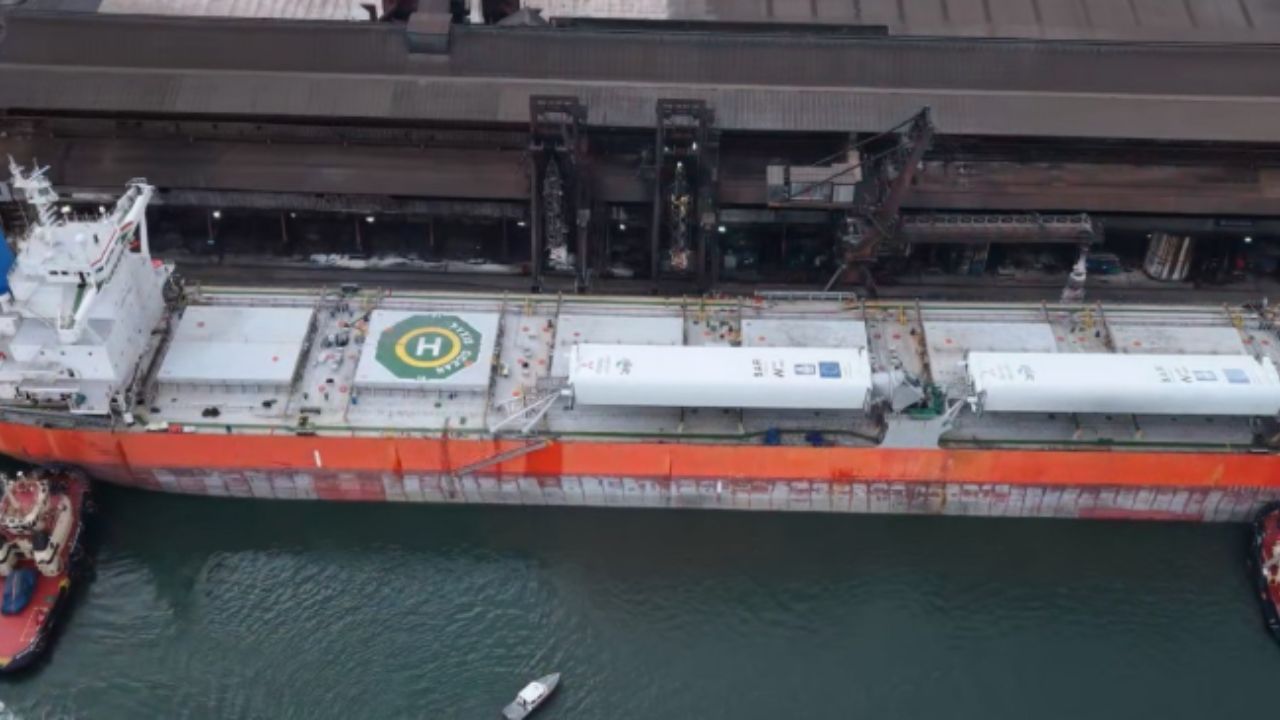
Pyxis Ocean Vessel, Equipped with Steel Sails, Embarks 72 Thousand Tons of Product at Santos Port Destined for China, Promoting a More Eco-Friendly Transport.
The Port of Santos was the scene of an innovative operation with the wind-powered ship Pyxis Ocean. This vessel, which uses wind power as auxiliary propulsion, loaded a cargo of 72 thousand tons of sugar. The operation, carried out by the maritime agency RZ Mura, marks a significant advancement towards more sustainable maritime transport.
Wind Propulsion Technology at the Port of Santos
For the first time, a bulk carrier with wind propulsion technology operated at the Port of Santos. The Pyxis Ocean, owned by Mitsubishi Corporation and chartered by Cargill, represents a milestone for the sector. Its presence at the Copersucar terminal dock in the Ponta da Praia neighborhood drew attention for its differentiated technology.
The Cargo: 72 Thousand Tons of Sugar Destined for China
The wind-powered ship was loaded with a large quantity of sugar. In total, 72 thousand tons of the product were embarked, destined for China. This type of cargo, essential for Brazilian exports, now has a transportation alternative that seeks to reduce environmental impact.
-
North Korean Fiasco: Launch of the Largest Warship Ends in Sinking

-
While giant ships still burn heavy fuel and the maritime sector races against climate targets, Maersk and Vale are starting to bet on ethanol as a new route to reduce emissions at sea.

-
China begins construction of the world’s largest LNG ship, a 344-meter giant capable of supplying 4.7 million homes for a month, carrying 271,000 m³ of gas, and placing QatarEnergy in the largest naval order ever recorded in world history.
-
China is designing a container ship with a thorium nuclear reactor that will operate for 40 years without refueling, and the 25,000-container giant from Jiangnan Shipyard will cross oceans without emitting carbon in an industry that burns 300 million tons of fuel per year.



Details of the Pyxis Ocean and Its Sail Technology
The main differentiator of the Pyxis Ocean is its steel sails, called WindWings. Developed by BAR Technologies, these sails can be deployed in open water to capture the wind. Standing 37.5 meters tall, they provide significant fuel savings, which can reach up to 30%. This represents a crucial innovation for the maritime industry.
The Impact of Wind-Powered Ship Technology on Emission Reduction
The use of a wind-powered ship has a clear purpose: the decarbonization of maritime transport. The WindWings technology allows for a considerable reduction in fossil fuel consumption. Consequently, there is a decrease in greenhouse gas emissions, aligning logistics with global sustainability goals.
The Logistics Operation of RZ Mura
RZ Mura Maritime Agency was responsible for the complex loading operation at the Port of Santos. The company, with offices in Santos and São Sebastião, managed all the procedures for the wind-powered ship to dock, load, and depart safely and efficiently, consolidating the success of this pioneering mission in Brazil.
With information from Portos e Navios.







Be the first to react!