Portuguese
  Spanish


Perforated PET bottles can function as homemade drip irrigation, delivering water directly to the root and reducing waste in the garden.
During drought periods, intense heat, or tight budgets, producers and urban gardeners have turned to a simple solution to keep the garden productive: using PET bottles as homemade drip irrigation. The logic is the same as conventional drip irrigation. Instead of spreading water over the soil surface, the system slowly releases moisture near the root, where the plant actually absorbs what it needs. According to the FAO, localized irrigation stands out precisely because it applies water only where it is needed, with less waste than more open methods.
The PET technique has gained traction because it is cheap, easy to assemble, and useful in small areas. According to the University of Vermont Extension, a plastic bottle with small holes in the cap can function as a simple dripper for plants that need regular irrigation, including in beds and pots that dry out quickly.
How drip irrigation with PET bottles works
The principle is straightforward. The bottle acts as a small individual water reservoir. Once filled, it is placed upside down in the soil, near the plant, with the perforated cap facing down. The water slowly exits through the micro-holes and infiltrates the soil around the root.
-
Study of Brazil’s Tietê River Finds 25 Pesticides in Water, Including Cancer-Linked Substance Near Source

-
Young Entrepreneur Expands from 50 to 1,400 Chickens, Proving “Happy Hens” Can Be a Viable Business
-
Small Farm in Brazil’s Minas Gerais Produces 403 Liters of Milk Daily, Sets Benchmark for Rural Producers
-
Man Revives 1930s Abandoned Trout Farm, Learns from Scratch, and Earns $1.1 Million Annually Selling Fish to Michelin-Starred Restaurants


According to the University of Vermont Extension, this system can be made with a used bottle, a small hole in the cap, and proper positioning next to the plant.
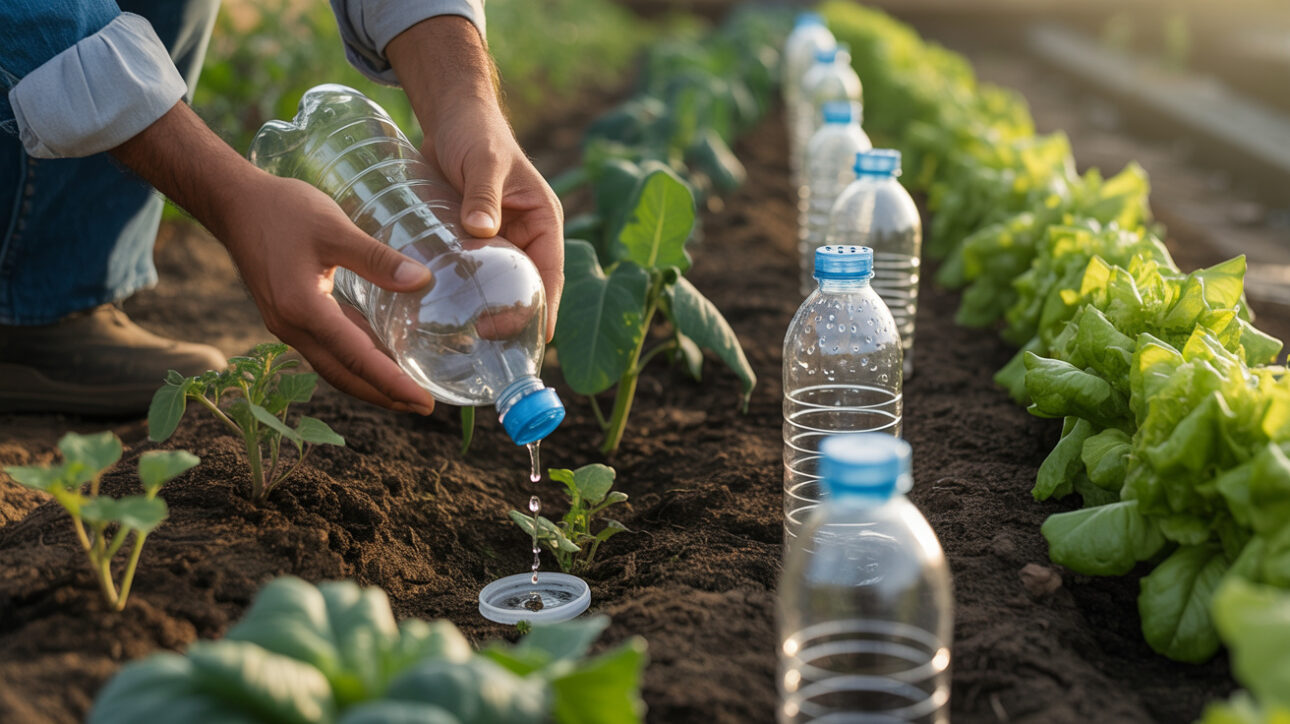
This model reduces the wet area on the surface and concentrates moisture at the most important point for the plant. Instead of wetting empty spaces between rows, the homemade drip delivers water in smaller volumes and continuously, which helps maintain soil moisture for longer.
The logic is the same as described by the FAO for localized irrigation: increasing water efficiency because water is applied only where necessary.
Why watering directly at the root reduces water waste
In conventional irrigation with a hose or open watering, part of the water is lost even before the plant uses it.
This happens due to surface evaporation, lateral runoff, and unnecessary wetting of areas where there is no significant absorption. In drip irrigation, this loss tends to decrease because the water enters the soil slowly and remains more concentrated in the root zone.
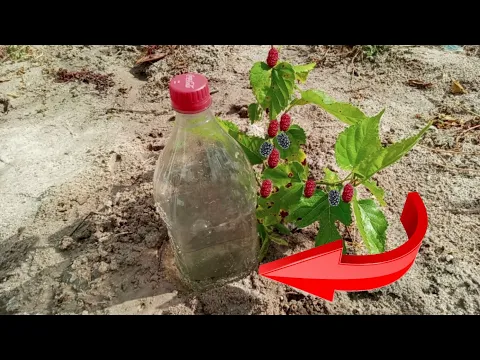

According to the FAO, localized irrigation systems, such as drip irrigation, are among the most efficient means of applying water in agriculture because they reduce losses and direct the resource to the plant’s actual point of use.
In the organization’s technical documents, drip irrigation appears with more efficient water use than more traditional surface methods.
In practice, this helps the garden maintain more constant moisture, reduces waste, and prevents surface waterlogging. On hot days, when the top layer of soil dries quickly, this type of slow supply can make a difference in the plant’s water balance.
How to set up homemade drip irrigation with a PET bottle
The setup requires few materials. Just use a clean PET bottle, water, and a sharp object to pierce the cap. Ideally, make small holes because the slow release is precisely what allows the system to function as drip irrigation and not as a quick dump.
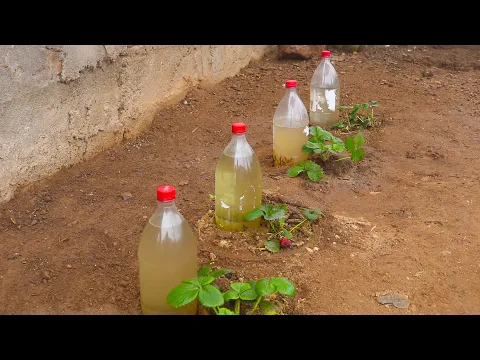
After that, the bottle can be partially buried next to the plant, with the cap facing down and close to the root area.
According to the University of Vermont Extension, this positioning helps maintain constant drip and is especially useful for plants that need regular irrigation or for containers that dry out faster.
The flow depends on the size and number of holes. If the water comes out too quickly, the adjustment can be made by reducing the diameter of the holes or the number of perforations. If it’s too slow, the hole can be slightly enlarged. The ideal point varies according to the soil, heat, and size of the plant.
Soil, climate, and type of cultivation change the system’s performance
The behavior of PET bottle irrigation changes significantly depending on the type of soil. In sandy soil, infiltration is faster, and water replenishment tends to be more frequent. In clay soil, retention is higher, and drip can be slower to avoid excess concentrated moisture. Meanwhile, soils rich in organic matter usually balance infiltration and retention better.
It is also important to observe the root depth. Plants with more superficial roots require positioning closer to the base. Crops with deeper roots can better utilize slightly larger reservoirs or more spaced replenishments. Since the technique is manual and simple, it allows for quick adaptation according to each plant’s response.
According to the FAO, the efficiency of irrigation depends not only on the technology itself but also on proper management. This applies to both professional systems and homemade solutions adapted to the garden.
Method is useful in urban gardens, backyards, and family farming
Drip irrigation with a PET bottle fits very well in home gardens, backyards, community gardens, and small family productions. It is also useful for newly transplanted seedlings because it provides water consistently without displacing the soil around the stem.
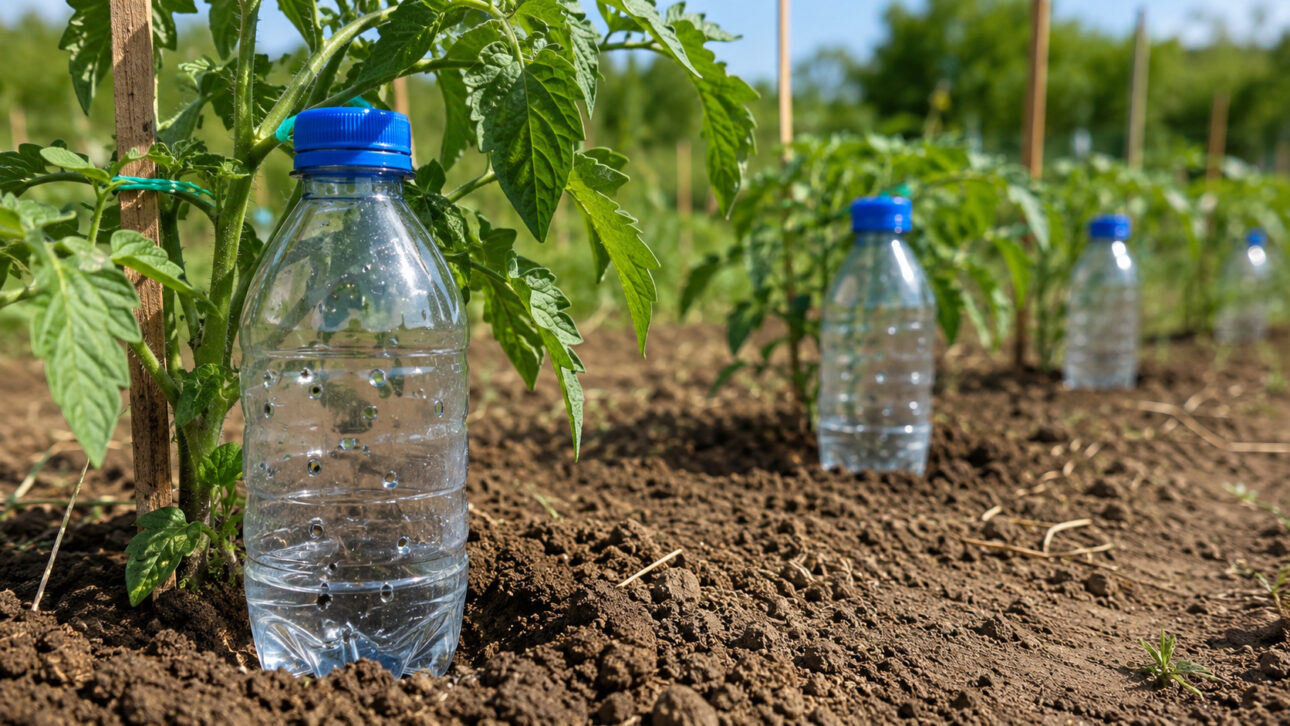
Another advantage is temporary autonomy. Since the release is slow, the technique can help during short periods of absence of the producer or resident, as long as the bottle’s capacity and the plant’s water needs are compatible.
According to the University of Vermont Extension, this adaptation is also a practical solution for containers and beds that require more regular irrigation.
PET bottle does not replace professional system, but works well on a small scale
The PET system does not replace a professional drip project in medium or large areas. It does not have calibrated emitters, filters, pressure regulators, or precise flow standardization. Even so, it works well as a low-cost alternative for small scale, especially when the goal is to save water and simplify management.
Besides water savings, there is an environmental gain in reusing plastic. The used bottle stops being immediate waste and starts fulfilling a useful function in cultivation. This gives the method a dimension of material reuse and more sustainable garden management.
There are limitations. The holes can clog if the water has sediments, the flow is not entirely uniform, and maintenance needs to be periodic. Still, the technique continues to attract interest because it combines simplicity, practical efficiency, and almost zero cost.
Simple solution follows the agronomic logic of localized irrigation
The most important point is that the homemade system is not just improvisation. It follows a consolidated agronomic principle: apply water directly to the root zone, slowly, locally, and with less waste.
According to the FAO, it is precisely this logic that makes localized irrigation one of the most efficient water use strategies in plant production.
By using perforated PET bottles next to the plants, farmers and gardeners transform a common material into a small drip irrigation system.
In home gardens and small productions, this can mean less waste, more stability in soil moisture, and a smarter way to use water during critical periods.