






 Portuguese
  Spanish


China designs the largest nuclear ship in history: a 25,000 TEU cargo ship will have a thorium reactor, 40-year autonomy without refueling, and promises to revolutionize the global maritime industry without carbon emissions.
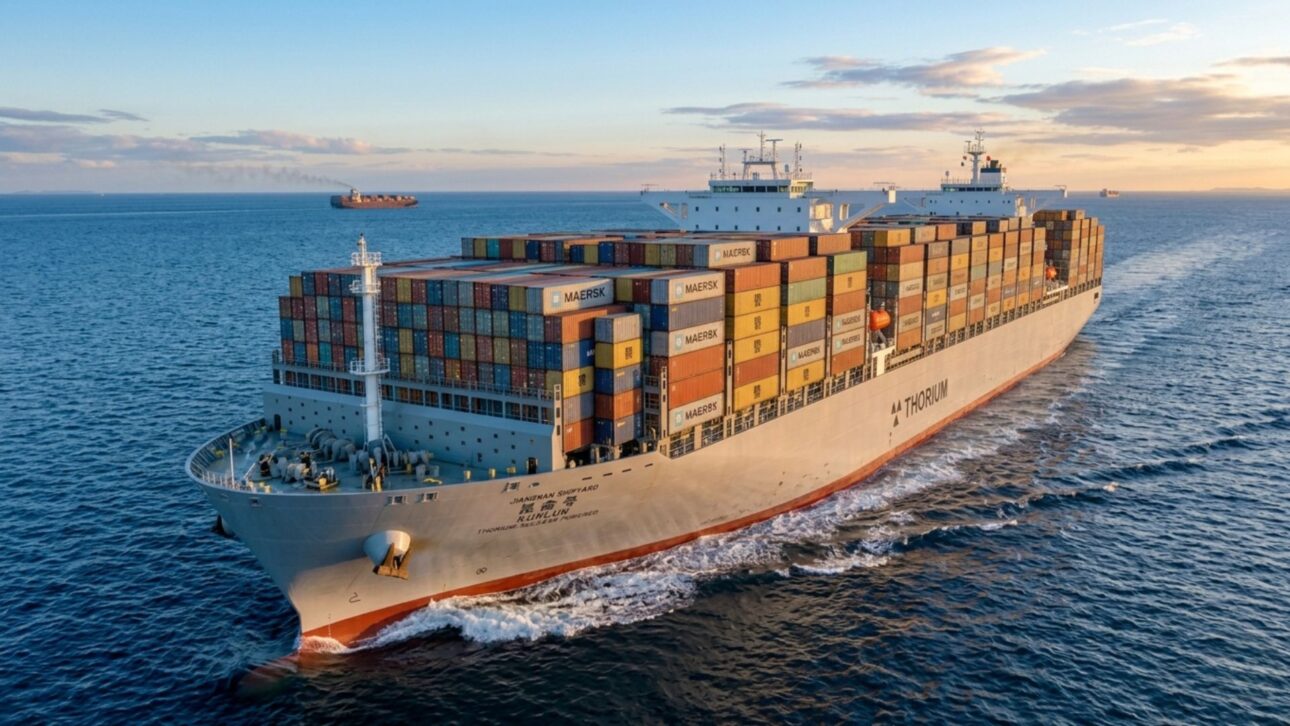
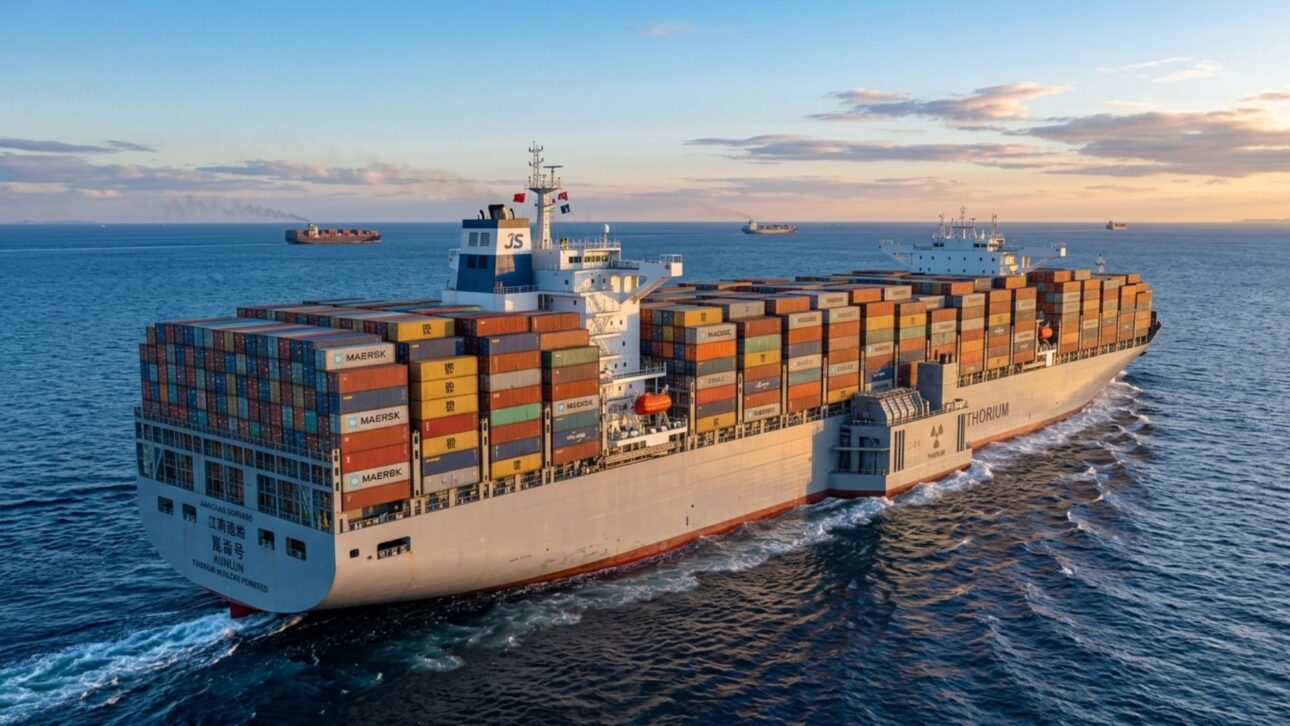
According to Interesting Engineering, the vice-president of Jiangnan Shipyard, Lin Qingshan, revealed during the Marintec China conference in Shanghai that the state-owned shipyard is designing a 25,000 TEU nuclear-powered container ship — the largest commercial nuclear-powered ship ever conceived. The ship’s engine will be a fourth-generation molten salt thorium reactor with a power of 200 megawatts and an operational lifespan of 40 years. “We want to be pioneers in this field,” Lin told the South China Morning Post.
The design phase is expected to be completed in 2026, with construction potentially starting at the end of this decade at a shipyard affiliated with CSSC — the China State Shipbuilding Corporation, a state conglomerate that controls Jiangnan. The project did not come out of nowhere. In December 2023, Jiangnan had already revealed at the previous Marintec edition the design of the KUN-24AP — a 24,000 TEU ship with a molten salt reactor — which received Approval in Principle from the Norwegian classification society DNV, one of the most demanding technical credibility seals in the international maritime sector.
The 25,000 TEU project announced in December 2025 extends this roadmap to an even larger scale. The commercial shipping industry burns approximately 300 million tons of fuel per year — mostly heavy fuel oil, the dirtiest petroleum derivative available — and accounts for about 3% of global CO₂ emissions. A ship that operates for 40 years without refueling and emits no carbon during operation is not just a technical change. It is a break with the economic and environmental model that has governed the industry since steamships replaced sailing ships in the 19th century.
-
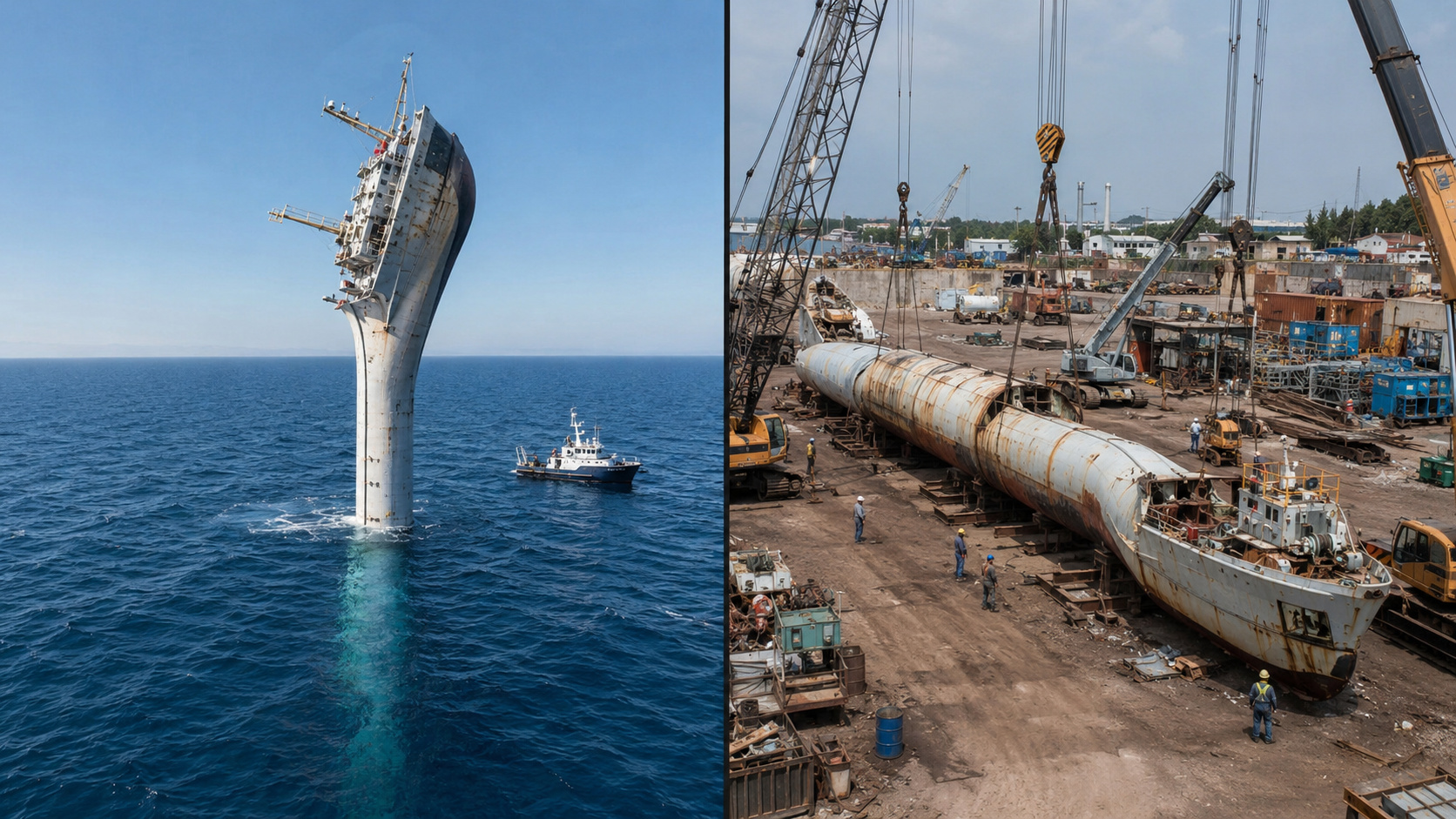
The FLIP: A 108-Meter Ocean Laboratory That Stood Vertically for 60 Years, Dismantled in 2023

-
North Korean Fiasco: Launch of the Largest Warship Ends in Sinking

-
While giant ships still burn heavy fuel and the maritime sector races against climate targets, Maersk and Vale are starting to bet on ethanol as a new route to reduce emissions at sea.

-
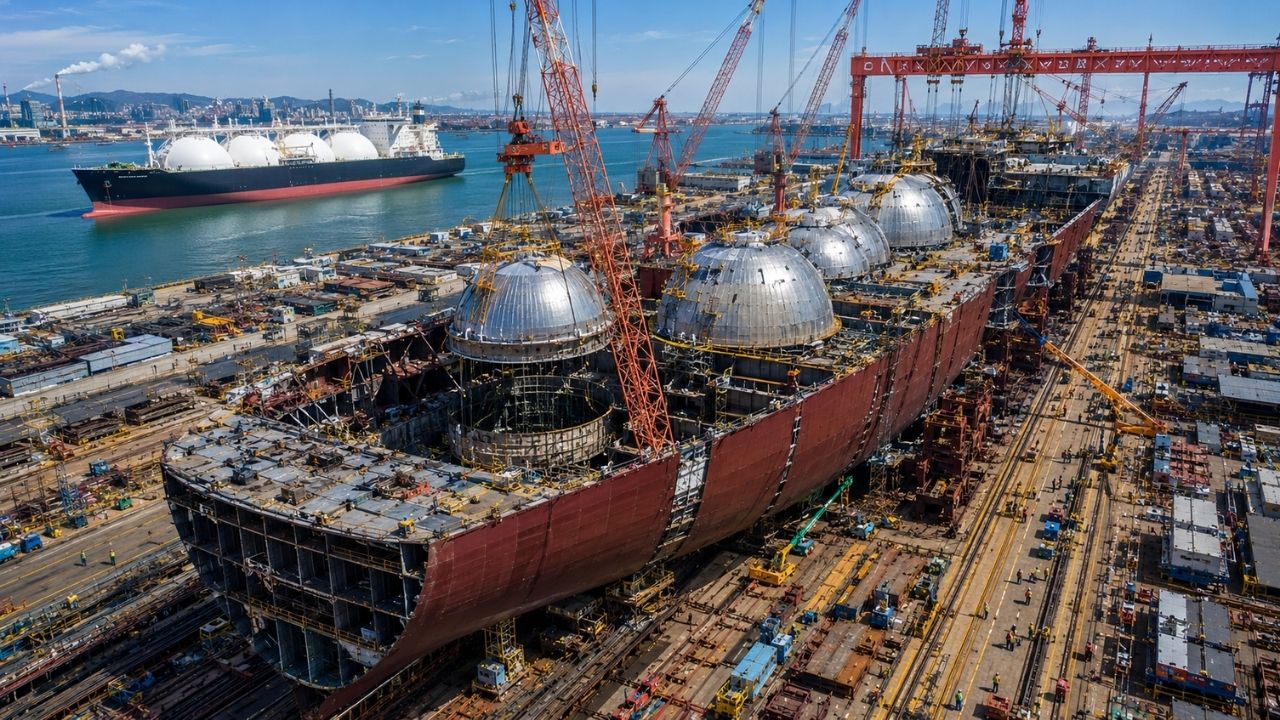
China begins construction of the world’s largest LNG ship, a 344-meter giant capable of supplying 4.7 million homes for a month, carrying 271,000 m³ of gas, and placing QatarEnergy in the largest naval order ever recorded in world history.


What is thorium and why China has invested in it
Thorium is a naturally radioactive metal, slightly heavier than lead, found abundantly in the Earth’s crust. One ton of thorium produces the same energy as 3.5 million tons of coal — or approximately 200 times more energy per weight than enriched uranium used in conventional reactors.
China has significant reserves of thorium — part of the rare earth ore that the country extracts on an industrial scale and which generates thorium as a byproduct. What for other countries is waste from rare earth processing, for China is an abundant and cheap raw material for a new generation nuclear fuel. The world had advanced research on thorium reactors in the 1960s — the Oak Ridge National Laboratory in the USA tested a molten salt thorium reactor for four years between 1965 and 1969, with positive results.
But the nuclear arms race of the Cold War favored uranium, which generates plutonium as a useful byproduct for weapons. Thorium does not generate plutonium, which made it less interesting for governments that wanted fuel and war material from the same reactor. With the end of the arms race, interest in thorium resurfaced as an exclusively civil fuel — and China became the country that invested the most in the development of thorium molten salt reactors over the past two decades.
Why molten salt and what makes this reactor different from those that exist today
The molten salt reactor — MSR, in the English acronym — is radically different from the pressurized water reactors that generate electricity in conventional nuclear plants. The difference is not just technical. It is a difference in reactor behavior when something goes wrong.
In conventional reactors, solid nuclear fuel is immersed in pressurized water at extremely high temperatures. If the cooling system fails, the water evaporates, the pressure rises, and the fuel can melt — the Fukushima or Chernobyl-type scenario. To avoid this, conventional reactors need emergency cooling systems, high-pressure containment, and evacuation procedures. In the molten salt reactor, the fuel is dissolved in the liquid salt itself, which acts as a coolant.
The system operates at high temperature but low pressure — there is no lethal combination of heat and pressure that causes explosions in conventional reactors. The CSSC described the passive safety principle of the KUN-24AP on Weibo: “This type of ship has high safety because the reactor operates at high temperatures and low pressure, which means it can in principle avoid core meltdown.”
The most revealing detail is what happens in case of an accident: the fuel salt solidifies at room temperature. If any system fails, the physics of the material solves the problem without human intervention — the salt stops flowing, stops reacting, and freezes. There is no emergency pump, no water injection system, no operator needing to activate anything. The reactor shuts down by itself.
What 25,000 TEUs means on the scale of global transport
To understand what a 25,000 TEU ship represents, it is necessary to understand what TEU means and how the scale of container ships has exploded in recent decades. TEU — Twenty-foot Equivalent Unit — is the standard unit of measurement for containers, equivalent to a 20-foot-long container. In 1956, when the first modern container ship sailed between New York and Houston, it carried 58 containers.
In 1988, the largest container ships in the world carried about 4,000 TEUs. By 2006, they reached 10,000 TEUs. The largest ships in operation today — the MSC Irina class and similar — carry between 24,000 and 24,300 TEUs. A 25,000 TEU ship would be the largest ever built. Each of these giant ships burns between 250 and 350 tons of heavy fuel oil per day at cruising speed — a fuel with sulfur and contaminant levels far above automotive diesel.
The International Maritime Organization implemented in 2020 a limit of 0.5% sulfur content for marine fuel — reduced from 3.5% — and yet large ships are responsible for SOx, NOx, and fine particle emissions on a scale equivalent to millions of cars. A 200-megawatt thorium reactor with a 40-year lifespan eliminates this consumption completely. There is no fuel on board other than molten salt. There is no carbon, sulfur, or nitrogen emission in the operation.
The regulatory obstacles that can delay everything — or accelerate
Lin Qingshan was explicit about the main non-technical obstacle of the project: there is no clear international regulation for commercial nuclear-powered merchant ships. The International Maritime Organization — IMO — has regulations for military nuclear ships and submarines, but has not yet finalized a specific framework for large commercial nuclear merchant ships in operation.
This means that a 25,000 TEU ship with a thorium reactor, even if successfully built and tested, might not have authorization to enter ports in the European Union, the United States, or Japan without complex and potentially lengthy bilateral negotiations. Lin acknowledged the problem: “It is still unclear which government agency would have the authority to approve the construction of a nuclear-powered ship.”
The regulatory issue is not trivial. Ports have sovereign autonomy to define which ships can dock. A nuclear ship, regardless of how safe the design is, raises questions of maritime insurance, liability in case of an accident, port emergency protocols, and public perception that no classifier can resolve alone.
The DNV’s principle approval for the KUN-24AP is an important technical step — it means that the classification society has evaluated the design and found no fundamental engineering objections. However, a principle approval is not a license for commercial operation.
Why China is building the shipyard before finishing the ship
The most revealing detail of Lin Qingshan’s statement at Marintec was not the size of the ship or the reactor’s power. It was the line about infrastructure investment: “We will also invest in the construction of shipyards intended for building nuclear ships.”
Building a specific shipyard for nuclear ships before having the first ship approved for construction is a long-term bet that says something about how China is strategically positioning this project. It is not a research project. It is an industrial project. The CSSC, through Vice President Ma Yunxiang, was clear at Marintec: nuclear ships are part of the strategy to move up the value chain — along with luxury cruise ships and deep ocean drilling ships.
Chinese shipyards account for 65% of global shipbuilding orders measured in gross tonnage in the first nine months of 2025. But this share is dominated by commodity ships — bulk carriers, tankers, medium-sized container ships — where the margin per ship is relatively low.
A nuclear container ship of 25,000 TEUs is the highest unit value product that any shipyard in the world could deliver. It is the product that no other shipyard in the world is technically positioned to build. The design phase is expected to be completed in 2026. Construction may begin at the end of this decade. And when — or if — the first commercial nuclear ship of 25,000 containers leaves the dock in Shanghai, the industry that burns 300 million tons of fuel per year will have before it, for the first time in its history, a ship that needs none of them.






Way to go, China! 👏👏👏