Portuguese
  Spanish


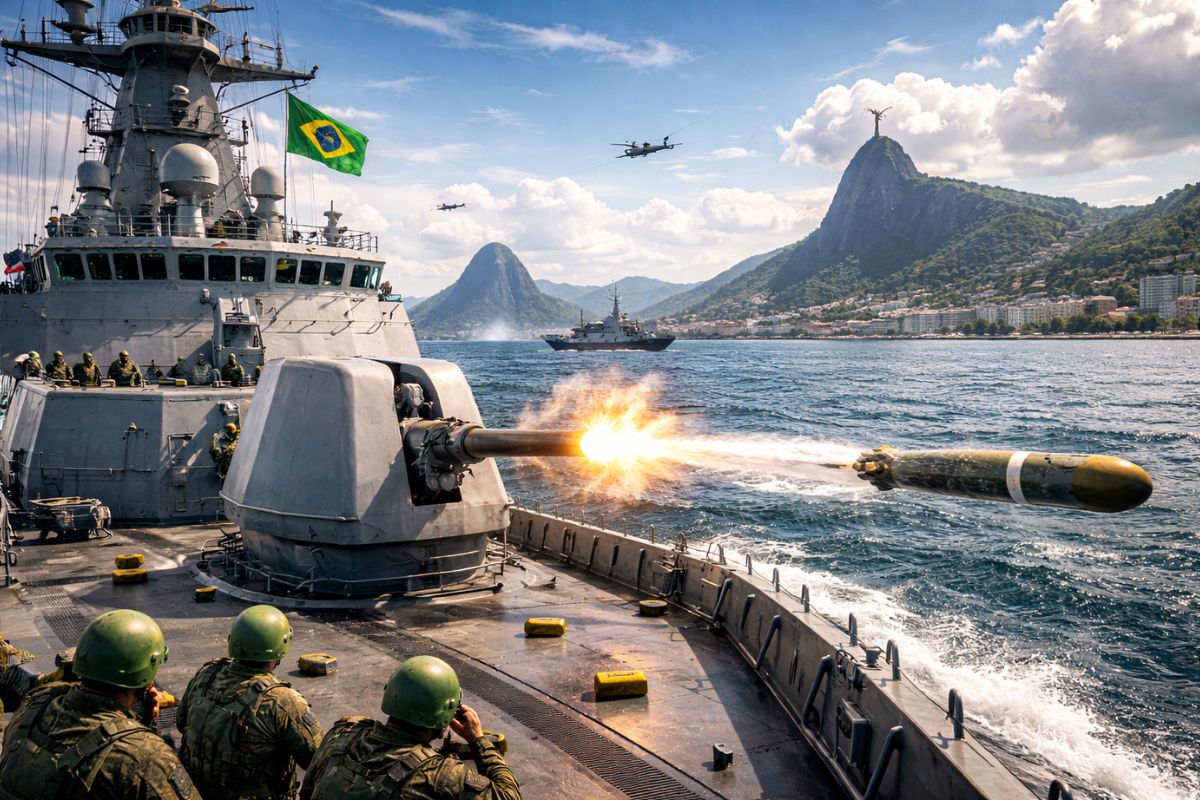

Frigate Tamandaré of the Brazilian Navy conducts live fire with a 76 mm cannon and launches MK54 torpedoes; advancement reinforces the Blue Amazon.
The Frigate Tamandaré has entered the final stretch of operational acceptance with live fire campaigns authorized by the Brazilian Navy and images highlighting the firepower of the new escort ship. The records show the operation of the 76 mm cannon and the launch of MK54 lightweight torpedoes during tests in Rio de Janeiro.
The Frigate Tamandaré (F200), the first unit of the new class, has been operating in Guanabara Bay and the coast of Rio de Janeiro since March 16, 2026, and is expected to be delivered to the operational sector within 90 days. The official incorporation into the Fleet is scheduled for April 24, 2026, with a ceremony in Rio.
Reality Checkpoint

What is happening now: the Frigate Tamandaré is advancing in operational tests in Rio, with technical evaluations and live fire trials involving the 76 mm cannon and MK54 torpedo. The focus is to validate safety, robustness, and integration of combat systems.
-
Almost 1 billion euros, two gigafactories, and a million-dollar public investment, Chinese company aims to turn Spanish city into Europe’s new battery hub.

-
Advancement in the industry: Brazilian company creates ultralight material comparable to steel and paves the way for hydrogen cylinders up to 70% lighter, with a direct impact on logistics, the energy industry, and national competitiveness – learn about Forza Composites

-
In Brazil’s backyard: Tesla, by Elon Musk, announces official operations in Uruguay, where electric vehicles already make up 20% of new cars but still leaves out the largest market in the region.

-
This Mars rover may finally reveal if life ever existed on Mars.



What is scheduled in the timeline: final delivery within 90 days and official incorporation on April 24, 2026, followed by an operational experimentation period of about a year.
Why the images of the Frigate Tamandaré attracted so much attention

The released images have an immediate effect because they place, in a real scenario, what is normally restricted to specifications: the complete linkage from sensor to weaponry.
In practice, it is the confirmation that the ship is not just sailing, but executing the type of activity that defines the readiness of a modern escort.
In addition to the visual impact, there is an institutional signal. When the Navy authorizes the release of live fire, the message is one of confidence in the stage the program is at, with the Tamandaré Frigate already close to the delivery and incorporation point.
Tests in Rio: final phase of operational acceptance
The Tamandaré Frigate completed initial sea tests between August and December 2025 and, since March 16, 2026, has been operating in Rio de Janeiro for the final verifications.
During this period, the crew monitors maneuvers and validations on the bridge, overseeing air and surface surveillance radars, hull sonar, and electro-optical and infrared systems.
The goal is to close a demanding acceptance cycle: to prove that the ship is safe, stable, and fully integrated, especially when sensors, command, and armament need to operate as a single unit.
76 mm Gun and MK54 Torpedo: what was tested

The material highlights the use of the Oto Melara 76/62 gun, described as rapid-fire and high cadence, engaging targets at sea and capable of acting against surface and air threats. This is a type of trial that serves to measure accuracy, repetition, and reliability under operational routine.
In the anti-submarine aspect, light MK54 torpedoes are launched from 324 mm tubes. The central point of this phase is to verify if the ship executes the complete flow, from tracking to firing, without integration failures.
Integration of the combat system and layers of armament
The mentioned tests reinforce that the Tamandaré Frigate operates with a layered logic: main gun, point defense, and integration with guided armaments.
The text mentions the integrated management of the combat system with anti-ship missiles Mansup, vertically launched air defense missiles CMM, a 30 mm gun, and 12.7 mm machine guns.
Another point is air operation. The hangar and flight deck extend the operational range with helicopters, adding reach, surveillance, and tactical response in escort and patrol missions.
Sensors, stealth, and interoperability
The Tamandaré Frigate is described as compatible with interoperability standards used by allied forces, while stealth elements reduce radar signature.
In practical terms, this means a ship designed to operate with modern sensors, faster command chains, and reduced exposure in tactical scenarios.
The report also highlights the sensor suite as part of the vessel’s “brain.” Without well-integrated sensors, the armament becomes brute force; with integration, it becomes combat capability.
Dimensions, automation, and crew readiness

The Tamandaré Frigate measures about 107 m in length, 15.95 m in beam, and has an approximate displacement of 3,455 tons.
The text emphasizes high automation and remote control of much of the systems, aiming for speed and precision in high-intensity scenarios.
The crew is described as consisting of 154 military personnel, trained since 2024, accompanying each stage of the tests. This detail is crucial: the ship may be ready, but real readiness depends on trained personnel operating the system with routine and discipline.
Delivery in 90 days and incorporation on April 24, 2026
The indicated schedule places the Tamandaré Frigate at two upcoming milestones: definitive delivery to the operational sector within 90 days and official incorporation into the Fleet on April 24, 2026, with a weaponry showcase ceremony in Rio de Janeiro.
After that, the ship enters an operational testing period of about a year. This is the phase in which the vessel begins to experience real routine, consolidating procedures, standards, and responses in different scenarios.
Tamandaré Class Frigates Program and the next units
The Tamandaré Frigate is presented as the first of four units in the program, with peak production involving over 1,000 Brazilian companies and technology transfer, including the development of combat software in the country.
The text mentions the other units at different stages: Jerônimo de Albuquerque (F201) already in the water receiving equipment, Cunha (F202) with the hull in the final phase, and Marise Barros (F203) with construction started in January 2026 with the cutting of the first plate.
There is also mention of a second batch under negotiation for four more frigates, raising the total to eight units and replacing older vessels. In this package, there is an intention to incorporate improvements, such as full integration of the extended-range Mansup and greater industrial autonomy.
Blue Amazon: why this naval advance matters in strategy


The text connects modernization to the concept of Blue Amazon, a maritime area under Brazilian jurisdiction described as larger than 5.7 million km², with 95% of exports transiting through maritime routes and the presence of relevant reserves and wealth. Threats such as illegal fishing, biopiracy, irregular trafficking, and foreign intelligence actions are also mentioned.
In this scenario, the Tamandaré Frigate is positioned as part of a larger effort. The logic is straightforward: protecting routes, deterring threats, and sustaining sovereignty requires modern and available means.
Frigates and submarines: the combined strategy
The text also brings frigates and submarines closer as complementary pillars, citing the Submarine Development Program, the Riachuelo class, and the progress towards Brazil’s first nuclear-powered submarine. The idea is to form a defense with surface presence and deep surveillance capability.
As a result, the Tamandaré Frigate is treated not only as a new ship but as a symbol of technological leap, workforce training, and strengthening the defense industrial base.
In your opinion, does the Tamandaré Frigate impress more with its 76 mm gun or with the complete set of sensors, automation, and combat system integration?