






 Portuguese
  Spanish
 5 min of reading
  1 comment


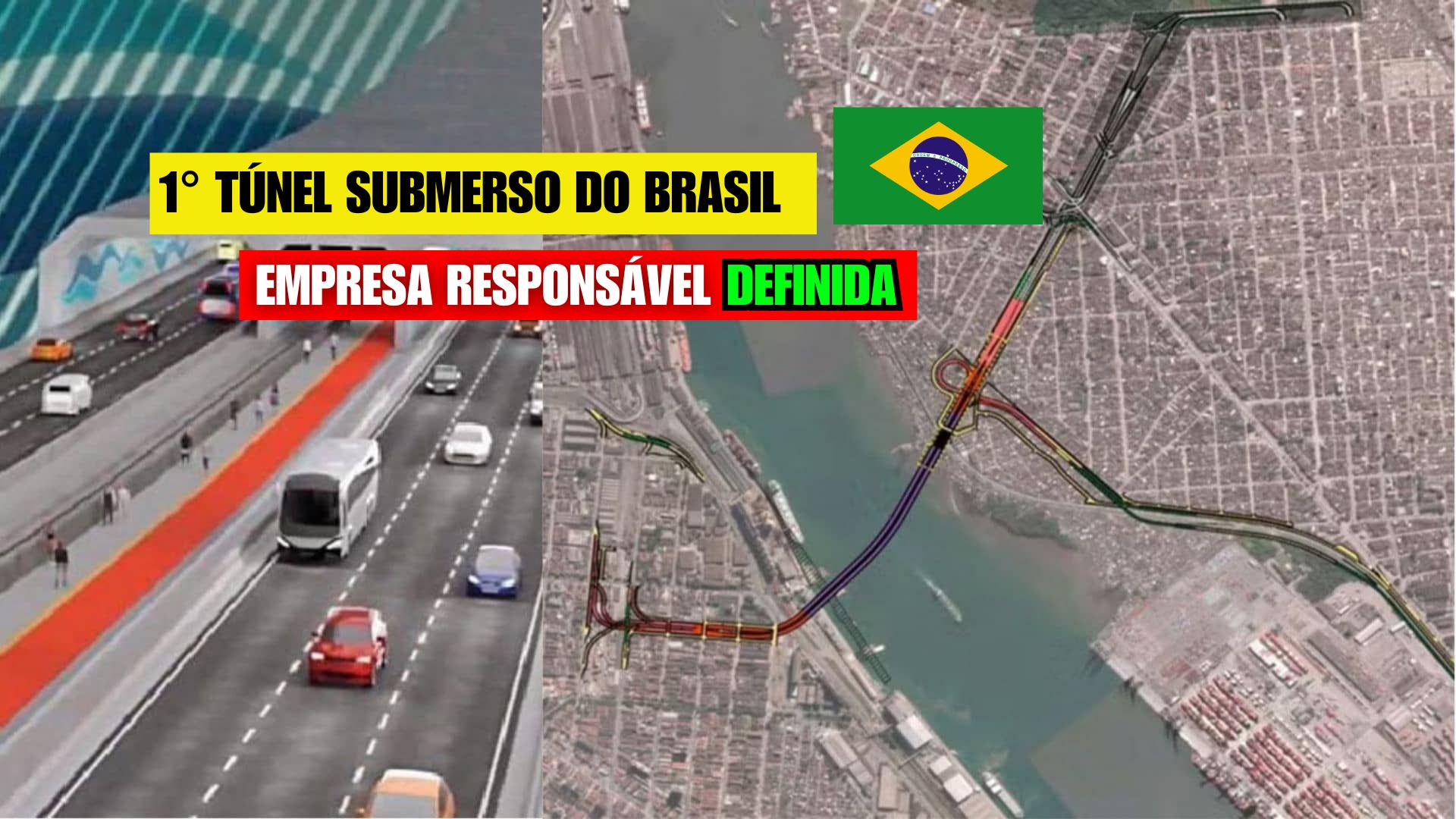

The First Underwater Connection Between Santos and Guarujá Promises to Change Mobility in Baixada Santista, Impacting Cars, Pedestrians, Cyclists, and VLT, After Auction Won by Portuguese Construction Company with Chinese Capital Participation.
Mota-Engil Wins Santos-Guarujá Tunnel Concession with a Discount of 0.5% The Portuguese Mota-Engil won the auction to build and operate the Santos-Guarujá Immersed Tunnel, the first submerged crossing in the country.
The bidding took place this Friday, September 5, at B3’s headquarters in São Paulo, and ended with a 0.5% discount on the maximum public concession fee. The Spanish company Acciona also participated but did not present a discount.
Billion-Dollar Investment and Concession Period
According to the bidding rules, the project will be contracted as a sponsored PPP, with an estimated investment of R$ 6.8 billion and a contract of 32 years.
-
Bolivian Female Construction Workers Form Association to Combat Discrimination and 38% Pay Gap in the Industry

-
Near Amsterdam, residents buy land and discover they must also build streets, manage drainage, handle waste, and grow food on half their plot.
-
Brazil’s WEG to Open New Factory in China by 2027, Expanding Production of Large Rotating Electric Machines and Low to Medium Voltage Motors in Rugao

-
Chinese Shipyard Secures $1 Billion in Orders for Low-Carbon Container Ships Amid Global Fleet Renewal Efforts


The annual public concession fee reference is R$ 438 million, paid after the start of operations.
The project is part of the New PAC and was structured in partnership between the São Paulo government and the federal government.
Structure of the Immersed Tunnel

The engineering solution envisions a total length of 1.5 kilometers, of which 870 meters will be submerged in the bed of the estuary leading to the Port of Santos.
The design includes three lanes in each direction, with one dedicated to the VLT (Light Rail Vehicle), as well as a bikeway, pedestrian crossing, and technical gallery.
The immersed tunnel technique, already applied in European and Asian countries, will be used for the first time in Brazil.
Who Won and How Much Will It Cost
Mota-Engil surpassed Acciona by offering the largest discount on the concession fee. According to the federal government, this is the largest infrastructure project of the New PAC in the aquaculture sector.
The model foresees that a significant part of the investment will be financed by the public authority, with the concessionaire responsible for constructing, operating, and maintaining the connection during the contract term.
Connection Between Santos and Guarujá
The tunnel will connect Outeirinhos/Macuco in Santos to Vicente de Carvalho in Guarujá, eliminating the exclusive dependence on ferries and reducing the road distance currently traveled on longer routes.
The route has been designed to allow safe passage of vessels in the port canal and to accommodate the VLT corridor, which will integrate with the metropolitan system of Baixada Santista.
Reduced Crossing Time
Currently, the connection between the cities is via ferry or road.
The distance of about 400 meters by ferry is covered in approximately 7 minutes, but the wait can vary from 15 minutes to over 1 hour, depending on the tide and demand.
By land, the travel time can reach 1 hour, depending on the volume of traffic.
With the tunnel, the public authority and specialized publications estimate a journey of around five minutes, with continuous flow.
Daily Public Served
The latest data indicates about 21 thousand vehicles per day in the crossing, in addition to 7.7 thousand cyclists and 7.6 thousand pedestrians who use vessels between Santos and Guarujá.
The federal government projects up to 80 thousand people per day using the future crossing when it is operational, alleviating lines and increasing the predictability of travel.
Authorities Present at the Auction
The public session was attended by Vice President Geraldo Alckmin, Governor Tarcísio de Freitas, and ministers such as Fernando Haddad (Finance) and Silvio Costa Filho (Ports and Airports), in addition to Márcio França (Entrepreneurship).
They witnessed the opening of the envelopes and the hammer falling at the São Paulo stock exchange.
Contract Oversight and Regulation
The Antaq will oversee the concession in cooperation with Artesp, given the direct interface with the port operations in Santos and the urban mobility of the region.
The regulatory arrangement was defined in a technical cooperation agreement between the Union and the State, which provides for coordinated action from planning to execution.
Expected Timeline
After the auction, the expectation stated by authorities is to sign the contract still in 2025, develop the executive projects throughout 2026, and complete the works around 2031.
These milestones still depend on contract processing and definitive licenses.
Profile of Mota-Engil
Founded in Portugal, Mota-Engil has a broad presence in infrastructure in Europe, Latin America, and Africa.
In 2021, the Chinese state-owned company CCCC entered the company’s capital and now holds 32.41% of the shares as a reference shareholder. The Mota family remains the main controlling entity.
The presence of CCCC gives financial strength to the European company, but operations in Brazil will be conducted by Mota-Engil’s local structure, the winner of the bidding.

Impact on Mobility in Baixada Santista
The new connection tends to shorten daily commutes and integrate modes — cars, bicycles, pedestrians, and VLT — making predictable a crossing that currently fluctuates according to demand and conditions in the estuary.
It should also ease traffic on the road route used by trucks and buses servicing the Port of Santos, directly impacting regional logistics.
In the short term, execution will require organizing work fronts and potential road interventions on the margins of the canal.
International Bidding
The bidding attracted two foreign companies and reinforced the presence of European groups in large concessions in Brazil.
Although Mota-Engil has significant Chinese capital in its shareholder structure, the company is of European origin and headquarters, which explains the result aligned with the title: the first Brazilian submerged crossing will be under the responsibility of a Portuguese company.
With works expected to start after the contract is signed, the expectation of users and managers is that the new crossing will shorten the journey “from one hour to a few minutes.”
In practice, which aspect of the project will most transform your routine: the VLT lane, the bikeway, or the reduction of travel time?





Na verdade a empresa portuguesa vai construir em parceria com uma empresa chinesa