Portuguese
  Spanish


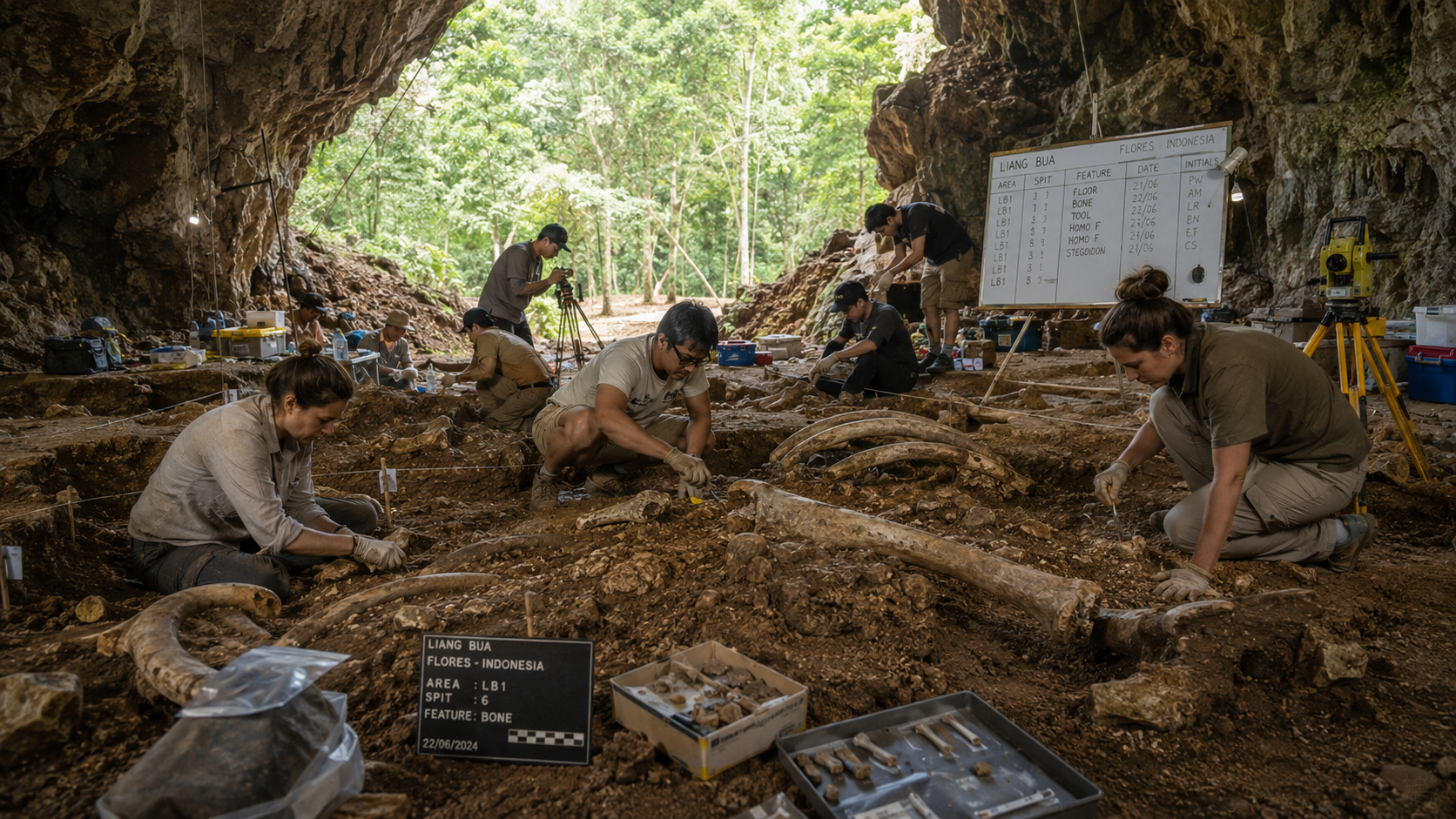

Study reveals unexpected behavior of Homo floresiensis and suggests that this species may never have mastered hunting large animals or using fire as scientists believed for decades, opening a new perspective on human evolution.
For decades, the image of Homo floresiensis, popularly known as the “hobbit,” was associated with the idea of a small hunter capable of making tools, hunting large prey, and using fire to cook food. However, a new international study published in the scientific journal Science Advances, on July 4, 2025, directly challenges this interpretation and proposes a completely different explanation for the survival of this prehistoric species.
The information was released by CNN, based on the scientific study published in Science Advances, developed by researchers from the Smithsonian Institution, the archaeological site of Liang Bua, and other international institutions specializing in paleoanthropology. The results indicate that Homo floresiensis likely took advantage of animal remains left by Komodo dragons, rather than hunting them directly.
Furthermore, the researchers found evidence that casts doubt on another widely accepted theory: that the “hobbits” mastered the use of fire. If this hypothesis is confirmed by new research, it will be necessary to revise an important part of the current knowledge about human evolution.
-
Tiny 10-centimeter fish in Brazilian reservoirs may play a surprising role in reducing methane emissions, scientists find.

-
ChatGPT Creator Bets Big on Fusion Energy Machine Promising Unlimited Power for Microsoft by 2028, But Physicists Skeptical

-
Time Travel Proven Possible by Science, Yet a Mystery Still Challenges Einstein, Quantum Physics, and Top Scientists
-
Pennsylvania Mine Creates Ice in Summer Heat and Melts in Winter, Turning a Mountain Crevice into a Reverse Natural Refrigerator




Who were the “hobbits” that lived in Indonesia?
The story of Homo floresiensis began to change in 2003, when archaeologists found fossils in the famous Liang Bua cave, located on the island of Flores, in Indonesia.
The researchers identified an extremely small hominid. Its skull was approximately the size of a grapefruit and its height probably reached only 1 meter.
Despite the brain being slightly larger than that of a chimpanzee, the species sparked enormous scientific interest because it presented unique characteristics.
Near the fossils, archaeologists also found thousands of stone tools and various bones of Stegodon florensis insularis, an extinct relative of modern elephants.
This animal had dimensions similar to those of a bison and represented the largest herbivore on the island at that time.
As a result of these discoveries, many experts concluded that Homo floresiensis made tools to hunt large animals.
Moreover, some burnt bones found in the excavations led part of the scientific community to believe that this small species also used fire to prepare food.
For years, this interpretation brought the “hobbits” closer to much more advanced species, such as Homo erectus, the Neanderthals, and Homo sapiens.
These groups developed larger brains and exhibited behaviors considered more sophisticated throughout human evolution.
New research questions old theories about the species
Paleoanthropologist Elizabeth Grace Veatch, a specialist in the evolution of human diet, decided to investigate the lifestyle of Homo floresiensis once again.
Her main goal was to discover how this population managed to survive on an isolated island between approximately 190,000 and 50,000 years ago.
To do this, Veatch and her team conducted a detailed analysis of the Stegodon bones found on the island of Flores.
The researchers sought to identify exactly which marks had been produced by stone tools and which could have been left by natural predators.
According to the scientist, it was necessary to verify if there was really enough evidence to claim that the “hobbits” hunted large mammals.
The study received collaboration from the Human Origins Program of the Smithsonian Institution’s National Museum of Natural History and used different investigative techniques to reconstruct the species’ dietary behavior.
The initial results already indicated that the traditional interpretation might be mistaken.
Therefore, the scientists decided to expand the experiments to directly compare the marks left on the bones by human tools and by large predators.
Experiment with Komodo dragon brought surprising answers
To test this hypothesis, the team conducted an unusual experiment at the Atlanta Zoo in the United States.
The researchers observed a Komodo dragon named Rinca as it fed on a goat carcass.
After the meal, the scientists used 3D scanning equipment to record all the marks left by the animal’s teeth.
Then, they compared this information with the bones of Stegodon found in the Liang Bua cave.
The results surprised the team.
According to Elizabeth Grace Veatch, most of the marks on the fossils were very similar to those produced by Komodo dragons.
Meanwhile, the marks left by stone tools appeared mainly in areas where little meat remained.
This detail drew a lot of attention.
Instead of indicating organized hunting, the evidence suggests that the Homo floresiensis arrived only after the large lizards had finished their meal.
Thus, the “hobbits” only took advantage of the available remains, using their stone tools to remove small pieces of meat still attached to the bones.
This interpretation profoundly changes how scientists view the behavior of this species.
Moreover, it reinforces the hypothesis that Komodo dragons played a central role in the island’s food chain during that period.
Study also questions the use of fire by Homo floresiensis
In addition to presenting a new hypothesis about the “hobbits’” diet, the research brought another result that could profoundly alter the understanding of this species: the possible absence of fire mastery.
For many years, various researchers argued that the Homo floresiensis used campfires to cook food. This interpretation arose after the discovery of some burnt bones during excavations in the Liang Bua cave.
However, the new investigation found evidence pointing to a different conclusion.
To clarify this issue, the scientists analyzed approximately 4,500 small rodent bones found in different sedimentary layers of the cave. These remains were naturally deposited over thousands of years by owls that used the site as a shelter.
According to the researchers, if the “hobbits” frequently used campfires, the bones in the lower layers would show clear signs of charring.
However, this did not happen.
None of the 4,500 bones examined showed evidence compatible with continuous exposure to fire.
Furthermore, no Stegodon bone showed burn marks related to cooking the meat.
On the other hand, a few charred fragments appeared only in much more recent archaeological layers.
Therefore, the team believes that these traces are linked to the arrival of Homo sapiens on the island of Flores, approximately 46,000 years ago, a period after the disappearance of both Stegodon and Homo floresiensis.
Another important detail also caught the researchers’ attention.
According to the study, the venom of the Komodo dragon probably did not pose a risk to the “hobbits.” This is because the proteins present in the venom would be naturally degraded by the enzymes of the digestive system, allowing the safe consumption of meat left by the large reptiles.
Thus, the hypothesis that Homo floresiensis acted as a scavenger gains even more strength.
Discovery may change the evolutionary tree of early humans
The study’s conclusions go far beyond diet.
According to the authors, simpler behavior may indicate that Homo floresiensis belongs to a much older lineage than previously thought.
For decades, part of the scientific community believed that the “hobbits” descended from Homo erectus. This hypothesis arose mainly because both used stone tools and supposedly mastered fire.
Now, however, the new research weakens this interpretation.
If Homo floresiensis really did not hunt large animals or use fire, it may represent a much more primitive branch of human evolution.
Among the possibilities raised by the researchers are species such as Homo habilis or even representatives of the genus Australopithecus.
These ancestors had smaller brains and exhibited a behavioral repertoire considered simpler.
According to the study, an ancestral population may have arrived on the island of Flores more than 1 million years ago. From this geographical isolation, this lineage would have followed its own evolutionary path for hundreds of thousands of years.
Researcher Chris Stringer, a paleoanthropology specialist at the Natural History Museum in London, stated that the new results reinforce an old hypothesis that Homo floresiensis might not even belong to the genus Homo.
Although he did not participate directly in the research, Stringer considers that the new evidence strengthens this possibility.
At the same time, he emphasizes that any potential reclassification will depend on the discovery of new fossils and additional information about the species’ ancestry.
Meanwhile, the archaeologist Thomas Sutikna, responsible for the research in Liang Bua since 2001 and a member of the team that found the first fossils in 2003, highlighted that each new excavation significantly modifies the knowledge about these ancient inhabitants of the island.
Similarly, Elizabeth Grace Veatch intends to expand the research to investigate whether the Homo floresiensis also consumed other animals present in the local ecosystem.
According to the scientist, understanding the entire diet of this population will allow reconstructing their true ecological role within the island of Flores.
Finally, the study published in the journal Science Advances demonstrates that human evolution was probably much more complex than scientists had imagined until now.
Instead of highly specialized small hunters, the “hobbits” may have survived thanks to the ability to take advantage of resources available in the environment, including carcasses left by Komodo dragons.
If future research confirms this hypothesis, it will be necessary to revise important chapters of the history of human evolution and reassess how different species developed distinct strategies to survive over hundreds of thousands of years.
Do you believe that new archaeological discoveries can still completely change the history of human evolution? Share your opinion in the comments.