





 Portuguese
  English
  Spanish
  4 min of reading
  0 comments


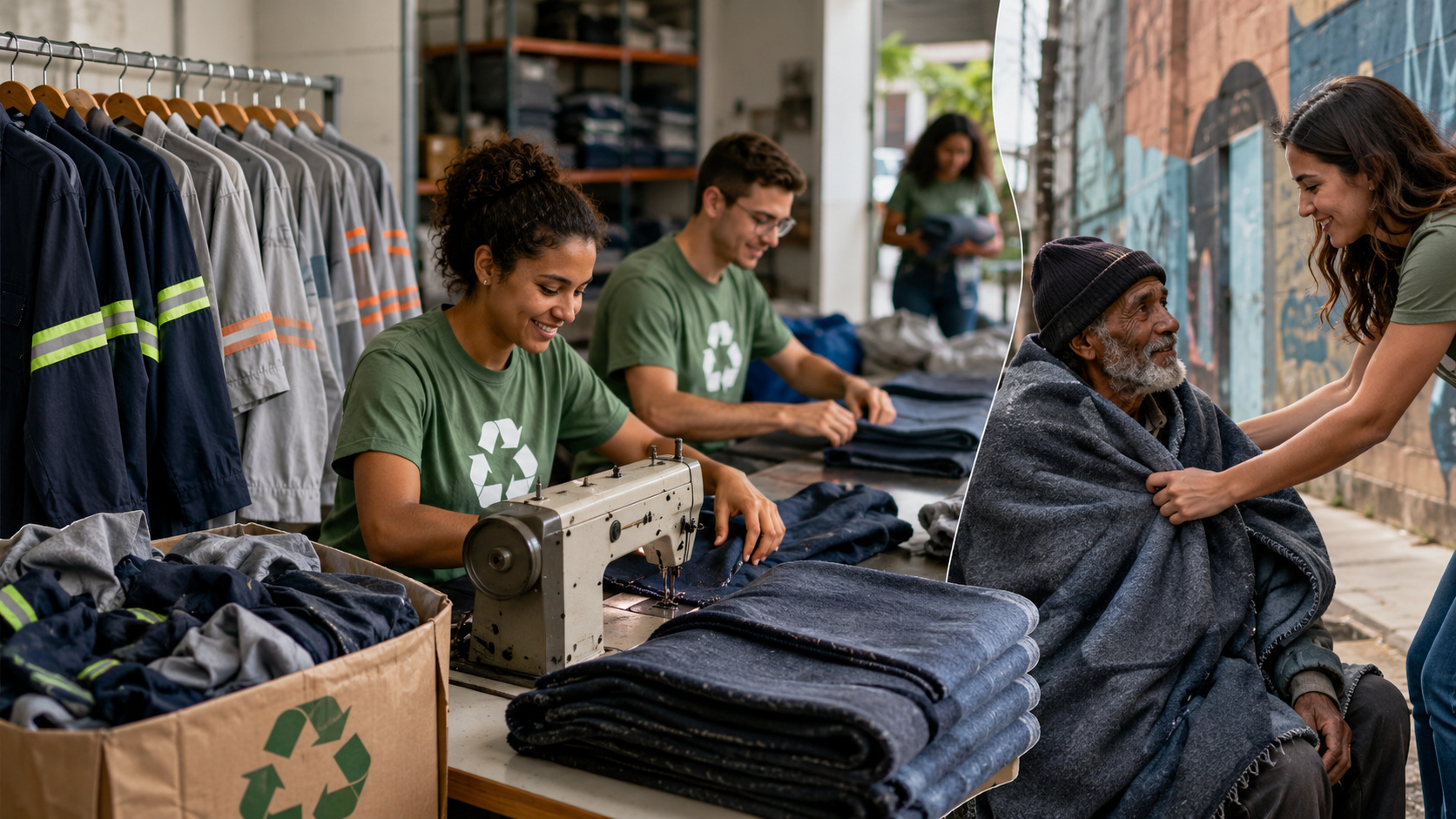
Used uniforms are being transformed into blankets for homeless people, in an initiative that combines textile recycling, circular economy, and social impact in Brazil.
Every year, companies accumulate out-of-use uniforms that have lost operational function, been replaced, or gone out of circulation. Instead of going directly to disposal, part of this material is being reused in a textile reverse logistics chain that transforms corporate waste into blankets for people in social vulnerability. According to Retalhar, the process even allows transforming the fibers of the uniform itself into a blanket, provided there is a minimum volume and suitable material composition.
The proposal gained strength in Brazil by combining a more environmentally responsible destination, industrial reuse, and direct social support. According to Retalhar, such actions also generate inclusive income for workers in vulnerable situations, showing that the discarded uniform can return to the production cycle with a completely different utility from the original.
Used uniforms become blankets in a textile recycling chain and social impact
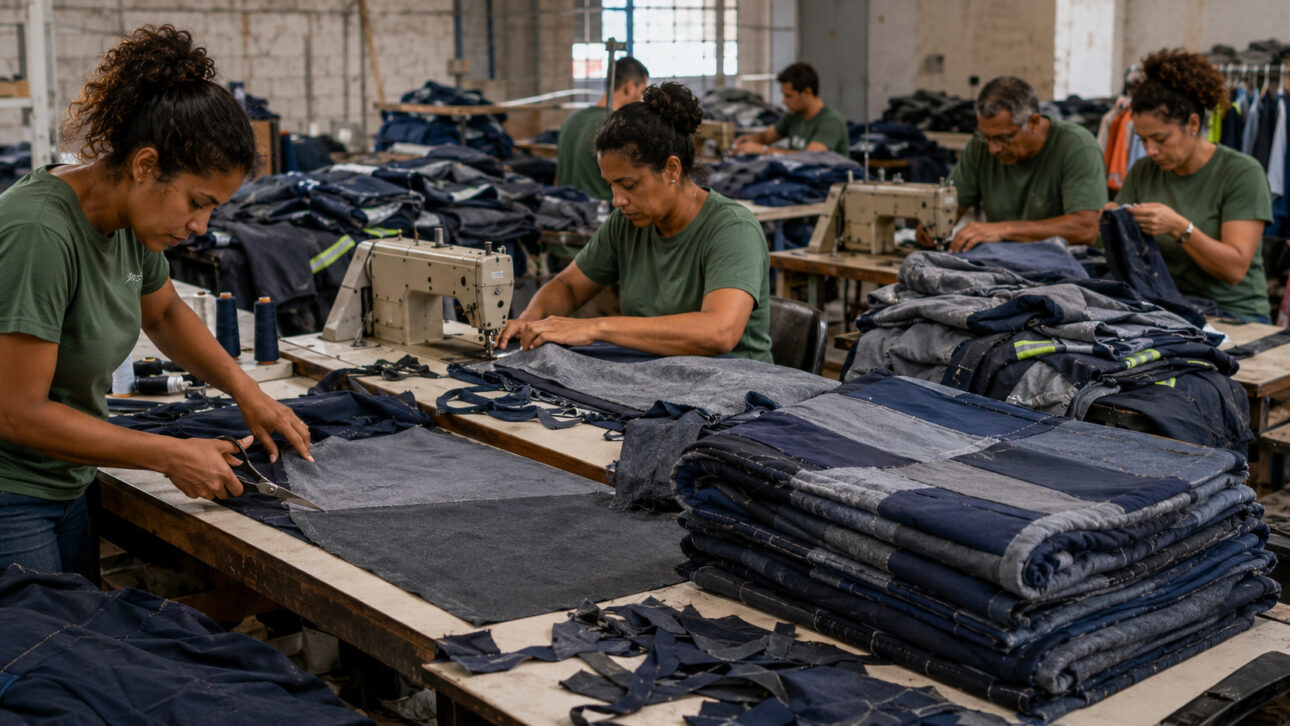
The project starts with the collection of uniforms no longer in use. Then, the pieces go through sorting and preparation stages until the fabric can be reused. According to Retalhar, this material can be transformed into new products, including recycled blankets, within a circular economy logic applied to corporate textile waste.
-
Engineers from Norway develop a submersible barge to lift structures of 2,500 tons without relying on the world’s largest crane ships, aiming to reduce the costs of offshore wind turbine installation.

-
The ocean has become raw material: fishermen remove plastic from the sea and a brand transforms bottles, nets, and marine litter into premium clothing.

-
Goodbye, manual recharging: Xiaomi has unveiled a robotic arm for home use that automatically plugs in the electric car and takes care of recharging without the driver touching the cable, a mechanical hand that automatically starts and stops charging and is expected to hit stores at the end of 2026.

-
Moon dust can be more dangerous than a storm: NASA studies glass-like sharp grains that stick to suits, get into seals, and can threaten lunar bases.




In practice, what would previously be just an environmental liability gains a new function. Instead of occupying space in landfills, the fabrics are reused and return as items of immediate utility for winter actions and support for homeless people.
According to Retalhar, this type of operation shows that reverse logistics can be used not only to reduce disposal but also to create direct social impact.
Retalhar showed that tons of uniforms can become thousands of blankets
One of the most well-known examples of this model came from a winter campaign organized by Retalhar itself. According to the company, the initiative mobilized civil society and 20 companies, repurposed more than 14 tons of professional uniforms, and produced 11,520 blankets for people living on the streets.
The same action also generated income for workers in vulnerable situations and prevented this material from being sent to landfills. According to Retalhar, the campaign saved more than 111 m³ of landfill volume and avoided the generation of 218.56 tons of CO₂ equivalent, reinforcing the environmental impact of this type of textile repurposing.
This result helps explain why the model has attracted the attention of companies dealing with large volumes of uniforms. Instead of simply discarding old pieces, they began to see textile waste as raw material for a socially useful product.
FedEx also transformed 93,000 uniforms into more than 37,000 blankets in Brazil
Another relevant case came from FedEx. According to an official statement from the company published in July 2025, the company’s uniform recycling program in Brazil had already transformed, over 10 years, 93,000 pieces of clothing, equivalent to 30 tons of fabric, into more than 37,000 blankets.
The company reported that these blankets benefited 60 institutions supporting people in social vulnerability and also animal protection. In the 2025 edition alone, FedEx recycled more than 13,000 uniforms and produced 5,650 blankets, with 4,600 for people and 1,050 in smaller sizes for animals.
The case shows that transforming uniforms into blankets is no longer a one-off action. It has become part of continuous programs by companies with large textile waste generation, expanding the scale of repurposing and donation.
Uniform Recycling Gains Importance in a Country Disposing of Millions of Tons of Textile Waste
The relevance of these initiatives grows when observing the size of the problem in Brazil. According to FedEx, based on a survey by the consultancy S2F Partners, the country disposes of about 4 million tons of textile waste per year. The same reference cited by the company states that, in 2024, each Brazilian household discarded an average of 44 kilograms of clothing and footwear.

In this context, uniform reuse programs gain relevance because they address a concrete fraction of this liability.
They do not solve the national textile waste problem alone, but they demonstrate a practical application of circular economy in an area where a large portion of the material still ends up being discarded.
Discarded Uniform Becomes Protection Against the Cold
The main value of these initiatives lies in changing the material’s destination. A uniform that has lost its commercial use ceases to be just waste and starts to fulfill a new social function.
Instead of being idle, stored without purpose, or sent to landfill, it returns as a blanket for those facing cold and vulnerability on the streets.
At the same time, the chain combines textile recycling, reverse logistics, waste reduction, and income generation. This is what makes the model stronger than an isolated donation. Corporate waste ceases to be just an environmental problem and becomes a tool for immediate social impact.






Be the first to react!