





 Portuguese
  English
  Spanish
  5 min of reading
  0 comments


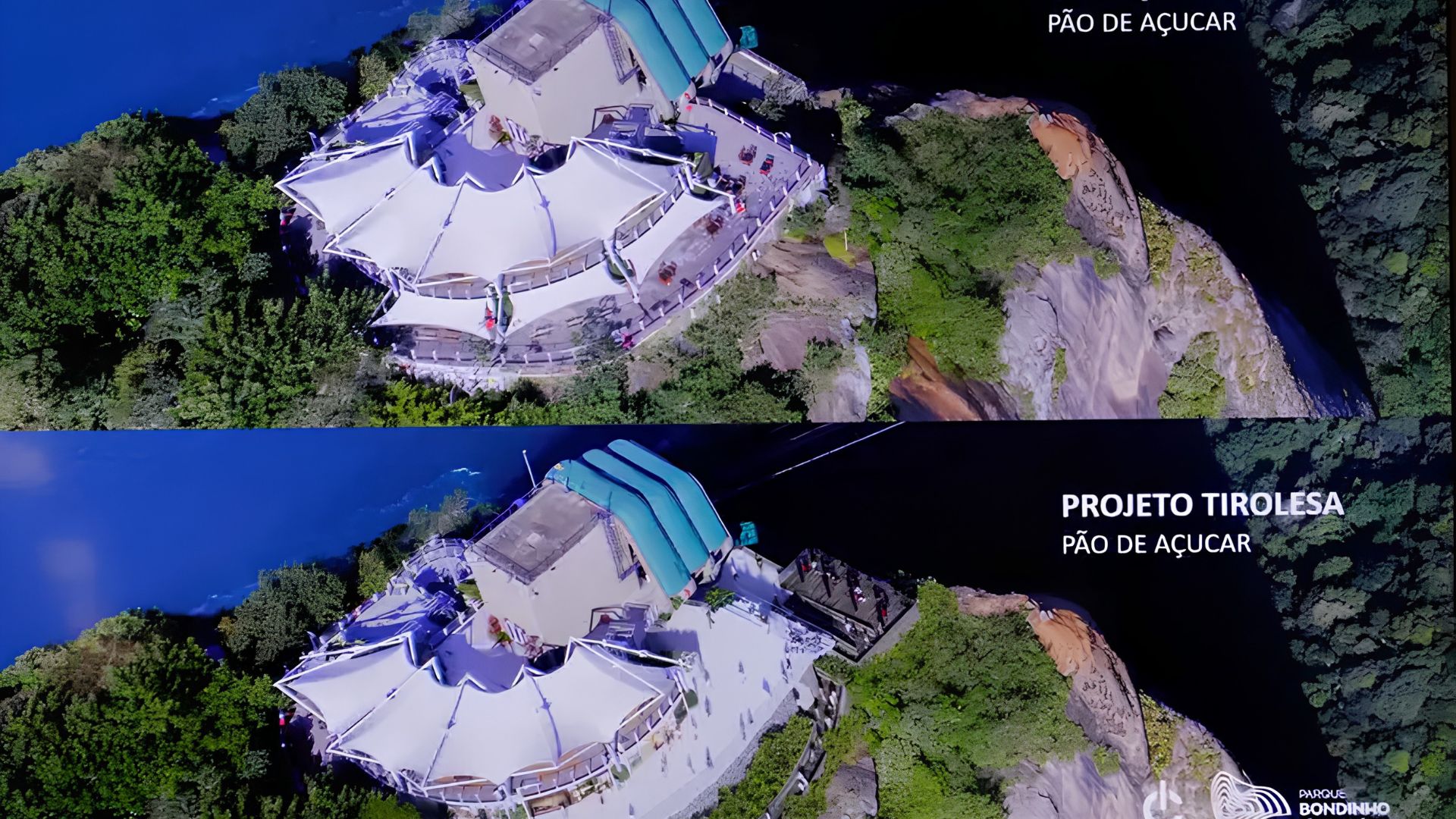
Zipline project on Sugarloaf Mountain anticipated 755 meters, four parallel lines, and an annual impact of up to R$ 107.8 million on Rio’s tourism.
The zipline project on Sugarloaf Mountain has once again drawn attention in Rio de Janeiro because it combined three elements with enormous public appeal: adventure tourism, economic impact, and the preservation of one of Brazil’s most famous landscapes. According to the Rio City Hall, in a study released on May 20, 2026, the proposal anticipated four parallel lines connecting Morro da Urca to Sugarloaf Mountain, over a distance of 755 meters with a panoramic view of the city.
The economic estimate was high. According to the Municipal Secretariat of Economic Development, the new attraction could generate an impact of up to R$ 107.8 million per year on Rio’s economy, considering additional tourists, longer stays in the city, spending on accommodation, food, transportation, leisure, and shopping. The figure placed the zipline at the center of a broader discussion about how Rio can exploit its landmarks without altering what made these places world-renowned. But on March 31, 2026, G1 reported that the Project was canceled, Iphan’s license was annulled due to lack of public debate.
Zipline project on Sugarloaf Mountain anticipated four 755-meter lines over Rio’s landscape
According to the Rio City Hall, the planned structure would connect the hills of Urca and Sugarloaf Mountain via four parallel cables, in a descent of 755 meters. The idea was to create an adventure experience at one of the city’s most visited tourist spots, taking advantage of the visual power of Guanabara Bay, Botafogo Cove, and the silhouette of Sugarloaf Mountain itself.
-
Man builds a 100 m² house with 11,000 PET bottles in Minas Gerais and moves people by revealing that his father collected almost all the material around the city before it became common trash.

-
50-meter tunnel below the seabed could retire old ferries in the Shetland Islands: £400 million project promises to connect communities, reduce isolation, and transform the future of transportation in Scotland
-
Brazil delivers a giant dam worth R$ 365.7 million in Rio Grande do Sul, capable of forming an artificial lake with 138 million m³ of water, equivalent to 55,300 Olympic swimming pools and an area larger than 2,500 football fields.

-
Most people use a tape measure their whole lives without ever understanding why some numbers are painted red; the explanation lies in a 16-inch spacing that is invaluable for those who work with walls and wood.




The proposal attracted attention precisely because of its scale. It was not an isolated attraction in a peripheral area, but an intervention in one of the country’s most recognized landmarks. Sugarloaf Mountain has had a consolidated tourist experience for decades with the cable car, and the zipline aimed to add a more radical layer to the traditional visit.


This contrast helped turn the project into a topic of national repercussion. On one hand, the promise of renewing Rio’s tourism with a visually appealing attraction. On the other, the necessary care with a landscape that is part of Rio’s identity and appears as an international symbol of the city.
City Hall estimated an impact of R$ 107.8 million per year with the new tourist attraction
The main economic argument presented by the City Hall was the potential to attract new visitors and increase the length of stay of tourists in the city. The zip line could increase by 85 thousand the number of tourists who would go to Rio exclusively because of the attraction or who would stay longer to experience the equipment, according to the Rio city hall.
The City Hall also reported that the Sugarloaf Cable Car Park receives approximately 2 million visitors per year, with 15% being locals and 85% tourists, divided between national and international visitors. The projection was that the zip line would reach about 200 thousand users per year, equivalent to approximately 10% of the annual audience of the complex.
The economic account considered effects beyond the attraction’s entrance fee. The study included expenses on hospitality, bars, restaurants, transportation, entertainment, telecommunications, and shopping. Therefore, the City Hall presented the zip line as equipment capable of producing an indirect impact on different sectors of Rio’s economy.
Rio wanted to transform a classic postcard into an adventure experience
The Sugarloaf has a rare characteristic: it is at the same time a natural monument, a tourist attraction, an urban symbol, and a setting of high emotional value for residents and visitors. Any new structure in that space tends to generate a greater impact than it would in a less symbolic area.

The zip line emerged precisely with this proposal to transform traditional contemplation into an adrenaline experience. Instead of just taking the cable car and observing the landscape, the visitor could cross part of the complex in high visual exposure, suspended over the void between the hills.
This type of attraction follows a global trend of experiential tourism, where established destinations seek new forms of permanence, consumption, and visual engagement. The problem is that, in the case of Sugarloaf, the landscape is not just a setting for a tourist activity. It is the cultural, natural, and symbolic product of the visit itself.
Project did not advance and left a question about the future of Brazilian postcards
Despite the tourist and economic potential, the project did not proceed as planned. The proposal was interrupted after questions about the impacts of the installation on the landscape ensemble of the Urca and Sugarloaf hills. Instead of becoming a new adventure attraction, the zip line came to symbolize the limit between tourist innovation and the preservation of iconic places.
This point changed the center of the conversation. The discussion was no longer just about how much the attraction could generate per year and began to involve a bigger question: how far is it possible to transform a postcard into a tourist product without compromising its visual identity and its historical relationship with the city?

In the case of Sugarloaf Mountain, this question gains special weight because the location is already one of Rio’s greatest tourist assets.
The landscape is valuable not only for the number of visitors but for the symbolic strength accumulated over decades. It is an image associated with Brazil abroad, with the Carioca imagination, and with the classic experience of those visiting the city for the first time.
Sugarloaf Mountain shows the challenge of modernizing tourism without erasing the value of the landscape
The case of the zip line sums up a dilemma that appears in several tourist cities around the world. Famous destinations need to renew themselves, generate revenue, expand experiences, and compete for visitors. At the same time, they need to preserve exactly what made them desirable.
The economic promise of the zip line was significant, with an estimated impact of over R$ 100 million per year. The technical proposal also had strong visual appeal, with 755 meters of route and four lines connecting two of the country’s most well-known hills. But the repercussion showed that high numbers do not end the debate when the involved scenario is a national symbol.
In the end, the project left an important mark even without becoming a tourist attraction. It revealed how Rio is still seeking new ways to explore its natural potential, but also showed that interventions in iconic landscapes need to balance revenue, experience, urban memory, and preservation.
Sugarloaf Mountain remains one of Brazil’s greatest postcards, and any attempt to reinvent it will inevitably be more than just a simple leisure project.







Be the first to react!