Portuguese
  Spanish




Laser Power Transmission System Validated In Tests Provides Continuous Electricity To Drones In Flight Up To 5,000 Feet, Operates Kilometers Away, Integrates Autonomous Transmitter And Lightweight Receiver And Prepares Full Demonstrations With Ultra Long Endurance Aircraft In 2026
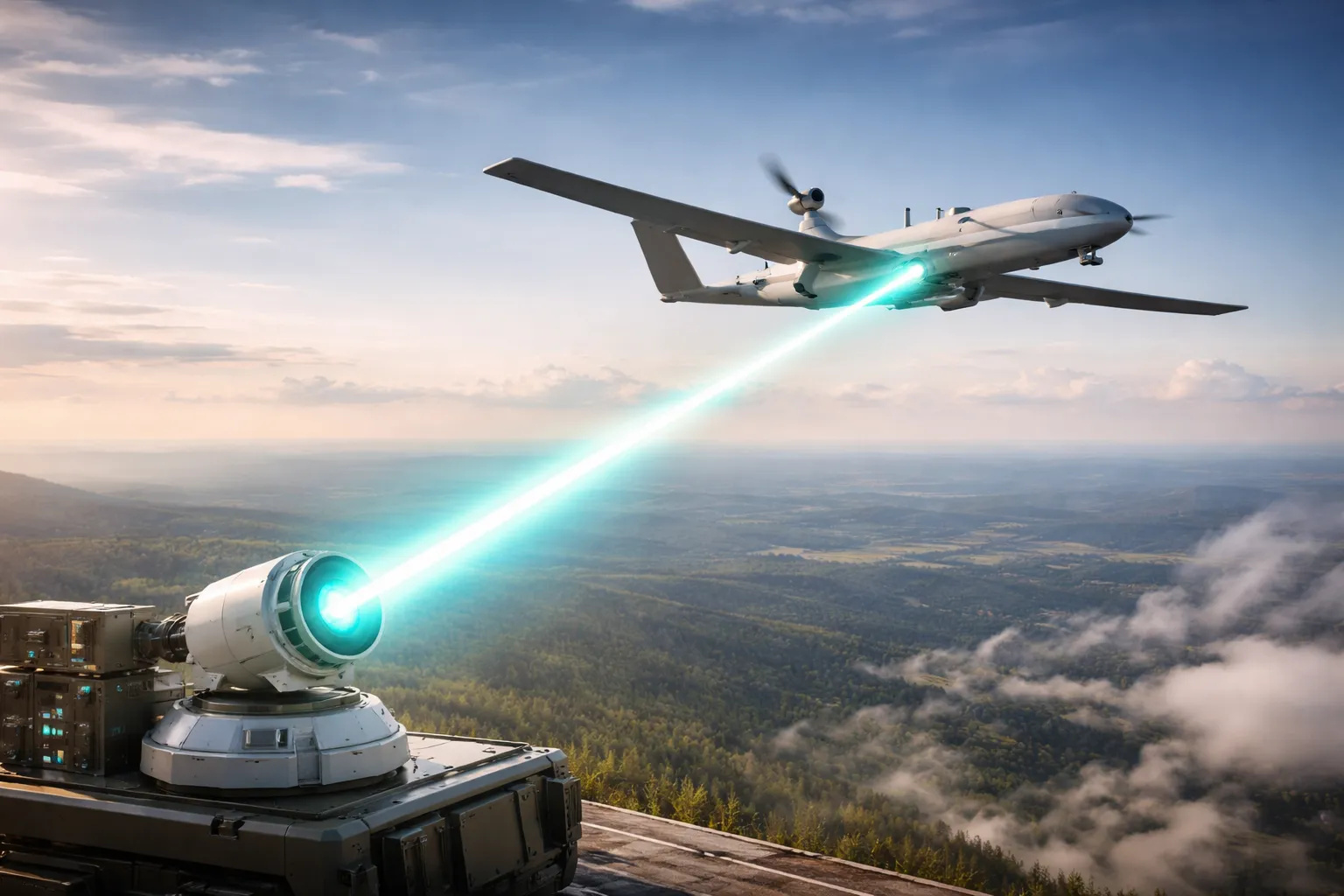
PowerLight Technologies has completed tests of a laser recharging system for unmanned aircraft, capable of providing in-flight power up to 5,000 feet, within the PTROL-UAS program, with a direct impact on the operational range of military drones.
PowerLight reported that the trials took place under the Power Transmitted Over Laser to UAS, the PTROL-UAS, partially sponsored by the U.S. Central Command, marking the transition from isolated components to complete integrated systems.
According to the company, this phase represents an essential technical step toward future flight demonstrations by validating the joint operation between high-power laser transmitter and lightweight airborne receiver in controlled conditions.
-
A Japanese governor single-handedly stalled the construction of the world’s fastest train for nine years, and only now has he agreed to allow a tunnel excavated at a depth of 1,400 meters.

-
Almost 1 billion euros, two gigafactories, and a million-dollar public investment, Chinese company aims to turn Spanish city into Europe’s new battery hub.

-
Advancement in the industry: Brazilian company creates ultralight material comparable to steel and paves the way for hydrogen cylinders up to 70% lighter, with a direct impact on logistics, the energy industry, and national competitiveness – learn about Forza Composites

-
In Brazil’s backyard: Tesla, by Elon Musk, announces official operations in Uruguay, where electric vehicles already make up 20% of new cars but still leaves out the largest market in the region.





System Architecture And Power Line Concept
At the core of the solution is a high-power autonomous laser transmitter, paired with an air-delivered receiver, designed to form a wireless power line in the air.
PowerLight described that the set is capable of delivering energy in the order of kilowatts over distances of several kilometers, sustaining drones operating at continuous altitude without the need for landing.
Beam Tracking And Control Tests
The recent tests validated the transmitter’s ability to generate and accurately control a high-power laser beam while safely tracking a moving airborne target.
According to the company, the system was designed to actively track and lock onto allied aircraft, ensuring precise, stable, and operationally safe power transmission.
Mobile Use And Advanced Field Operation
The transmitter was developed for mobile deployment and advanced field operation, combining beam control software with hardware capable of sustaining continuous high-energy output for extended periods.
PowerLight emphasized that the software provides real-time monitoring and analysis, as well as compatibility with existing drone control systems and ground energy infrastructures.
Validated Altitude And Operational Parameters
During the trials, the system demonstrated the ability to provide power to aircraft flying at up to 5,000 feet, equivalent to about 1,500 meters, according to the data released.
The company indicated that the performance observed meets the initial requirements of the program, paving the way for applications in high-speed military aircraft operating in shared airspace.
Safety As A Central Design Requirement
PowerLight stated that safety was a fundamental concern throughout the testing process of the laser power transmission system.
The setup incorporates various protection measures, managed by automated controls and specialized oversight, to ensure safe operation in environments with multiple users and air traffic.
Communication Between Transmitter And Aircraft
“This is much more than a simple point-to-point energy transfer,” said Tom Nugent, Chief Technology Officer and co-founder of PowerLight.
“The transmitter communicates with the aircraft, tracks its movement, and provides power exactly where it’s needed. These tests validate the main architecture for future flight demonstrations,” Nugent stated.
Compact Airborne Receiver And Energy Conversion
On the aircraft side, PowerLight developed a compact receiver weighing about six pounds, designed for integration into long-endurance drones.
The receiver uses laser energy converters to capture the invisible energy from the beam and convert it into electricity, recharging onboard batteries during flight.
Telemetry And Future Optical Connections
An integrated control module within the receiver collects telemetry data and sends it to the ground station, according to the company, enhancing situational awareness for the operation.
This module also prepares the system for future optical data connections, expanding the functional scope of the architecture beyond simple energy transfer.
Strategic Objective Of The Program
One of the main goals of the PTROL-UAS is to establish power transmission as an essential capability for operational energy supply in the air, transforming the deployment of autonomous systems.
PowerLight stated that this approach could significantly change how drones are employed in extended missions, reducing dependence on conventional refueling or recharging.
Integration With Ultra Long-Endurance Aircraft
The company is working with Kraus Hamdani Aerospace to integrate the system into the K1000ULE, an ultra-long-endurance unmanned aircraft aimed at missions for the U.S. Navy and Army.
The K1000ULE has been designed for scenarios where long battery life is essential and access to traditional support infrastructure is limited or nonexistent.
Operational Impact According To The Manufacturer
“The K1000ULE has been built to push the limits of endurance,” said Fatema Hamdani, CEO and co-founder of Kraus Hamdani Aerospace.
“The addition of laser beams provides a new level of persistence for large-area missions,” she stated, highlighting the expected operational gain.
Next Step And Timeline
With subsystem tests nearly completed, PowerLight reported that it is preparing for fully integrated flight tests in early 2026.
The demonstrations are expected to show continuous in-flight charging of a K1000ULE equipped with a laser receiver, a capability described by the company as infinite flight under controlled conditions.
PowerLight Technologies specializes in high-power laser transmission systems for commercial and defense applications, including optical communications and remote power supply.
The company is focused on developing solutions aimed at the persistent operation of aerial platforms, expanding energy capabilities in environments where conventional infrastructure is limited or nonexistent.