Portuguese
  Spanish


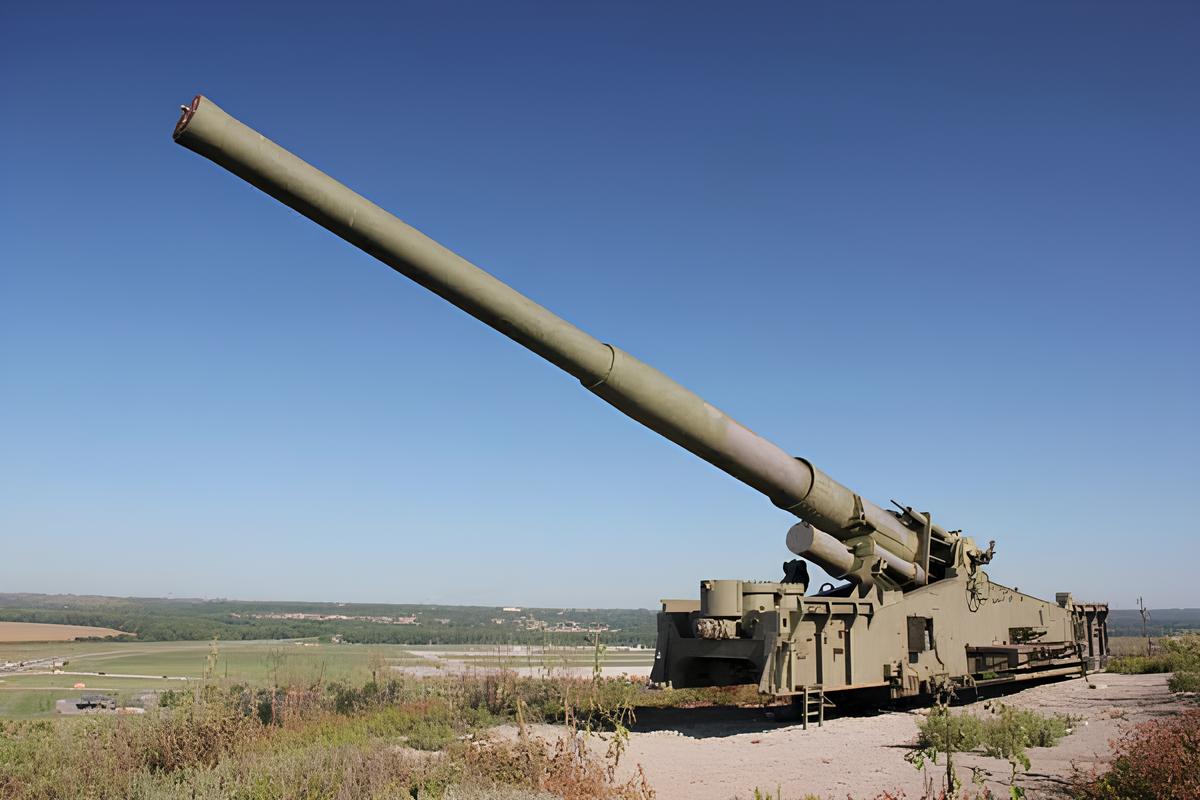

The Insane M65 Atomic Annie, 84-Ton Cannon, Fired a 15-Kiloton Nuclear Warhead in 1953 and Became the Symbol of the Cold War in the U.S.
At the beginning of the Cold War, the Soviet Union had tested its first atomic bomb in 1949, breaking the American monopoly. The world entered a spiral of nuclear fear, and the United States sought ways to bring atomic power to the conventional battlefield. It was in this context that the M65 Atomic Annie emerged, a 280 mm artillery gun designed to fire tactical nuclear warheads.
It was not just another piece of artillery: it was the fusion between traditional artillery engineering and nuclear devastation, amid the arms race.
The 84-Ton Titan That Traveled on Rails and Roads
The M65 impressed with its size. Weighing 84 tons, it was so large that it needed to be transported in two sections towed by specially adapted tractors.
-
Free Willy’s Orca, Captured as a Calf, Became a Global Star in a Mexican Tank and Was Part of the Most Controversial Attempt to Return a Captive Whale to the Wild

-
15-year-old Palestinian girl who fled Gaza war learns Portuguese in Brazil and wins gold at São Paulo Math Olympiad, inspiring teachers and classmates on social media.

-
“Vampire Deer” Rediscovered in Remote Afghan Forest After Nearly 60 Years, Highlighting Urgent Conservation Efforts
-
Historic Living Hedge in Brazil, Over 300 Years Old and 13 Meters Tall, Enters Guinness World Records


Its mobility was hybrid: it could be moved on roads in long military columns or adapted to operate on train tracks, reminiscent of the gigantic railway guns from World War II.


When assembled, it measured over 25 meters in length. Its presence was intimidating, not only because of its size but also because of what it represented: the possibility that an apparently conventional weapon could unleash an atomic explosion on the battlefield.
The First Nuclear Shot from an Artillery Piece
On May 25, 1953, in the Nevada desert during Operation Upshot–Knothole, the M65 made history.
In the test known as Grable, it fired a W9 nuclear projectile of 15 kilotons — a power similar to the bomb dropped on Hiroshima in 1945.
The warhead traveled about 10 km in less than 30 seconds and detonated 160 meters above the ground, producing a mushroom cloud that symbolized the nuclear age. It was the first and only time in history that an artillery piece fired an atomic bomb in real test conditions.
Range and Destructive Power
The M65 had a maximum range of approximately 32 km, which allowed it to hit targets deep within a battlefield.
With a nuclear warhead, this meant not only neutralizing fortifications or concentrations of enemy troops but obliterating entire medium-sized cities.
For military doctrine in the 1950s, it represented the ideal response: tactical nuclear power that was portable and capable of accompanying armies in ground operations.
A Nightmare for Moscow
For the Soviet Union, the existence of the M65 was a strategic shock. Until then, the Soviets were aware of the devastating power of bombs dropped from planes, but now there was the possibility of facing columns of artillery carrying nuclear warheads in conventional war scenarios.
The mere prospect of seeing nuclear cannons crossing land borders increased the risk of escalation in any conflict.
Moscow responded by ramping up its own nuclear and missile programs, further accelerating the arms race.
Limitations and Rapid Obsolescence
Despite being impressive, the M65 had several limitations:
- Excessive Size and Weight: required complex infrastructure for transportation.
- Low Rate of Fire: preparing and firing a nuclear projectile took time.
- Advancement of Missiles: from the late 1950s, ballistic and tactical missiles began to offer greater range, superior mobility, and strategic versatility.
Thus, in less than a decade, the atomic cannon began to lose operational sense. By the early 1960s, it was already obsolete in the face of the evolution of mobile nuclear rockets and more effective launch systems.
How Many Were Produced and What Was Their Final Fate
About 20 units of the M65 Atomic Annie were built. During its service life, they were showcased in military parades, demonstrations in Washington, and power displays at test fields, serving much more as a political and psychological symbol than as a practical weapon.
With the arrival of medium-range missiles, the cannons were gradually phased out of service. Today, some examples can be seen in military museums in the United States, such as those in Aberdeen and Fort Sill, preserving the memory of one of the craziest weapons of the Cold War.
The Legacy of the M65 Atomic Annie
Although it was never used in combat, the M65 marked the transition from the era of traditional artillery to the advent of tactical nuclear weapons.
The equipment demonstrated that, amid the fear and tension of the Cold War, military engineering could create machines that combined classic concepts with the power of atomic destruction.
The Atomic Annie was a giant that terrorized with its image and possibility, even though its practical value was limited. Today, it is remembered as the cannon that brought the atom to the battlefield, a symbol of the period when humanity flirted daily with nuclear annihilation.