






 Portuguese
  Spanish


Chinese Portal Highlighted Criticism of the Brazilian Army, Generating Debates on Priorities, Investments, and the Reputation of the Armed Forces in the International Arena, Highlighting the Impact of These Analyses on Brazil’s Image Abroad.
The Brazilian Army was at the center of an internationally resonant episode after being critically mentioned in a widely circulated publication from China.
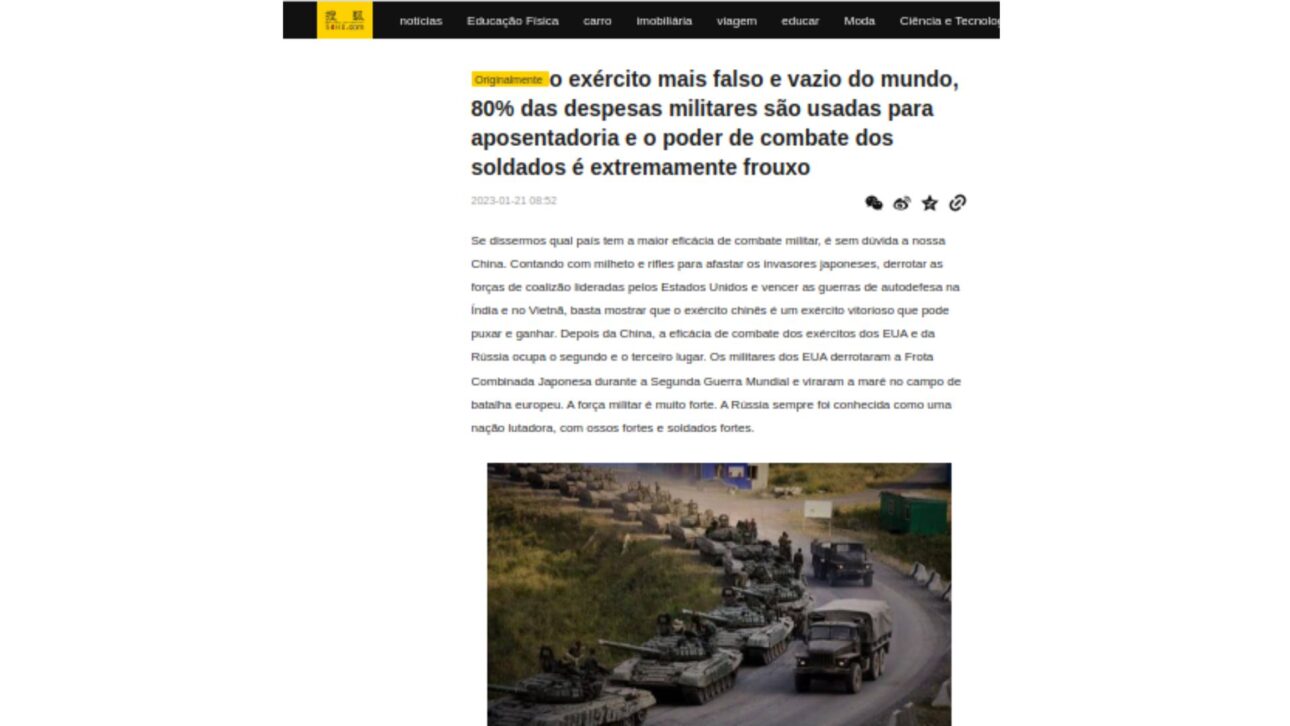
An article published by the portal Sohu.com, belonging to one of the main Chinese communication groups, presented an analysis of the Brazilian Armed Forces, questioning the distribution of the military budget and the effectiveness of the national defense structure.
The content, published in 2023, attracted the attention of experts, military personnel, and the Brazilian public, fueling debates about the role and readiness of the country’s military institutions.
-
77-Year-Old Woman Earns Top Marks for Embroidered Children’s Book Thesis with Her 98-Year-Old Mother, Moves Audience After Returning to University Entrance Exams 30 Years Later with a Score of 980

-
Domestic Workers in Switzerland Earn Around $220 per Day, Compared to $24-$60 in Brazil

-
As Engineering Jobs Decline in Brazil, Professionals Eye the U.S. with 186,500 Annual Openings and Salaries Up to $170,000
-
Brazilian Innovator Develops Concrete Blocks from Recycled Plastic, Eliminating Mortar and Reducing Construction Costs




International Criticism of the Brazilian Army
At the time, Sohu.com classified the Brazilian Army as “the most fake, weak, and empty in the world,” based on data about resource allocation in the defense sector.
The article mentioned that approximately 1.3% of the national military budget would be allocated for the acquisition of weapons and equipment, a figure below the international average, which hovers around 30%.
According to the text, this scenario would contribute to a low combat effectiveness and a modernization framework considered insufficient.
Budget Structure of the Brazilian Armed Forces
In addition to investments in equipment, the publication highlighted that around 80% of the expenditures of the Brazilian Armed Forces were spent on salaries, pensions, and benefits for active and reserve military personnel.
According to the Chinese analysis, this configuration highlighted a priority different from that observed in countries with a history of high investment in technology and military training.
Historical References and International Perceptions
The article retrieved historical references to illustrate the international perception of the Brazilian Army.
Among the examples cited was the phrase attributed to Adolf Hitler during World War II, stating that “if Brazilians knew how to fight, snakes could smoke cigarettes.”
Although the expression has been redefined by the Brazilian military itself, Sohu.com used the episode to illustrate foreign evaluations of the Brazilian troop’s operational capacity at that time.
Geographical and Strategic Factors
The text also addressed possible reasons for the profile of the Brazilian Armed Forces, citing factors such as Brazil’s geographical location, surrounded by countries with no recent history of armed conflict, and the influence of the United States on national defense policy.
The portal stated that, in the absence of strategic threats, Brazil would have no incentive to increase military investments or seek regional prominence in defense issues.
Peaceful Profile and International Repercussions
At the end of the publication, Sohu.com highlighted that the peaceful profile of Brazilian forces was perceived as a factor of stability in the international context.
The article indicated that, according to this analysis, Brazil’s stance of not seeking domination or exporting its ideas could be associated with promoting a more harmonious environment among nations.
The repercussions of the article were observed both in debate forums and in the international press, bringing discussions about the structure of the defense sector in Brazil to the forefront.
According to data from the Ministry of Defense, today, the majority of the budget of the Brazilian Armed Forces remains allocated to salaries and benefits, limiting the resources available for acquiring equipment, modernization, and troop training.


