






 Portuguese
  Spanish


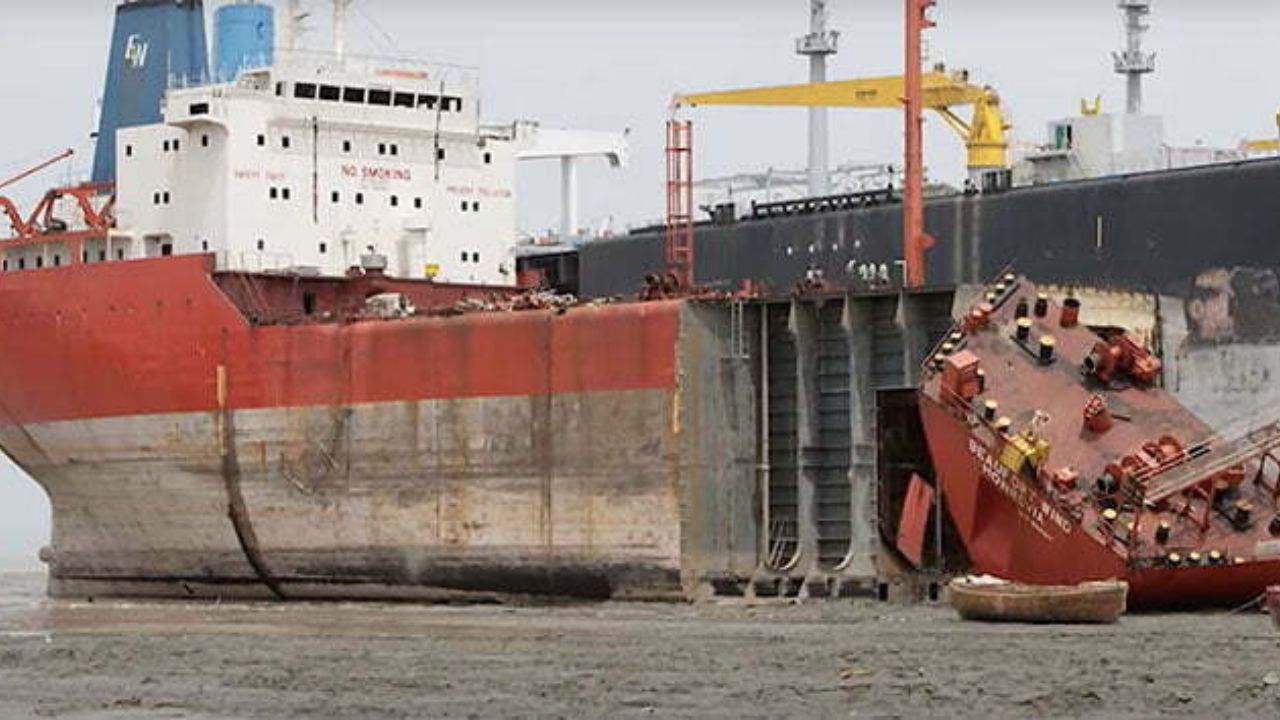


The End of Giants at Sea Fuels Construction, But Pays a Devastating Human and Environmental Price in India and Pakistan Shipyards.
The end of giants from the oceans occurs on muddy beaches in South Asia. Far from luxurious ports, colossal ships are deliberately grounded and “devoured” by armies of workers in Alang, India, and Gadani, Pakistan. This industry is an indispensable pillar of the global circular economy, transforming obsolete hulls into millions of tons of recycled steel that directly feed the construction industry.
However, this economic engine, designed to generate over 2.2 billion dollars in India, operates under a brutal paradox. Its financial viability fundamentally depends on the outsourcing of social and environmental costs: loose regulations, desperate labor, and a sacrificed ecosystem. The sector moves billions, but the true cost of this recycling is paid by the bodies of workers and the health of the planet.
The Economic Logic: Why Die in South Asia?
The migration of the shipbreaking industry from Europe and the US to Asia, which began in the 1960s, was not accidental. It was a purely economic decision. As Western nations tightened their environmental regulations and labor laws, the operational costs to safely dismantle a ship skyrocketed. South Asia offered the opposite: a potent combination of cheap labor, less stringent safety and environmental rules, and a ravenous domestic demand for steel.
-
At 9, Hailey Builds Mini Shelters for the Homeless Using Recycled Materials in Her Backyard

-
Seven-Year-Old Nicknamed Hulk Wins Gold in Brazilian Jiu-Jitsu After Defeating South American Competitors

-
Once Burdened by $90,000 in Debt and a Divorce, Now Leads a Beauty Group Targeting $150 Million by 2026
-
Ice Cream Shop Grows from 39 Square Meters to $19 Million Revenue with Popsicles Sold at 20 Cents in Brazil




The impact of this industry on the local economy is immense and strategic. As detailed by the academic publication NUJS Law Review, activities in Alang generate millions of tons of metal scrap annually. This industry contributes about 1% to 2% of India’s domestic demand for steel (although some sources cite as much as 15%) and, in the case of Pakistan, supplies about 15% of the country’s steel needs. In Alang, the activity directly supports over 30,000 workers and over 500,000 indirect jobs, making it a vital asset for national economic security.
The Dismantling Procedure: The “Beaching” Method
The dominant process in South Asia is known as “beaching”, a method that, while economically efficient, is the root of serious safety concerns. The NÁUTICA Blog provides a vivid description of the process: at high tide, the ship is hurled at full speed against the beach, aiming to ground it as deeply as possible in the mud. When the tide goes out, the vast muddy plain becomes the open-air factory floor.
The NÁUTICA Blog illustrates what happens next as relentless manual labor, comparing the workers to “human ants” devouring a giant carcass. Teams, often without proper protection, use torches and basic tools to cut the hull into gigantic pieces. Massive steel plates, weighing half a ton, are simply dropped into the mud by gravity or carried by dozens of men. This system is optimized not for safety but to minimize investment in capital and infrastructure (like dry docks and cranes), substituting them for the cheapest resource available: human labor, with reported wages as low as the equivalent of 15 reais per day.
The Human Cost: Lives at Risk for Steel


The workforce that fuels this industry is almost entirely composed of migrants from the poorest regions of India and Pakistan. These men arrive vulnerable, disorganized, and desperate for work, a condition the industry exploits to keep wages low and suppress collective bargaining. Child labor is a concerning reality; one source estimates that a third of the workers in Alang may be between 15 and 17 years old.
A comprehensive report from the Tata Institute of Social Sciences (TISS), highlighted by the Maritime Executive, reveals the devastating reality of working and living conditions. The publication was crucial in detailing the lack of basic sanitation, citing a shocking example of only 12 showers and six toilets available for a workforce of approximately 35,000 people in Alang. Workers live in overcrowded slums, without drinkable water or adequate electricity.
The Maritime Executive also emphasizes the systemic lack of personal protective equipment (PPE). Workers are seen cutting molten steel using only t-shirts and rubber sandals, improvising masks with rags. Accident rates (explosions, falls, crush injuries) are tragically high and underreported. In addition to immediate trauma, there is the invisible epidemic of occupational diseases caused by direct exposure to asbestos, lead, and mercury, whose fatal effects, such as mesothelioma cancer, can take decades to manifest.
The Environmental Paradox and Regulatory Pressure
The “beaching” method makes pollutant containment impossible. As ships are opened, residual oils, toxic paints, plastics, heavy metals, and asbestos are released directly into the intertidal zone. With each tide, these pollutants are swept into the sea, destroying vital mangrove forests and ruining the livelihoods of local fishing communities. Ironically, while steel recycling avoids CO2 emissions from mining, it does so through the direct poisoning of coastal ecosystems.
A wave of regulatory change, however, is forming. The Hong Kong International Convention (HKC), the first global treaty on the subject, will finally come into force on June 26, 2025, establishing safety and environmental standards. The stricter EU Regulations on Ship Recycling (EU SRR) is already in effect and effectively prohibits “beaching” for European-flagged ships, requiring that they be recycled in approved facilities on a “European List.”
Despite the pressure, the main loophole persists: evasion. Ship owners can easily circumvent EU law through “flagging out,” selling the ship, and re-registering it under a “flag of convenience” (like Liberia or Panama) months before its final voyage for dismantling. This practice allows European shipowners to remain the primary clients of beaching shipyards, perpetuating the low-cost, high-risk model, despite improvements made by some shipyards in Alang.
The Recycled Steel Dilemma
The end of giants in Alang and Gadani remains one of the greatest paradoxes of the global economy. It is simultaneously a triumph of the circular economy, recovering millions of tons of steel and reducing the need for virgin resource extraction, and a social and environmental catastrophe, built on the exploitation of vulnerable labor. The industry is at a crossroads, divided between the high profitability of the status quo and the growing international pressure for truly sustainable recycling.
What do you think about this dilemma? Is it fair that the steel that builds our cities has such a high human cost in other countries? Leave your opinion in the comments, we want to know how you view this production chain.




Índia o povo comum são escravos
Vale citar o caso do Porta-aviões “São Paulo que permanece em silêncio.
Sou do Instituto São Paulo Foch que tentou resgatar a embarcação e da-la um outro destino. Mas infelizmente por força maior, foi afundada em Pernambuco.
Aparentemente são empresas de fachadas do alto clero. Eis o motivo da facilidade de burlar leis.