






 Portuguese
  Spanish


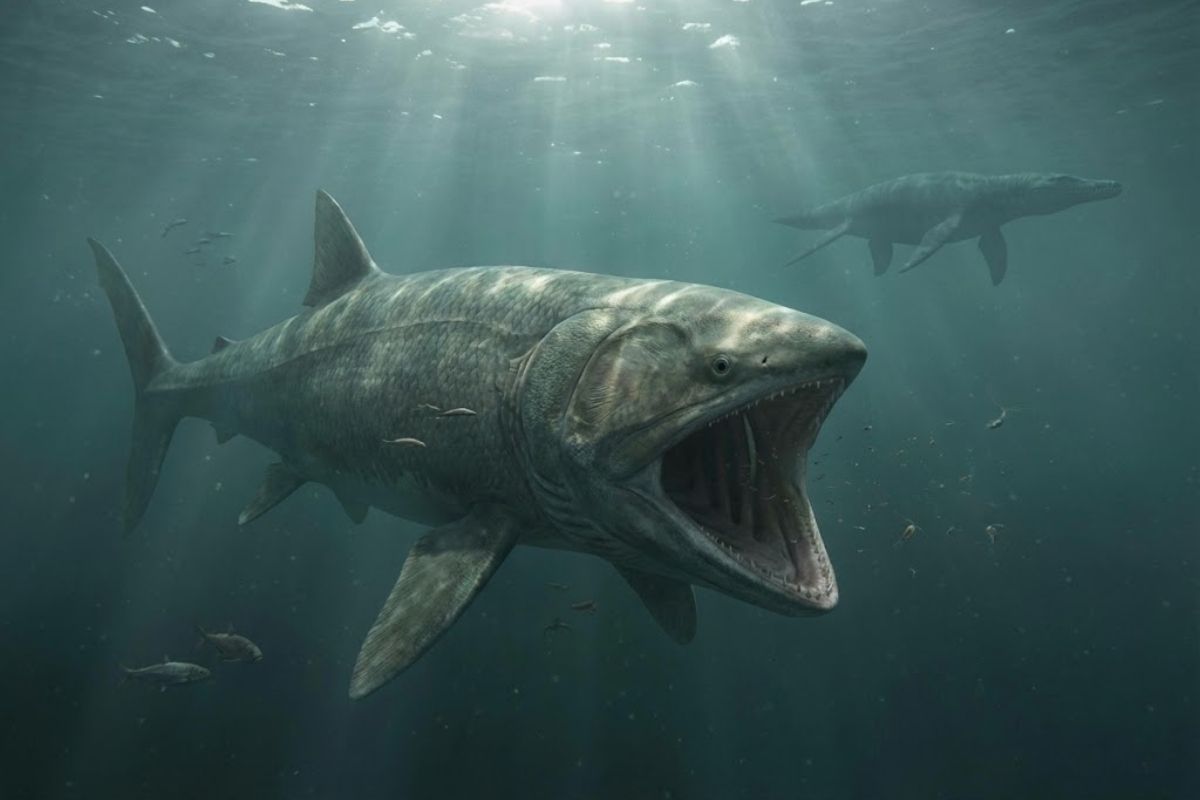


In The Jurassic Seas, Between 165 And 152 Million Years Ago, The Leedsichthys, The Largest Bony Fish In History, Reached Up To 16 Meters And 45 Tons, Filtered Plankton With Gill Rakers, Left Fossils In Rocks In England, France, Germany, Chile And Argentina, And Disappeared When Plankton And The Sea Changed.
In the Jurassic seas, the largest bony fish in history was not a top predator, but a filter feeder. The Leedsichthys earned this status by combining gigantism, unusual anatomy, and a lifestyle that depended directly on the productivity of the sea.
Between 165 and 152 million years ago, the Leedsichthys swam in oceans where marine reptiles like the Pliosaurus circulated and left fossils in regions today separated by continents. The combination of fragmented fossils and partially cartilaginous skeleton explains why the giant still raises debates about its shape, mass and size.
The Scenario In The Jurassic Seas

The Jurassic Period is remembered for large marine predators.
-
Chinese Student Builds Humanoid Robot for $2,100 at Age 20, Now Leads Robotics Startup in China

-
Sumatran Rhino: The Rare “Prehistoric Survivor” with Fewer Than 50 Left and a Fascinating Natural History

-
Chinese Humanoid Robots Transition from Labs to Real Factories to Assemble Tablets: AgiBot Deploys G2 Machines at Longcheer, Aiming for 100 Robots in Electronics, Cars, Chips, and Energy by 2026

-
Shopkeeper Buys Notebook at English Bazaar, Discovers Rare 1915 WWI Record Listing 900 Volunteers, 140 Fallen




The Pliosaurus, described as a short-necked plesiosaur, appears associated with estimates of up to 15 meters in length.
This data helps gauge the ecological pressure on marine megafauna, including giant filter feeders.
At the same time, the Jurassic seas housed a food chain whose base was microscopic.
The engine was plankton, sustaining schools of fish, invertebrates, and in extreme cases, filter-feeding vertebrates weighing tens of tons. When the base changes, the entire biological structure must readjust.
Who Was The Leedsichthys And Why Did It Become The Largest Bony Fish In History

The most cited name is Leedsichthys problematicus, a bony fish linked to the Pachycormidae family.
The pachycormids are recorded from the early Jurassic to the end of the Cretaceous and share common traits, such as elongated serrated pectoral fins and reduced pelvic fins.
The exact relationships with other fish remain unclear, but the group is often treated as closer to teleosts, which include most living fish.
Within this family, Leedsichthys occupies the extreme filter feeder role.
The most cited estimates suggest lengths of up to 16 meters and about 45 tons, making the animal the largest bony fish in history known.
For comparison, references to two current giants appear: the oarfish, cited as reaching 8 meters and 270 kg, and the sunfish, noted as the largest bony fish by mass, reaching up to two tons.
The size range is controversial. There have been proposals of 30 meters and, on the other extreme, limits close to 9 meters.
This variation is a direct consequence of incomplete preservation and the difficulty of reconstructing a gigantic body from few diagnostic pieces.
Fragmented Fossils And The Difficulty Of Measuring A Giant


Even with fossils attributed to more than 70 individuals, most correspond to few elements.
The main reason is structural: the Leedsichthys did not have a completely ossified skeleton, with a large portion formed by cartilage, something comparable to sturgeons and paddlefish.
Cartilage fossilizes poorly, and this often creates critical gaps in the skull and spine.
On the other hand, there is a set that preserves better: bones of some fins and elements of the gill arch.
This preservation asymmetry is decisive because the gill arch holds direct signs of the filter-feeding habit and allows inferring how the animal fed on plankton.
The timeline of discovery begins in England in the 1880s with farmer Alfred Leeds.
In 1886, British physician and geologist John Hulke examined the material and even attributed it to plates of the stegosaurid Omosaurus.
In 1888, American paleontologist Othniel Marsh concluded that they were fossils of a giant fish skull and contacted specialist Arthur Woodward, who described the species as Leedsichthys problematicus.
The name carries two clues. Leedsichthys means “fish of Leeds,” in honor of the discoverer.
Meanwhile, problematicus points to the difficulty of identifying and reconstructing the animal from fragmented fossils, a problem that runs through the entire debate about the largest bony fish in history.
The distribution of fossils is also a central datum.
There are records in England, France, and Germany, and also in South America, including Chile and Argentina.
This range reinforces the idea of an animal associated with broad and connected seas, consistent with a filter feeder that would need to follow areas rich in plankton.
The Pachycormidae Lineage And Carnivorous Relatives
The Pachycormidae include carnivorous forms described as ecologically similar to modern tunas and swordfish, as well as filter-feeding forms.
Among the carnivores, the Hypsocormus stands out, cited at about 1 meter in length, with fossils in the United Kingdom, France, and Germany, described as an agile predator of fish, with a crescent-shaped caudal fin associated with fast swimming.
Another example is Ohmdenia, from the Jurassic of Germany, cited at around 2.5 meters.
Unlike Hypsocormus, it is associated with a diet based on mollusks, supported by small but robust teeth.
The presence of two fossils of belemnites in the abdominal region is used as evidence of mollusk predation.
This overview helps understand the Leedsichthys as an ecological experiment within a versatile family: instead of competing for large prey, the gigantic filter feeder opted to capture small food in huge volumes, transforming plankton into body mass.
How A Toothless Filter Feeder Fed On Plankton
The Leedsichthys is described with long pectoral fins and an elongated caudal fin, favoring efficient movement.
The most cited anatomical evidence for feeding lies in the gill arches, particularly the gill rakers.
These structures function like a filtering system, retaining nutritious particles that pass through the gill cavity during feeding.
Filter feeders tend to have numerous and closely spaced rakers, increasing the efficiency of capturing plankton and other small particles.
This logic brings the Leedsichthys closer to modern filter feeders such as the whale shark and elephant shark, as well as the manta ray, although these modern examples are cartilaginous, not bony fish.
The detail of “growing without teeth” fits into this system.
The focus is not on biting, but on filtering. Therefore, the stability of the food base is vital: if plankton declines, a filter feeder weighing tens of tons quickly loses ecological support.
Gigantism In The Mesozoic And The Absence Of Modern Equivalents
There is a relevant temporal clue: before the Mesozoic Era, aquatic vertebrate filter feeders are noted as being less than 50 cm in length.
The emergence of giant filter feeders in the Jurassic indicates a scale change in the availability of plankton, possibly related to the increase of small crustaceans like copepods, which make up a significant part of the plankton.
Today, the scenario is different.
There is no large bony filter-feeding fish, although there are thousands of species of small to medium-sized planktonic fish.
Among the hypotheses cited for the rarity of gigantism in modern bony fish are the high degree of ossification of the skeleton, reproductive aspects like oviparity and indirect development, and the presence of other giant filter feeders, such as whales, occupying the niche on a large scale.
In this contrast, the Leedsichthys remains a signature of the Mesozoic: a largest bony fish in history that only makes sense in oceans with a different plankton dynamics.
Speed, Metabolism, And Coexistence With Pliosaurs
Gigantism does not automatically mean slowness.
There are performance estimates suggesting that the Leedsichthys could reach potential speeds of 17.8 km/h, maintaining good tissue oxygenation, based on comparisons with modern teleost fish.
For a filter feeder weighing tens of tons, this indicates the capacity to cover large distances and explore productive areas.
Coexistence with predators like the Pliosaurus is plausible and brings a cautious hypothesis: young individuals would be more vulnerable, while adults, due to their size and mass, would be harder to take down.
Even so, attacks might not be immediately fatal and could still leave an animal weakened, creating opportunities for predation or indirect mortality.
The emerging image is of Jurassic seas with multiple giants sharing space: top predators and base filter feeders, all dependent, in different ways, on the structure of the ocean.
Why Did The Leedsichthys Disappear With Changes In The Ocean
The most commonly cited explanation for the disappearance of the Leedsichthys points to significant changes in the plankton community in the Middle Jurassic.
An increase in plankton might have supported the growth of the largest bony fish in history, but later changes could have reduced zooplankton to levels incapable of sustaining such large filter feeders.
In this model, it’s not the “strength” that disappears, but the biological fuel.
The Leedsichthys depended on a constant supply of plankton, and a decline in availability would have a direct impact on survival, reproduction, and the recruitment of juveniles.
The niche for giant filter feeders continued to exist, but with substitutions.
Other smaller pachycormids, like Bonnerichthys and Rhinconichthys, are cited as dominant in the role of filter-feeding vertebrates until the Cretaceous.
Later, in the Cenozoic Era, the role of giant filter feeders became associated with whales, changing who occupies the top of the oceanic “filter.”
What Fossils Of Leedsichthys Reveal About Ancient Oceans
The fossils of Leedsichthys function as an indirect indicator of marine productivity.
An animal weighing 16 meters and tens of tons requires an enormous energy base, which implies a considerable and regular supply of plankton over extended periods.
At the same time, the fragmentation of fossils necessitates caution.
The absence of complete spine and skull increases the margin of error in estimates of body shape, mass, and even the limit of gigantism itself.
Still, the set of fossils, distributed from Europe to South America, reinforces that the Leedsichthys was an oceanic phenomenon, not an isolated exception.
In the end, the Leedsichthys connects three layers of information: fragmented fossils, plankton ecology, and Jurassic megafauna.
It is this connection that keeps the animal as a reference for the largest bony fish in history and as a sign that changes in the ocean can rewrite the list of giants.
If you want to follow more technical reports on marine megafauna and fossils, keep up with the upcoming publications in this series. Which hypothesis about the Leedsichthys and the Jurassic plankton makes the most sense to you today?


