






 Portuguese
  Spanish


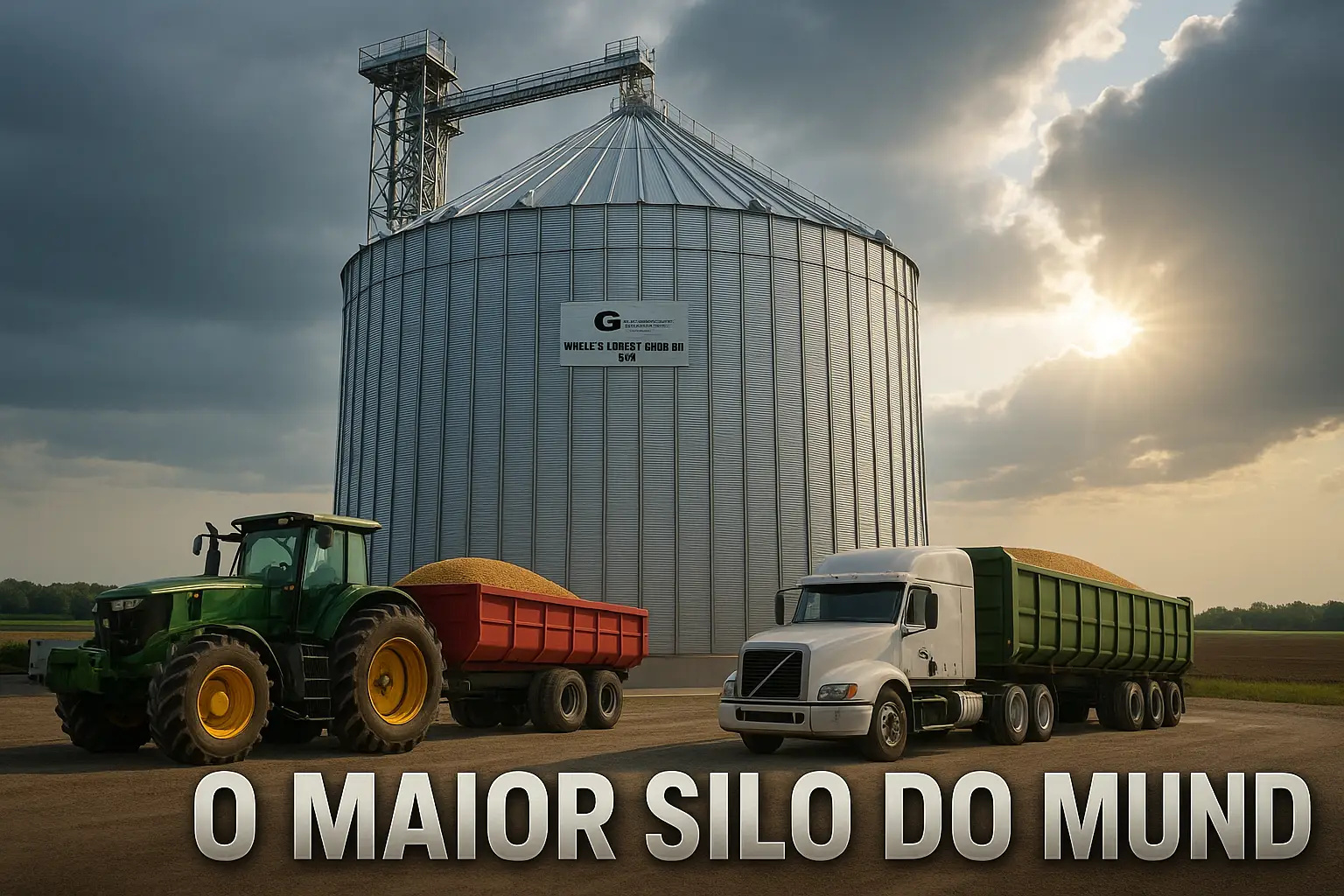


Discover How The World’s Largest Grain Silo In Iowa Combines Cutting-Edge Engineering And Agriculture To Transform Global Production
Imagine a structure so grand that it required 111 hydraulic jacks to be built. This is the largest individual grain silo in the world, located in Mason City, Iowa, a symbol of engineering, infrastructure, and agriculture intertwined to ensure food security and global logistical efficiency. This metal colossus impresses not only with its size but also with its ability to overcome complex industrial challenges in food and energy storage.
A Monster of Engineering In Iowa
In 2021, the Golden Grain Energy ethanol plant inaugurated a “free-span” metal silo in Mason City, built by Sukup Manufacturing, holder of the title for the largest individual silo in the world. With a capacity of 2.25 million bushels (approximately 57,000 tons), the equipment is 50.3 meters in diameter and 47.4 meters tall and stands out for having no internal columns, optimizing space and expediting the unloading of grain.
The capacity of the complex nearly doubled, increasing from 1.37 million to nearly 3.5 million bushels, while the receiving flow increased from 40,000 to 65,000 bushels per hour. According to Chad Kuhlers, CEO of Golden Grain Energy, the goal is to ensure up to 30 days of stock on-site, three times more than the previous 10 days, ensuring the continuous supply of the plant.
-
Crab Trapped in Plastic Bottle for 62 Days Near Okinawa Highlights Little-Known Impact of Marine Pollution on Small Animals

-
Esperanza’s Bamboo Barrier in Oaxaca Redirects River and Reduces Erosion by 85% in Five Years

-
Family Builds Homemade Wind Turbine to Power Off-Grid Home, Video Reaches 555,000 Views on Ngô Thị Huyền’s Channel
-
Indian Brand Creates Sneakers from Recycled PET Bottles and Discarded Tires, Repurposing Over 1 Million Bottles and Raising $4 Million for Expansion




The silo integrates advanced automated ventilation systems and sensors that monitor temperature and humidity to minimize losses and preserve the quality of the stored corn.

Behind The Scenes Of The World’s Largest Metal Structure For Grains
Building this silo was a significant technical challenge. Laminated sides were applied, a base capable of supporting more than 125 million pounds without sinking, and a reinforced roof to support up to 150,000 pounds of equipment. The use of 111 hydraulic jacks, compared to the approximately 20 used in conventional silos, and patented screws with “watertight” seals illustrate the complexity. The assembly was handled by Global Bin Builders and McGough Construction, who used over 2 million pounds of steel precisely lifted.
More Than Storing: The Strategic Logic Behind The Scale
Investing in a silo of this magnitude goes beyond scale. Expanding the stock from 10 to 30 days ensures operational stability for the plant, even in the face of logistical fluctuations. The automated structure allows for greater control over seasonality, prices, and continuous supply, essential for ethanol plants, feed production, and vegetable oil processing. Furthermore, it reduces losses due to mold and pests, efficiently integrating with highways, railroads, and logistics terminals.
Comparison Of The Giants: USA, Brazil, China, And Iraq
The largest individual silo in the world is located in Mason City, Iowa (USA), operated by Golden Grain Energy, with a capacity of 57,000 tons and dimensions of 50.3 meters in diameter and 47.4 meters in height.
In Brazil, Silo 156, built by Uniagro in partnership with Kepler Weber in Primavera do Leste (MT), has a capacity of 35,000 tons, measuring 47 meters in diameter and 30 meters in height. Since 2013, it has been one of the largest and most technologically advanced in the country, standing out for technologies such as wind rings and automated systems for protection against mold.
In Iraq, the Kirkuk silo project, being developed by Bühler and Samco, will have a projected capacity of 60,000 tons per unit, surpassing current records for free-span silos, with a strategic focus on food security.
In China, the largest storage complex in the world is in Qinhuangdao, operated by Sinograin Base. There are over 90 interconnected silos, totaling 810,000 tons, integrated with ports and railroads. The investment exceeded US$ 3.3 billion, consolidating a robust and automated logistical infrastructure.
Brazil: Advances And Structural Challenges
Despite the progress represented by Silo 156 and the billion-dollar fund of R$ 500 million launched by Kepler Weber to expand national capacity, with a goal of an additional 500,000 tons through long-term contracts with agri-food industries, Brazil faces a critical deficit. The lack of more than 100 million tons in storage capacity can lead to estimated losses of up to R$ 41 billion per harvest, according to sector studies published in Valor Econômico.
Initiatives such as the update of technical standard NBR 17066 indicate progress, but gaps remain in public policies and structured investments to overcome this logistical bottleneck.
The Storage That Drives The Agribusiness Of The Present And Future
Storing grains is crucial for ensuring stock security and efficiency in agribusiness transactions. The Iowa silo exemplifies what advanced engineering and automation can offer to strengthen strategic chains such as ethanol, feed, and exports.
Experts emphasize the urgency of this advancement. The consultancy Nextech Agri Solutions highlights that “well-designed silos provide the best economic results.” Research in smart infrastructure, involving sensors, automation, and the Internet of Things (IoT), transforms these giants into integrated management and control platforms.
Brent Hansen, manager at Sukup, summarizes: “Storing grains in Sukup silos keeps the product in better condition than in temporary piles… It is safer, more practical, and economical.” Denis Jungerman, director of Jubarte, warns: “The newer the agricultural frontier, the greater the storage capacity deficit.”
The spectacle of steel and technology in Mason City transcends storage: it symbolizes mastering the global logistics game, supporting vital industries, and strengthening food sovereignty. Brazil, with its immense agricultural potential, has both the urgency and opportunity to scale projects of this magnitude and transform its infrastructure landscape.
What do you think about this type of mega structure in agribusiness? Leave your comment and share this post to debate with more people!


