






 Portuguese
  Spanish
  3 min of reading
  0 comments


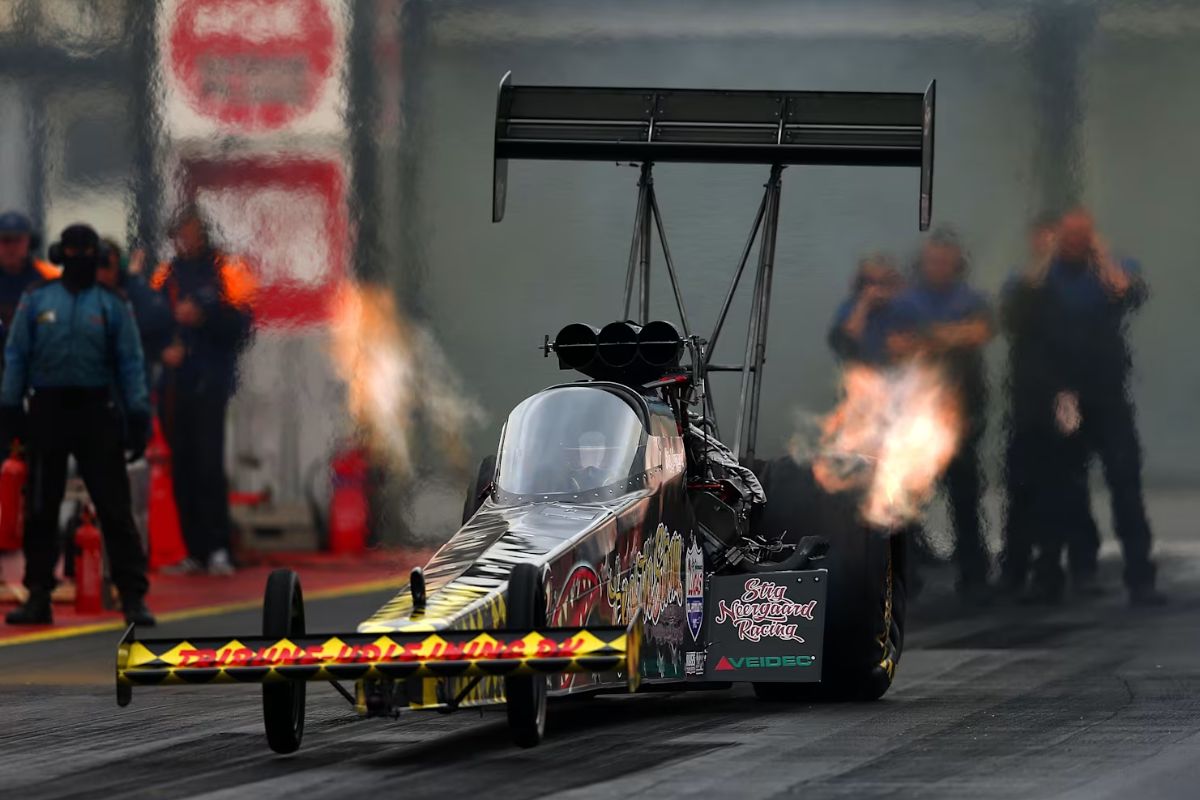
Understand How the Top Fuel Dragster Engine Generates Absurd Power, Burns 60 Liters of Fuel in a Single Run, and Needs to Be Completely Rebuilt After Each Race
The Top Fuel dragster engine is the pinnacle of automotive engineering taken to the extreme. These machines are designed for a single purpose: to cover 300 meters in less than 4 seconds, reaching speeds over 530 km/h. To achieve this feat, their engines generate an estimated 11,000 horsepower.
This incredible performance, however, comes at a cost. Each race is a cycle of “controlled self-destruction”, where the engine is pushed to the limit and needs to be completely disassembled and rebuilt in less than an hour. This is a look into the science and mechanics behind the fastest racing cars in the world.
The Architecture of 11,000 Horsepower: What’s Inside an 8.2L V8 Hemi Engine?
The foundation of the Top Fuel dragster engine is a highly modified version of the classic Chrysler V8 Hemi engine, with a displacement of 8.2 liters. Its architecture is considered the “sacred geometry” of drag racing due to its durability and airflow capability.
-
Brazilian mechanic invented a lamp made from a PET bottle during the 2001 blackout, the idea turned into an NGO present in 30 countries and has already illuminated 40,000 people in 200 communities without electricity in Brazil.

-
Centuries-old mystery gains new chapters in Greece after excavations reveal a possible lost temple of Poseidon, hidden among ancient lagoons, monumental remains, ritual objects, and an architectural plan that surprised even the experts.

-
2-month-old baby says “I love you” to parents and the video froze the internet: doctors say most babies only speak after the first year of life
-
At 98 years old, Priscilla Sitienei returned to school in uniform, sits next to children, and has a new dream: to become a doctor, after decades of working as a midwife in rural Kenya.



To force air into the engine, a gigantic supercharger is used. It alone consumes about 1,000 horsepower to operate and is so violent that it needs to be secured to the engine with Kevlar straps. The fuel is injected through a system with 42 nozzles, which spray a mixture of nitromethane and methanol so intensely that it becomes “almost solid” before ignition.
Nitromethane Dragster Engine: The Fuel That Burns 60 Liters in a 4-Second “Pull”

The secret to extreme power lies in the fuel: nitromethane. It has less energy than gasoline, but its great advantage is that it contains oxygen in its composition. This allows the engine to burn up to 8 times more fuel for the same amount of air, generating 2.5 times more power.
The consumption is absurd. At full acceleration, the engine burns approximately 4.5 liters of nitromethane per second. In a 4-second race, consumption can reach 15 gallons, equivalent to nearly 57 liters, validating the estimate of 60 liters. Besides generating power, the fuel also acts as the primary cooling agent for the engine, which has no radiator.
The Numbers of the Fastest Acceleration in the World: 530 km/h in 3.7 Seconds
The performance of a Top Fuel is hard to comprehend. It accelerates from 0 to 160 km/h in just 0.8 seconds, faster than a fighter jet launched from an aircraft carrier. The acceleration force on the driver reaches peaks of 5.6 G, more than an astronaut feels during a space shuttle launch.
Final speeds exceed 530 km/h at the 300-meter mark. The current speed record, set by Brittany Force in April 2025, is an impressive 549.7 km/h. These numbers make the Top Fuel the fastest acceleration car in the world.
The 40-Minute Rebuild: The Cycle of “Self-Destruction” Controlled
The term “self-destruction” does not mean that the engine explodes at each race, but that the stress is so extreme that it needs to be completely redone. After each 4-second “pull,” the team has between 40 and 60 minutes to fully disassemble the engine and rebuild it.
Pistons, rods, bearings, and cylinder heads are inspected and, most of the time, replaced. It is a proactive and choreographed maintenance, where each team member has a specific role. A complete Top Fuel engine is designed to last only 11 to 12 races before being entirely replaced.
Why 300 Meters? The Safety Change That Shortened the Track in 2010

Originally, drag races took place over a quarter-mile distance (about 402 meters). However, around 2010, the NHRA, the main governing body of the sport, reduced the official distance for the Top Fuel category to 1,000 feet (304.8 meters).
The decision was purely motivated by safety. Cars were reaching such high speeds by the end of the straight that it became extremely dangerous to stop them in time. The reduction of the track was a necessary adaptation to ensure the safety of drivers amid the constant evolution of the dragster engine.





-

2 people reacted to this.