Portuguese
  Spanish


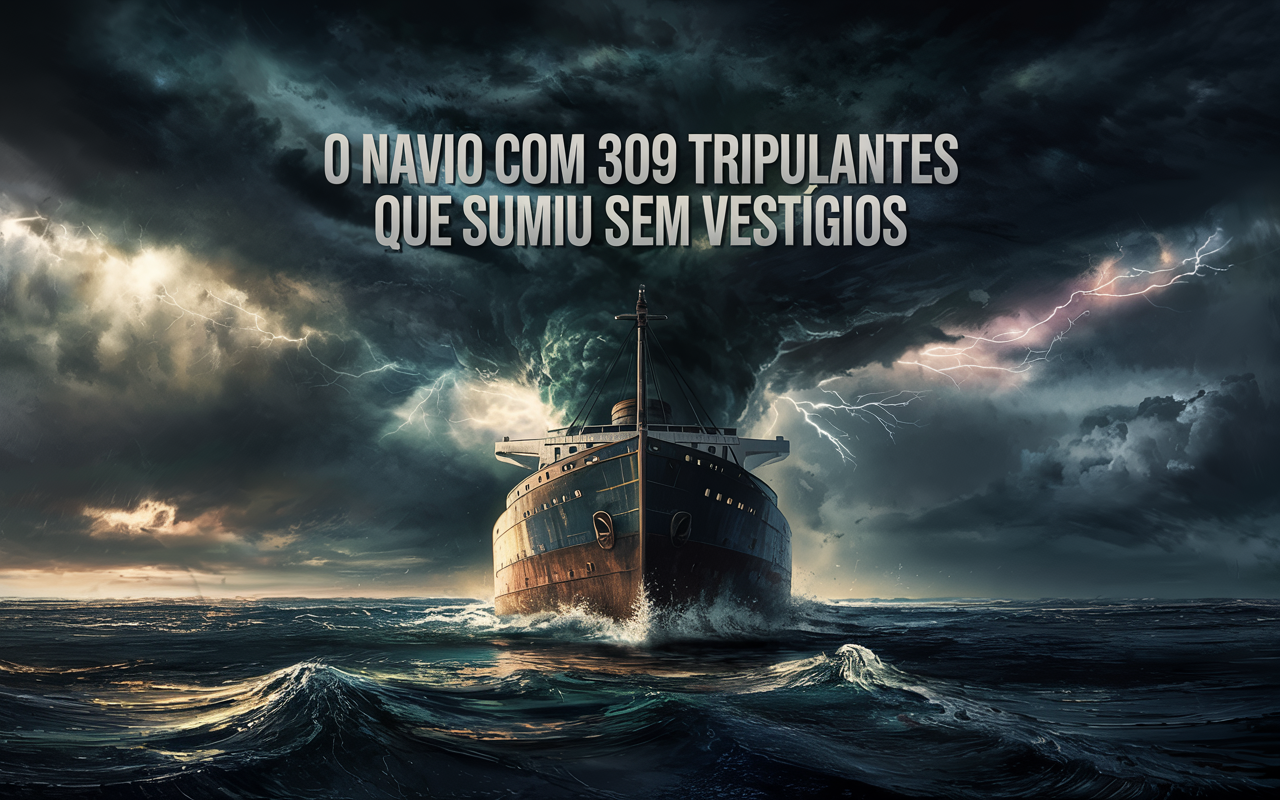


The Ship That Vanished Without a Trace: The USS Cyclops Departed Brazil With 309 Crew Members and Disappeared in the Bermuda Triangle — No Wreckage Has Been Found to This Day.
In March 1918, the cargo ship USS Cyclops of the U.S. Navy mysteriously disappeared in the Atlantic Ocean with 309 crew members on board. The vessel had departed from Brazil bound for the United States carrying manganese ore. It never reached its destination, and to this day no wreckage has been found. The case, one of the largest non-combat disappearances in American naval history, is among the most cited when discussing the enigmatic Bermuda Triangle.
The Cyclops left the port of Salvador (BA) in late February 1918 and made its last known stop in Barbados, in the Caribbean, where it reported mechanical problems. After that, it disappeared without sending any distress signals. No concrete evidence was located, even after extensive searches conducted by American naval authorities.
One of the Largest Ships in the American Navy at the Time
The USS Cyclops was a colossus of its time. Built in 1910, it was 165 meters long and could carry up to 12,500 tons. Although originally designed to supply fleets with coal, it was converted during World War I for the transport of strategic ore — manganese, used in the manufacture of armaments.
-
The U.S. Navy Conducts Submarine Tests in Idaho Lake to Detect Underwater Noises Hidden by the Ocean

-
Nuclear Submarine USS Alexandria Retired After 35 Years, Having Completed Over 1 Million Miles in Missions

-
MODEC Introduces New Hull Design for FPSO Gato do Mato to Produce Up to 120,000 Barrels of Oil Per Day in Brazil’s Pre-Salt Region
-
This Massive 12-Meter, 21-Ton Underwater Drone Can Operate Autonomously for Up to Five Days


The ship was part of the Proteus class, with a steel structure and steam propulsion. During the war, the vessel operated supply routes between the U.S., the Caribbean, and South America. In January 1918, it arrived at the port of Rio de Janeiro loaded with coal, which was unloaded. On its return, it carried 10,800 tons of manganese to Baltimore, Maryland.
Last Stop in Barbados and Total Vanishing
On March 4, 1918, the cargo ship USS Cyclops made an unscheduled stop at the island of Barbados, citing problems with one of its engines. The vessel continued its journey without escort and was never seen again. No radio messages were recorded. No ship reported contact. The ship vanished.
The area where it disappeared encompasses part of the famous Bermuda Triangle, defined by the Bermuda Islands, Miami (U.S.), and Puerto Rico — known for supposed unexplained disappearances of ships and aircraft.
Theories About the Disappearance in the Bermuda Triangle
Several hypotheses have been raised over the decades, but none proven:
- German Attack: There was suspicion that the ship could have been targeted by an enemy submarine during World War I, but records from the German Navy do not support this theory.
- Overweight and Structural Failure: Experts suggest that the overloaded cargo, combined with propulsion issues and possible structural failures, could have caused the sinking.
- Storm: The region experienced meteorological instability during the period. The ship, with excessive cargo and a compromised engine, may not have survived a sudden storm.
- Bermuda Triangle: The mystery of the Cyclops’s disappearance is one of the cases often associated with the legendary triangle, although without scientific evidence to support paranormal phenomena.
No Wreckage, No Survivors
Despite intensive searches conducted by the U.S. Navy at the time, no part of the ship was found. No lifeboats, no pieces of metal structure, no cargo or crew members were located. The total disappearance of the Cyclops remains unexplained for over 100 years.
Three other sister ships of the Cyclops — the USS Proteus, USS Nereus, and USS Jupiter — also disappeared or sank under mysterious circumstances in later decades, further fueling theories surrounding the Proteus-class ships.
The Largest Non-Combat Naval Disaster in U.S. History
The disappearance of the USS Cyclops is still regarded as the largest non-combat naval disaster in the U.S. The number of missing persons exceeds that of any peacetime sinking recorded thus far by the U.S. Navy.
The case is cited in studies on naval safety, structural failures, and navigation in high-risk areas. It has also become a recurring topic in documentaries, books, and publications about the Bermuda Triangle.
More than a century after the disappearance, the fate of the cargo ship USS Cyclops remains shrouded in mystery. The combination of absolute silence, lack of wreckage, and the scale of the tragedy makes this one of the most intriguing episodes in modern maritime history.