Portuguese
  Spanish


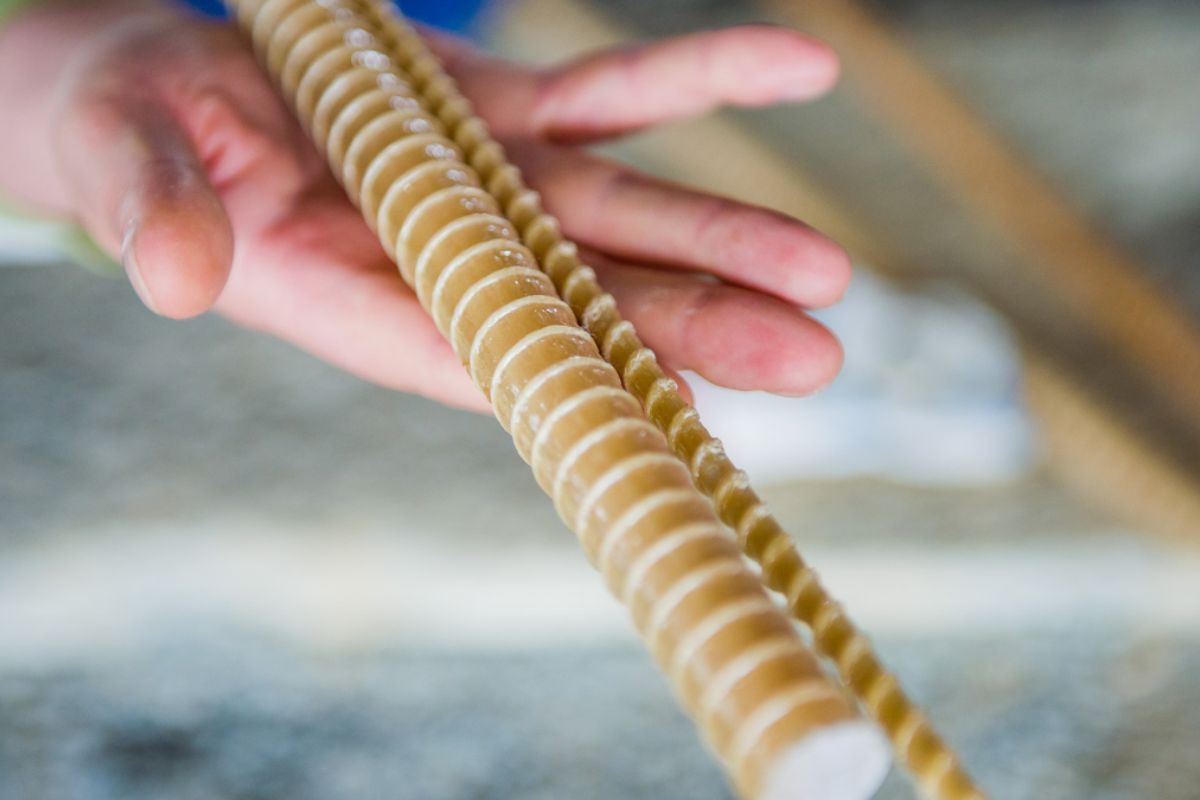

Know The GFRP Reinforcements, A New Material That Is Immune To Rust And Could Redefine The Durability Of Bridges, Ports, And Buildings.
The construction industry is in a continuous search for more durable, efficient, and sustainable materials. In this scenario, a new material has gained prominence: Glass Fiber Reinforced Polymer (GFRP) rebar. They emerge as an innovative alternative to steel, promising to overcome limitations such as corrosion.
This article explores GFRP in detail. We will analyze its characteristics, advantages, challenges, and the real potential of this new material to redefine construction practices, based on technical data and expert analysis.
What Is GFRP Rebar? The Science Behind The New Material
GFRP rebar is an advanced composite material. It is formed by the combination of two main components:
-
17-Story Building with 112 Apartments Opens in Australia to House Homeless Population, Offering Fully Equipped Units with Daily On-Site Support

-
81-Meter Bridge Made from Over 7 Tons of Recycled Plastic Connects Isolated Communities in Panama Canal Basin, Allowing Safe Passage for Over 300 Residents
-
Australia’s First Two-Story 3D-Printed House Built in 18 Hours, 22% Cheaper Than Traditional Methods, Uses Concrete That Hardens in 3 Minutes
-
Architect Converts 1955 Grain Silo into 31m² Home with Full Amenities, Including Kitchen, Bathroom, Curved Living Room, and Loft Bedroom




- Glass fibers: are the reinforcement element, responsible for high tensile strength and rigidity.
- Polymeric matrix: a resin that envelops and protects the fibers, distributes stresses among them, and ensures the durability of the rebar.
This new material is manufactured through the pultrusion process, which ensures consistent mechanical properties. GFRP was designed to overcome the main limitation of steel: its vulnerability to corrosion, which causes deterioration and significant repair costs in reinforced concrete structures.
The Advantages Of GFRP: Why Is It Considered A Superior Material?

GFRP offers a set of properties that distinguishes it from traditional steel.
Exceptional Strength-to-Weight Ratio: GFRP rebar has a tensile strength that can be up to twice that of steel while being up to four times lighter. This facilitates handling on the construction site and reduces transportation costs.
Corrosion Immunity: perhaps its greatest advantage, GFRP is immune to rust. This makes it ideal for structures in aggressive environments, such as coastal or industrial areas, drastically increasing the lifespan of constructions.
Non-Conductive Nature: being an electrical and thermal insulator, it is perfect for projects that need to avoid electromagnetic interference, such as hospitals with magnetic resonance imaging equipment, or to reduce thermal bridging in buildings.
Where Is The New Material Already Being Used?
The versatility of GFRP allows its application in various areas of construction. This new material is already employed in roofs, columns, slabs, floors, and garages.
Its use is ideal in marine and port environments, where corrosion from salt is a severe problem for steel. Bridge decks, especially in regions that use salt for de-icing, are also a growing application. The Minnesota Department of Transportation, for example, has conducted projects to investigate the use of GFRP in bridges, seeking to eliminate corrosion issues and enhance the longevity of structures to over 100 years.
The Technical Challenges And Limitations Of GFRP

Experts and technical studies indicate that, despite the advantages, GFRP has limitations that require a careful engineering approach. The main difference compared to steel is its lower ductility. Steel deforms before breaking, providing a warning of overload. GFRP, on the other hand, has a brittle and sudden rupture.
Another point of concern is its lower modulus of elasticity, which means that structures reinforced with GFRP may exhibit greater deformations (deflections) under load. The design must take this into account to ensure stability and comfort. Fire resistance is also a limitation, as the polymer matrix deteriorates at high temperatures (above 350°C). Finally, GFRP rebar cannot be bent on-site, requiring more rigorous logistical planning.
The Cost-Benefit And Sustainability Of GFRP
The use of GFRP can lead to a project cost up to 30% lower. This savings is more evident when analyzing the total lifecycle cost of the structure. Although the initial cost of GFRP rebar may be higher than that of steel, the drastic reduction in maintenance and repair costs over decades, especially in aggressive environments, makes the investment advantageous.
From an environmental perspective, the new material also presents benefits. A Life Cycle Assessment (LCA) study showed that GFRP can have a carbon footprint up to 85% lower than that of steel for the same structural function. This is mainly due to the lower mass of material needed to achieve equivalent performance. The greater durability of structures also means fewer demolitions and reconstructions, conserving resources over the long term.