Portuguese
  Spanish


The novelty is in the method: instead of testing only the effect of saltwater, the researchers added constant mechanical pressure, and the rubber aged much faster. The treacherous detail is that it hardens on the outside appearing firm, while it deteriorates on the inside, deceiving inspections, according to the study from China.
A study conducted in China revealed that the rubber seals responsible for sealing submerged tunnels under the sea can degrade much faster than previously thought. According to the research, when the salinity of seawater and constant mechanical compression act simultaneously, these seals can lose up to 67% of their original strength over their lifespan, although researchers emphasize that existing structures are not at immediate risk of failure.
The work was conducted by researchers from Shijiazhuang Tiedao University in China and published in 2025 in the scientific journal Tunnelling and Underground Space Technology. Before any alarm, it is important to highlight two points: it is a laboratory study, conducted with specific samples and simulated conditions, and the study itself concludes that the structures in operation are still within the safety margin. The discovery serves, therefore, as a warning to improve maintenance, and not as an announcement of collapse, as we will see below.
What the study from China discovered anew
Until then, most studies evaluated only how seawater degrades the rubber of seals, but the Chinese scientists added to this factor the constant mechanical compression to which the seals are subjected, and the combination of the two greatly accelerated the material’s wear, revealing a deeper deterioration than previous models predicted.
-
Prefabricated Home Assembled in Days Offers Cleaner, More Efficient Construction with Factory-Made Panels, Requires Technical Design to Prevent Moisture Issues

-
Single Mother Working Three Jobs Receives 111 m² 3D-Printed Home with Concrete Walls Built in 12 Hours, Featuring 3 Bedrooms, 2 Bathrooms, and a Printer for Replacement Parts

-
Simple Technique to Restore Rusty Metal Window Grilles Gains Attention for Revitalizing Old Structures Without Full Replacement

-
Couple Transforms Suffolk’s Last 1891 Windmill into Luxurious Four-Story Home with Zinc Observation Room in England



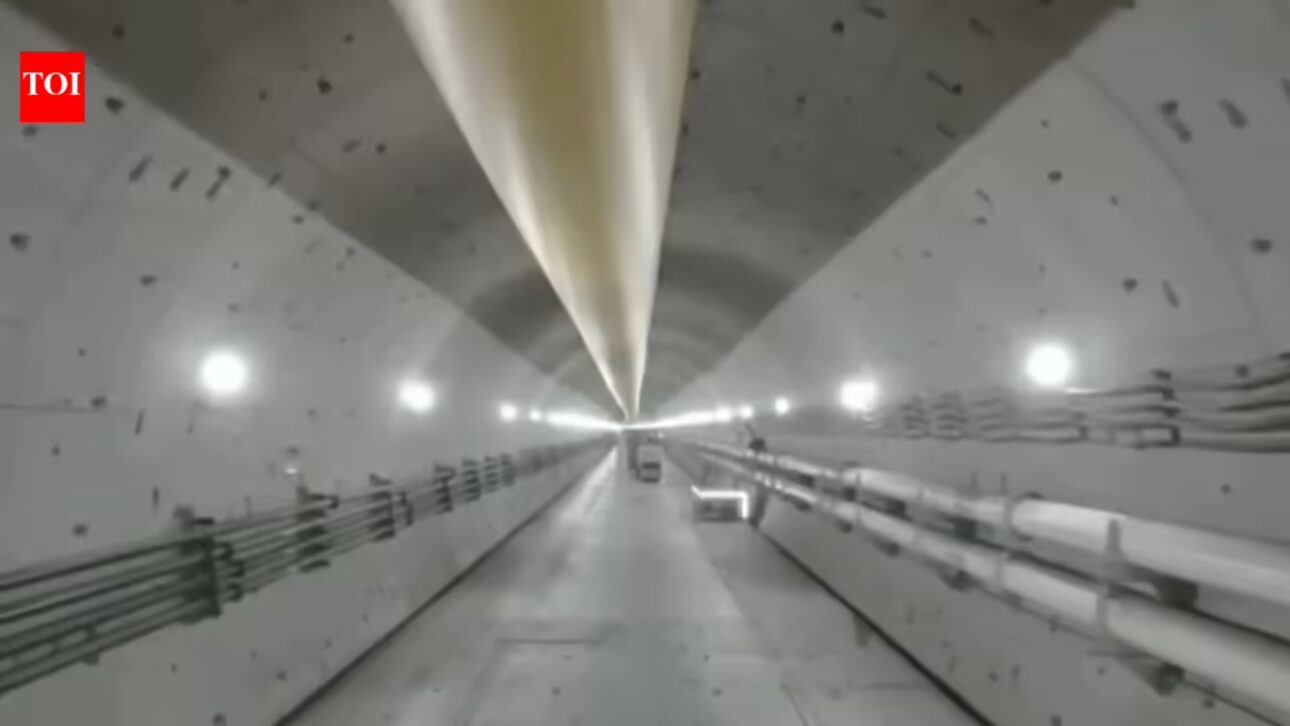
To reach this conclusion, the team tested samples of GINA-type seals, used as the main seal in submerged tunnels, taken from an operational tunnel in China.
The parts were subjected, in equipment specially developed for this purpose, to pressure and saltwater simultaneously.
This is how the researchers observed that the sealing lost strength more quickly than estimated, at a rate about one-third faster than previously predicted.
The numbers behind the wear
The data helps to dimension the phenomenon but requires context.
According to the study, under the combined conditions of salinity and compression, the joint lost 67.66% of its original sealing strength over the simulated lifespan, and its ability to withstand pressure dropped from 2.32 to 1.51 megapascals, with signs of internal chemical aging appearing in just 90 days of exposure in the tests.
It is essential to understand that these numbers refer to a specific experiment, with samples from a particular tunnel and in controlled laboratory conditions, and not a direct measurement of all submerged tunnels in the world.
Even so, the results are relevant because most of these structures follow a similar design logic, making the alert useful for engineers and infrastructure project managers in different countries.
The trap that can deceive inspections
According to the research, with aging, the rubber hardens on the surface, which can give a misleading impression of good conservation during routine inspections, while inside, the networks that provide elasticity to the material deteriorate and lose the ability to recover after compression.
Among the changes observed are an increase in the material’s stiffness and density and a rise in the temperature at which it becomes brittle.
Therefore, one of the main recommendations from the researchers is that inspections should stop evaluating only the external hardness of the rubber and start measuring its real elasticity, which better reflects the true state of conservation of the sealing.
The lower edge of the rings, where the contact pressure is lower, was identified as the most vulnerable area to silent leaks.
Why it’s not a reason to panic
Despite the alert tone, the study from China is clear in dismissing the immediate risk.
The researchers themselves highlight that the current levels of seal resistance still remain above the minimum acceptable limit defined by the designers, which indicates that the existing structures are not at imminent risk of collapse, even with the wear being more accelerated than previously imagined.
The central message, therefore, is one of prevention, not fear.
The discovery suggests that the durability goals of these structures, previously treated as fixed estimates, should now serve as triggers for maintenance reviews, anticipating reinforcements before any failure becomes visible.
This represents a change in engineering mindset: to monitor continuously and proactively, instead of waiting for the problem to appear, ensuring user safety and avoiding higher costs in the future.
The solution proposed by the scientists
The research did not stop at pointing out the problem but also offered solutions.
The scientists proposed a protection technique that involves coating the rubber with a layer capable of isolating oxygen and slowing down the chemical aging of the material, in addition to suggesting adjustments to the formulas of future compounds to better withstand the extreme mechanical stresses of submerged environments.
These solutions, combined with smarter monitoring, can increase the lifespan of the seals and reduce the need for costly repairs.
The study thus reinforces the importance of scientific research applied to engineering: understanding in detail how materials behave over decades is what allows for the construction of increasingly safe and durable structures, especially in environments as hostile as the seabed.
What this has to do with Brazil
Although Brazil does not have many submerged tunnels, the topic relates to national challenges.
The country has been studying submerged crossing projects for years, such as the dry connection between Santos and Guarujá on the São Paulo coast, and knowledge about the durability of these materials is essential for any large-scale construction in a marine environment here.
More broadly, the lesson on monitoring the invisible degradation of materials applies to all Brazilian infrastructure, from bridges to dams, where preventive maintenance and thorough inspection make the difference between safety and risk.
Keeping up with scientific advances like this helps the country adopt good international practices and invest in safer and longer-lasting constructions, protecting both public assets and the people who depend on these structures.
The Chinese study on the rubber joints of submerged tunnels is a good example of how science works to anticipate problems before they become dangerous.
By revealing that the combination of saltwater and compression accelerates the wear of these seals, the research does not announce an imminent collapse, but offers a valuable warning to improve inspections and maintenance of large submerged structures around the world.
In the end, it is proof that understanding the invisible, that which degrades out of sight, is fundamental to maintaining bridges, tunnels, and crossings safe for many decades.
And you, have you ever stopped to think about the engineering and materials that keep an underwater tunnel safe beneath the sea? What did you think of this discovery about the invisible wear of seals? Leave your comment, share your opinion on infrastructure works, and share the article with those interested in engineering, science, and large constructions.