Portuguese
  Spanish


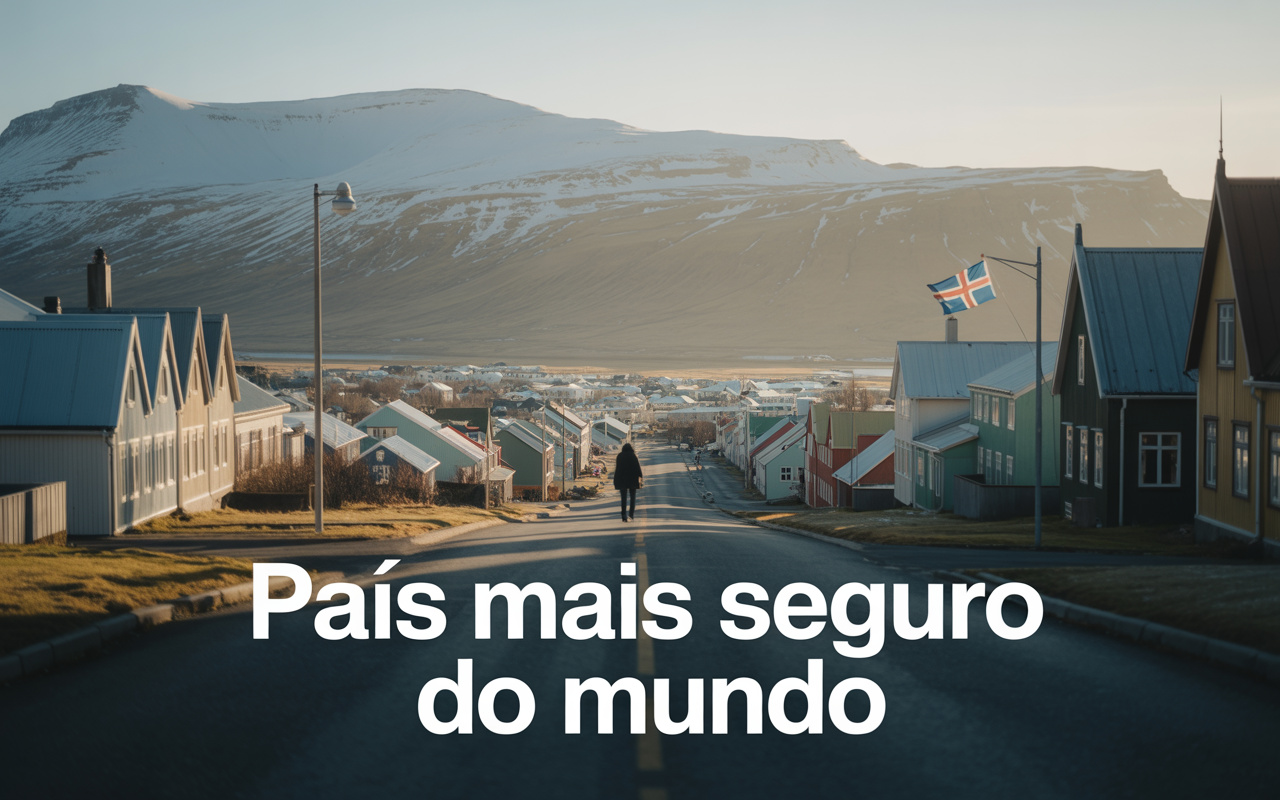


Iceland Is Voted The Safest Country In The World In 2025 By The Global Peace Index, With Nearly Zero Crime, High Social Trust, And Absence Of Permanent Armed Forces.
The Iceland, a small island in the North Atlantic with about 390,000 inhabitants, has again been voted the safest country in the world in 2025, according to the Global Peace Index (GPI), a report prepared annually by the Institute for Economics and Peace (IEP). The study analyzes 163 nations based on indicators of internal security, crime, political stability, military presence, and respect for civil rights. Iceland has held first place since 2008, maintaining impressive stability even amid global crises.
The Secret of Icelandic Security
Iceland owes its position to a set of unique sociocultural and economic factors. With a homicide rate close to zero, the country practically registers no violent crimes. According to data from the Icelandic government, in 2024 there was only one homicide across the entire territory, a number considered statistically irrelevant.


Another determining aspect is the level of social trust. In Reykjavík, the capital, it is common to see strollers left outside cafes while parents have coffee, and houses often remain unlocked, something unthinkable in much of the world.
-
Entrepreneur Who Started at 13 Delivering Flyers by Bike in São Paulo Now Runs a 4,000 m² Culinary Complex in Brazil

-
In China, Workers Use VR Goggles and Body Sensors to Train Humanoid Robots for Tasks Like Folding Clothes and Stocking Stores
-
12-Year-Old Math Prodigy from Brazil Wins Two Gold Medals and Aims for Elite IMPA Tech
-
Magnet Weighing Over 360 Kilograms, Designed for Cardiac Surgery Machine and Valued at $100,000, Retrieves Sawed-Off Shotgun with Scratched Serial Number from Sea During Magnetic Fishing


This culture of mutual trust is also reflected in institutions: surveys show that more than 90% of citizens trust the police, and the police themselves do not carry firearms on everyday patrols.
Stable Economy and Social Equality
Despite being a small and isolated country, Iceland has one of the most developed economies on the planet, with a per capita GDP of about US$ 80,000 and a strong presence in sectors such as renewable energy, tourism, and technology.
The Icelandic energy matrix is nearly 100% clean, based on geothermal and hydroelectric power, which reduces social and environmental tensions.
The welfare system is another pillar of stability. Inequality is among the lowest in the world, and education and health indices are among the highest, with an average life expectancy exceeding 83 years. Social cohesion is reinforced by a penal policy focused on rehabilitation rather than punishment, and the prison system has one of the lowest recidivism rates in the world.
A Model of Peaceful Coexistence
Iceland also stands out for not having permanent armed forces. Since the end of World War II, the country has opted for a policy of military neutrality, maintaining only a small coast guard and a symbolic participation in NATO missions.
This absence of a military is seen by many analysts as a reflection of the internal success of its civil security policy.
Furthermore, the country has one of the lowest prison populations in Europe and faces no internal or external terrorist threats, according to the Global Terrorism Database 2025. Corruption indices are also virtually nonexistent, making Iceland one of the most transparent and efficient countries in public governance.
A Global Example of Balance Between Freedom and Security
According to Steve Killelea, founder of the Institute for Economics and Peace, Iceland is “an example of how security does not depend solely on military strength, but on social cohesion, transparency, and institutional trust.”
The report also highlights that Scandinavian countries, such as Denmark, Norway, and Sweden, appear among the ten safest, reinforcing the Nordic model of a peaceful and sustainable society.
As the world faces political tensions, climate crises, and armed conflicts, Iceland remains an oasis of tranquility. A place where peace is as natural as its volcanic landscapes, and where the concept of security goes far beyond the absence of crime — it is part of the culture, education, and daily life of its people.