






 Portuguese
  Spanish
  2 min of reading
  62 comments


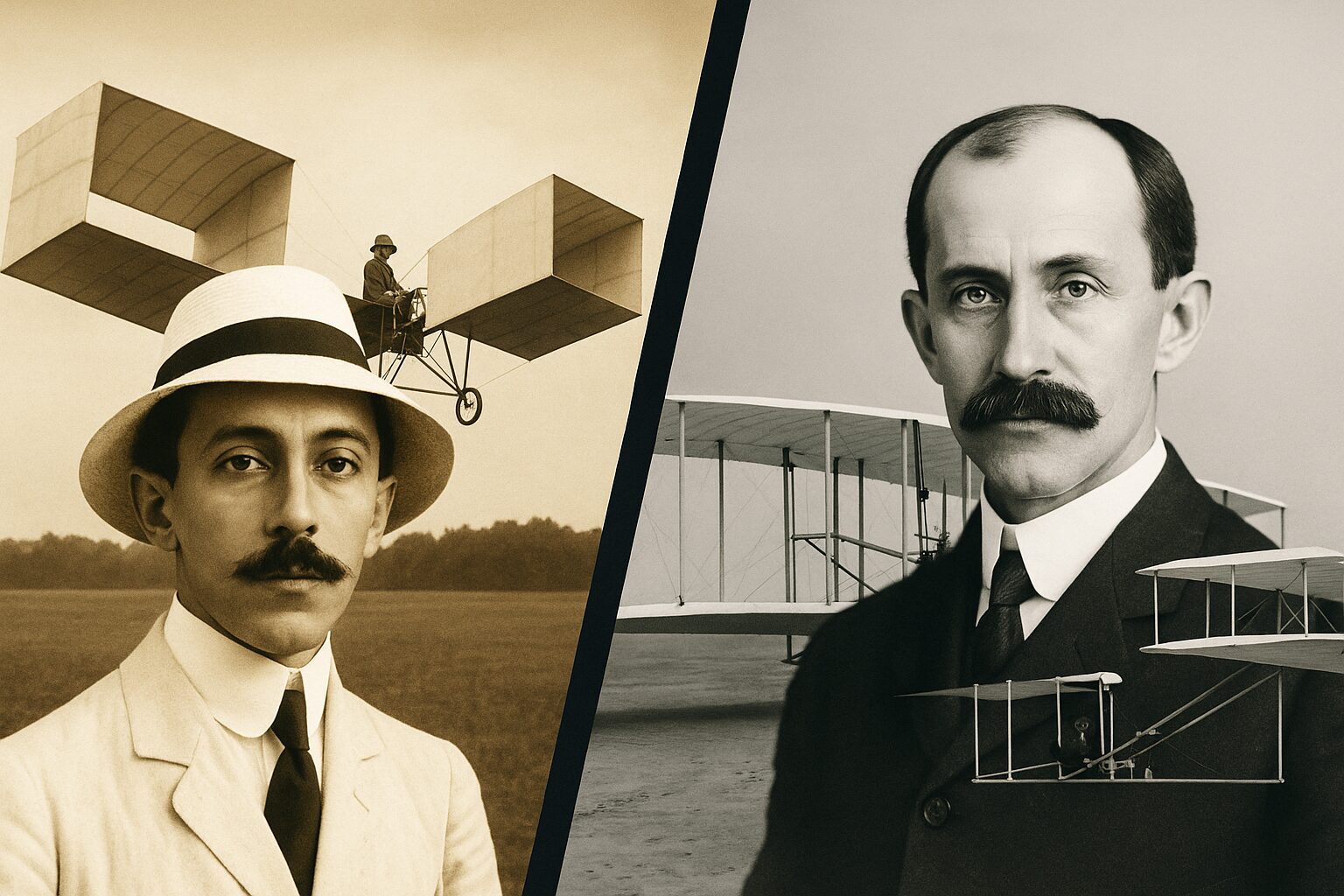


Two Pioneers, Two Paths: The Public Flight of Santos Dumont and the Takeoff with Help from the Wright Brothers Still Divide Opinions on Who Invented the Airplane
The dispute over the invention of the airplane involves two central names: the Brazilian Alberto Santos Dumont and the American brothers Orville and Wilbur Wright. Both flew in the early 20th century, but with distinct methods. This difference still fuels the debate over who truly deserves the title of father of aviation.
The Historic Flight of Santos Dumont
On October 23, 1906, Santos Dumont made a flight with the 14-Bis in the Campo de Bagatelle, in Paris. The aircraft traveled 60 meters at about 2 meters in height.
The most important aspect is that the flight was made without external assistance for takeoff. Everything happened in front of an official commission from the Aeroclub of France and several witnesses. The feat was widely recorded and internationally recognized.
-
Brazilian mechanic invented a lamp made from a PET bottle during the 2001 blackout, the idea turned into an NGO present in 30 countries and has already illuminated 40,000 people in 200 communities without electricity in Brazil.

-
The first trillionaire in history, Elon Musk, opens his wallet and pays the equivalent of R$ 306 billion, or US$ 60 billion, for the artificial intelligence programming startup Cursor, in yet another AI investment made through SpaceX, his rocket company.
-
The future of computers may change sooner than expected: Amazon bets on commercial quantum computing within seven years, while qubits, the Ocelot chip, AI, and scientific simulations take center stage in the new race among big techs.

-
What does a Covid-19 vaccine have to do with heart attack and stroke? A study with over 1 million veterans reveals an unexpected link between immunization, the heart, and seniors over 75 years old.




The 14-Bis, nicknamed “Oiseau de Proie”, was a biplane made of bamboo and Japanese silk. It had a 50-horsepower Antoinette engine. The takeoff and landing were made without rails, catapults, or any other assistance. Its construction was simple but effective.
The Reserved Flight of the Wright Brothers
Three years earlier, on December 17, 1903, the Wright brothers made a flight with the Flyer in Kitty Hawk, in the United States. The aircraft traveled 37 meters in 12 seconds. But, unlike Santos Dumont, they used rails and a catapult for takeoff.
Additionally, the Wrights’ flight had no independent witnesses and was not publicized at the time. Recognition only came years later when they made public demonstrations in Europe.
The Flyer was also a biplane, made of wood and fabric. Its engine had 12 horsepower. However, the need for an external system for takeoff raises questions even today.
What Separates Both Pioneers
The main difference between the feats lies in the way they were conducted. Santos Dumont made public flights with autonomous takeoff and landing. Meanwhile, the Wright brothers conducted more closed tests, with assistance from external equipment.
Another point is recognition. Santos Dumont’s flight was certified by an official entity shortly after it was made. In contrast, the Wright brothers’ flights were only validated later, based on future presentations.
Even with differing views, both marked history. The debate continues, but records show that Santos Dumont flew first in a public, free, and recognized manner.




Meu bisavô vôo antes deles só que não filmou. Aí dizem que foi os brothers brancos. kkkk
A história perdida da tartaria havia aeronaves muito avançadas, sistema elétrico era auto suficiente sem tantas parafernalias como tem hoje.
A geometria das asas é fundamental para a sustentação da aeronave e foi introduzida pelo Irmãos Wright. Santos Dumont passou longe.